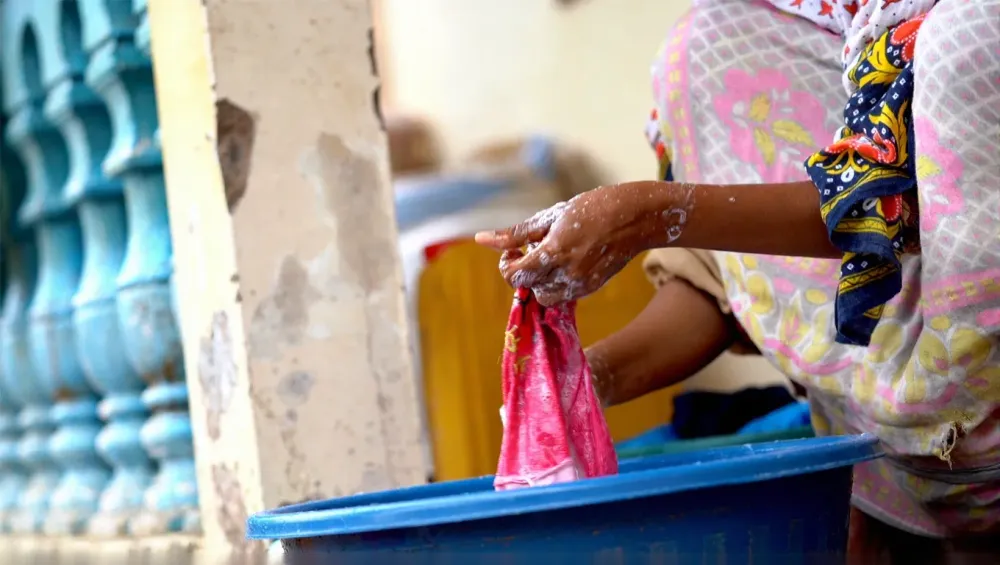
On any given weekday in Addis Ababa, the quiet machinery of middle-class life hums into motion long before sunrise. Breakfast is prepared, children are dressed for school, floors are swept, and laundry is folded. Much of this labor is performed by live-in domestic workers, overwhelmingly young women and girls, whose presence is essential and whose protections remain almost nonexistent.
Many arrive through a loose network of informal brokers that stretches deep into Ethiopia’s rural hinterlands. Promises of steady pay and urban opportunity travel by word of mouth, village to village. What rarely travels with them are contracts, safeguards, or legal clarity. Domestic work in Ethiopia exists largely outside the formal labor system, leaving workers exposed to abuse, wage theft, and isolation behind closed doors.
Government officials acknowledge the gap. In late 2024, the Ministry of Labor and Skills announced that new employment contracts and regulations would bring domestic workers under formal protection and allow them to access social security benefits, including pensions. The rules were expected within six months.
“The draft remains unreleased for many reasons, one of them being reluctance to intervene in employer–employee relationships in domestic work, as there is often a family link between them,” Teshome Berhe, executive director for industrial relations and compliance at the Ministry, told Shega.
Before any release, he said, the ministry is prioritizing awareness campaigns, identifying regulatory gaps, and conducting further research to ensure the rules are comprehensive and enforceable. One of the draft’s central aims, perhaps an ambitious one, is to reduce the influence of informal brokers by limiting third-party involvement altogether. Officials envision a digital system that would allow workers and employers to connect directly, creating clearer accountability on both sides.
Legal advocates say the delay carries real consequences. Existing provisions in the Civil Code, Articles 2601 to 2604, touch on domestic employment but were written in the 1960s and no longer reflect today’s labor realities. The text refers to domestic workers as domestic servants, reflective of its roots in an earlier social order, according to some research outputs.
These antiquated provisions fall short of modern international benchmarks, such as International Labor Organization (ILO) Convention No. 189’s call for written contracts, social security access, and freedom from abuse, standards that, if ratified, could modernize Ethiopia’s framework and align with the ministry’s draft aims.
A 2020 study by researchers from Addis Ababa University and the University of Gondar, based on interviews with domestic workers, brokers, and government officials, documented the scale of exploitation: most workers lacked written contracts, earned less than 1,000 Birr monthly for workdays reaching 16 hours, and faced routine verbal, physical, and sexual abuse. The research confirmed that Ethiopia’s Labor Law Proclamation excludes domestic workers from protection, a legal vacuum the draft regulation seeks to address.
Devoid of a tight-knit legal framework, room for exploitative practices endures.
“Through our call center, 7711, we receive many cases from domestic workers across the country,” says Tinsea Ayalew, a legal expert at the Ethiopian Women Lawyers Association. The hotline operates in Amharic, Tigrigna, and Afan Oromo, allowing women to report abuse directly. “The first thing we advise is to report to the nearest police station and collect evidence where possible.”
A 2023 study conducted in Jimma, Oromia Regional State reported that 46.7% of the surveyed 422 housemaids experienced at least one incident of physical, psychological, or sexual violence; broader studies show 56% physical abuse, 82% verbal abuse, and 26% sexual abuse rates.
Prosecutors who spoke to Shega describe a fragmented legal pathway when disputes arise. “If the case involves wage issues, we use existing labor law. If it is criminal, we apply criminal law,” said one prosecutor. “Cases involving rape or physical abuse go to women and children’s affairs units, while other disputes fall under the civil code.”
These legal gaps intersect with daily realities inside private homes.
Most domestic workers are hired without written agreements or clearly defined terms. Studies indicate how ambiguity leaves them vulnerable to verbal abuse, arbitrary dismissal, withheld wages, and in some cases physical or sexual violence. For live-in workers, the risks are compounded. The workplace is also the bedroom, the kitchen, the only place of rest, all under the authority of employers who may restrict movement, limit contact with family, or deny rest days altogether. Access to social protection is minimal. Illness, injury, or pregnancy can quickly mean the loss of income and shelter.
“Usually, when there is a conflict, the worker calls us first,” said Alemayehu Welde, a broker in with 15 years of experience. “We try to reconcile both sides. If the case is serious and cannot be solved, then we report it to the police.”
Another broker, Jemal Hussein, said some intermediaries now provide basic training to reduce misunderstandings. “We try to teach workers how to communicate properly with employers,” he said. Many brokers operate without formal offices but have begun drafting their own contracts in an effort to introduce a measure of accountability into an otherwise informal system.
A small number of private firms are experimenting with more structured placement models, offering background checks, standardized contracts, and training programs for domestic workers, an emerging alternative to the traditional broker system, though still accessible primarily to wealthier households.
Ethiopia is also a major source country for migrant domestic workers, particularly to the Gulf States and parts of the Levant. Many women migrate through informal brokers and loosely regulated agencies, exposing them to additional dangers. On arrival, some encounter contract substitution, confiscation of passports, excessively long working hours, and confinement inside employers’ homes. Reports of beatings, nonpayment of wages, food deprivation, and conditions resembling forced labor remain common.
Despite periodic government interventions, including temporary bans, tighter recruitment rules, and bilateral negotiations, weak enforcement and economic pressure continue to push women into risky migration channels.
For many workers, the path into domestic labor begins with a broker.
Economic pressure continues to push workers toward overseas employment. Over 338,000 Ethiopian women migrated as domestic workers between July 2023 and June 2024, primarily to Saudi Arabia, UAE, Jordan, and Qatar. Wages at home remain low and unregulated.
“Most domestic workers who come to our agency have already worked locally and want to improve their lives because the pay here is not sufficient,” said Andualem Yeneneh, an agent at Enat Agency. Workers interviewed echoed this view, saying they often learn about overseas opportunities through friends and relatives who have migrated.
One domestic worker, who asked Shega not to be identified, began working at age 15. There were 12 people in the household, she said, and she was responsible for all the cooking and cleaning. Some days stretched into nights without rest.
“It was more than just the physical labor,” she said.
If enacted, the draft regulation would establish minimum wage standards, regulated working hours, paid leave, and annual leave. It would introduce mandatory health screenings prior to employment, benefiting both workers and employers. Labor inspectors would be tasked with monitoring compliance, while structured skills training and certification programs would help domestic workers adapt to new household technologies and standards.
The proposal also includes an identification system under the Ethiopian Labour Market Information System, a digital platform intended to increase transparency between employers and workers. The system would eventually extend to guards and gardeners, bringing other forms of household labor under regulatory oversight.
For the young women who clean kitchens, raise children, and quietly sustain urban households, the reform cannot come soon enough. Until the law catches up with daily reality, their work remains essential, invisible, and precarious.
Globally, 75.6 million domestic workers sustain households much like Addis Ababa’s, yet without Ethiopia’s embrace of ILO standards, this essential labor risks remaining a shadow economy of unchecked precarity.