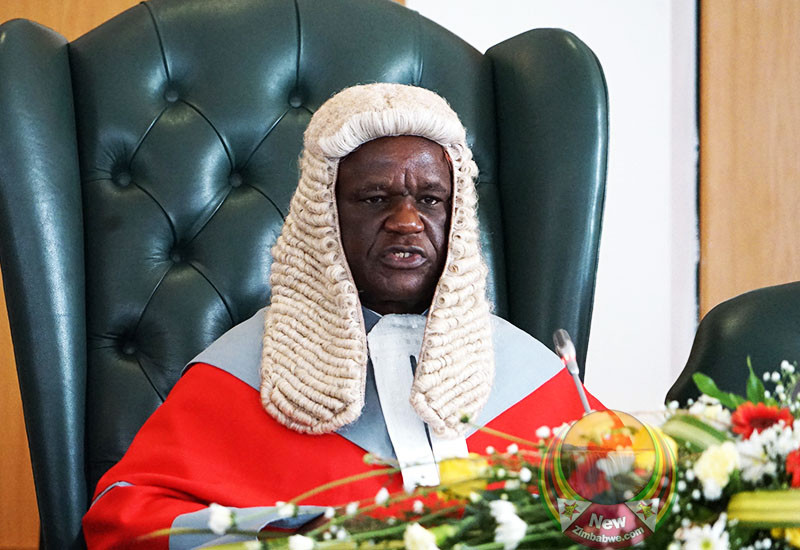
Chief Justice Luke Malaba on Monday warned that Zimbabwe’s judiciary is operating under “untenable” staffing levels, saying a growing population and expanding court network are being serviced by only a few judges and magistrates, even as official figures show that case backlogs have largely been kept under control.
Speaking at the official opening of the 2026 Legal Year at the Constitutional Court in Harare, Malaba said the decentralisation of courts across the country had not been matched by increased deployment of judicial officers and support staff, placing severe strain on those currently in office.
“The number of judges and magistrates in the country has barely increased despite the opening of new courts,” Malaba said. “It is not ideal that such a large population expects both its criminal and civil dispute resolutions to be shouldered by a paltry eighty (80) judges and two hundred and fifty (250) magistrates.”

Zimbabwe’s population has risen to more than 16 million, while litigation has increased as citizens become more aware of their rights and increasingly turn to courts to resolve disputes.
Malaba warned that the “misalignment of staffing levels and the workload significantly contributes to delays and may compromise both quantitative and qualitative service delivery,” adding that the Judicial Service Commission (JSC) must expand its human resource base at the same pace as the growing court network.
“The number of judges and magistrates in post must be dramatically increased if the Judiciary is to continue performing its constitutional mandate,” he said.
However, Malaba was at pains to stress that case backlogs are not, in most instances, a direct result of staff shortages. He said a review of court performance during 2025 showed “exceptional performances by judges across all the superior courts and by magistrates,” with backlogs largely kept in check despite increased caseloads.
“All the courts received increased numbers of both criminal and civil cases,” he said, noting that improving economic activity had led to more civil disputes and an increase in crimes involving dishonesty such as fraud.

Statistics presented in the address showed that the superior courts reduced their civil case backlog by 2,469 cases in 2025, closing the year with 10,045 cases from an opening figure of 12,514.
“By any standard, these statistics are impressive and reflective of judges together with support staff who applied themselves well,” Malaba said. “I would like to congratulate them on a job well done.”
The magistrates’ courts recorded mixed results. Criminal cases increased marginally by 386 to 7,701, a rise Malaba attributed partly to the festive season when more offences are reported. Civil matters in the magistrates’ courts, however, surged sharply, with the backlog rising by 5,311 cases to 6,174.
Malaba said investigations showed the spike was not driven by staffing shortages alone but by “poor supervision of performance by the responsible officials in the hierarchy of the magistracy and unnecessary postponement of cases,” particularly following a flood of summonses from local authorities in the final quarter of the year. He said corrective measures had since been put in place.
He also credited several interventions for improved case disposal, including a 2025 practice direction allowing registrars to clear dormant cases, special circuit courts in Midlands province that targeted long-pending murder trials, expanded research support for judges, and the establishment of anti-drug and substance abuse courts and revived fast-track courts.
Despite these gains, Malaba cautioned that chronic understaffing was pushing judicial officers to breaking point.
“Such shortages are making those in post operate under unbearable pressure,” he said. “It may ultimately affect not only the quality of work but also their health as well.”
