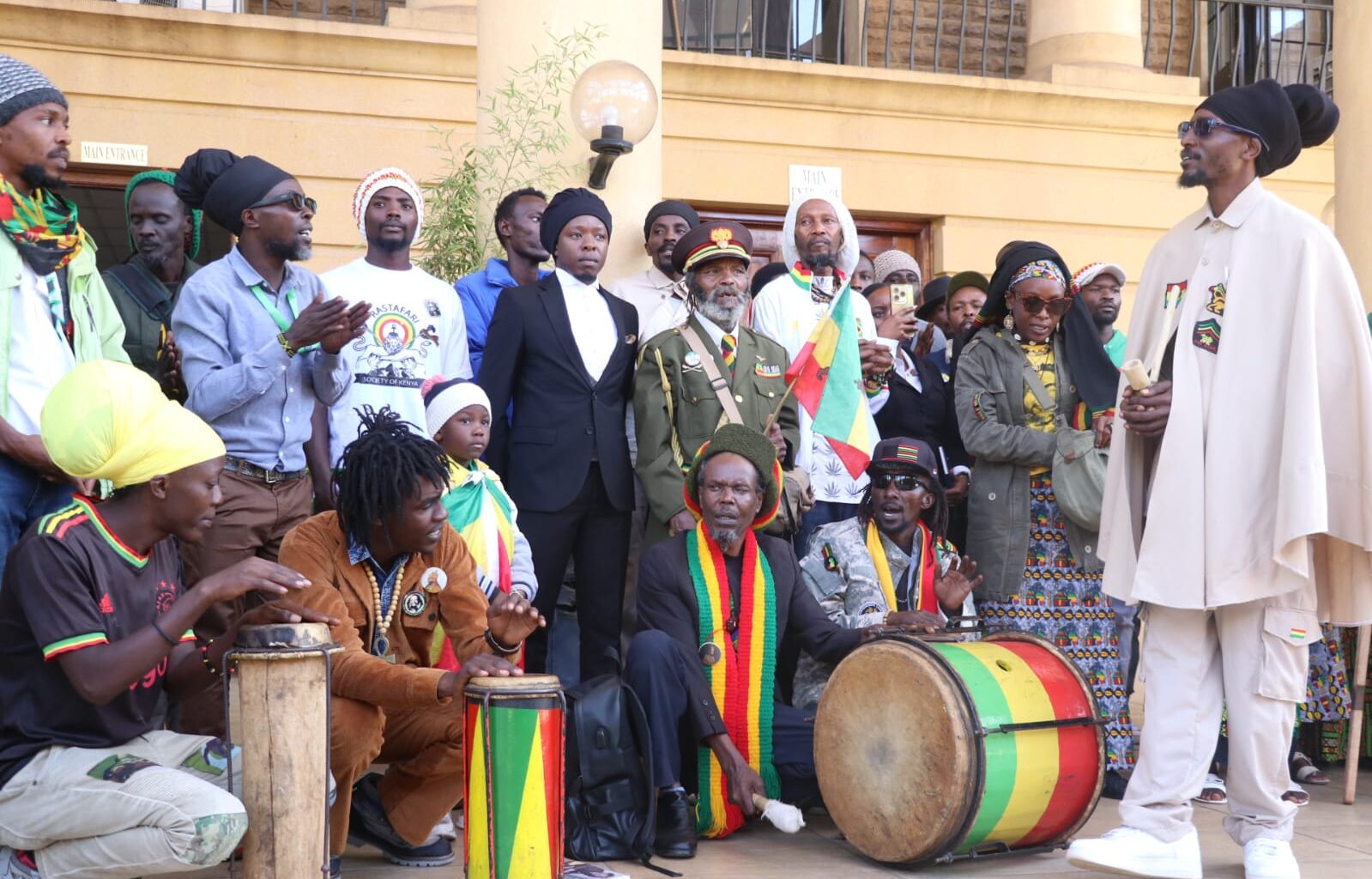
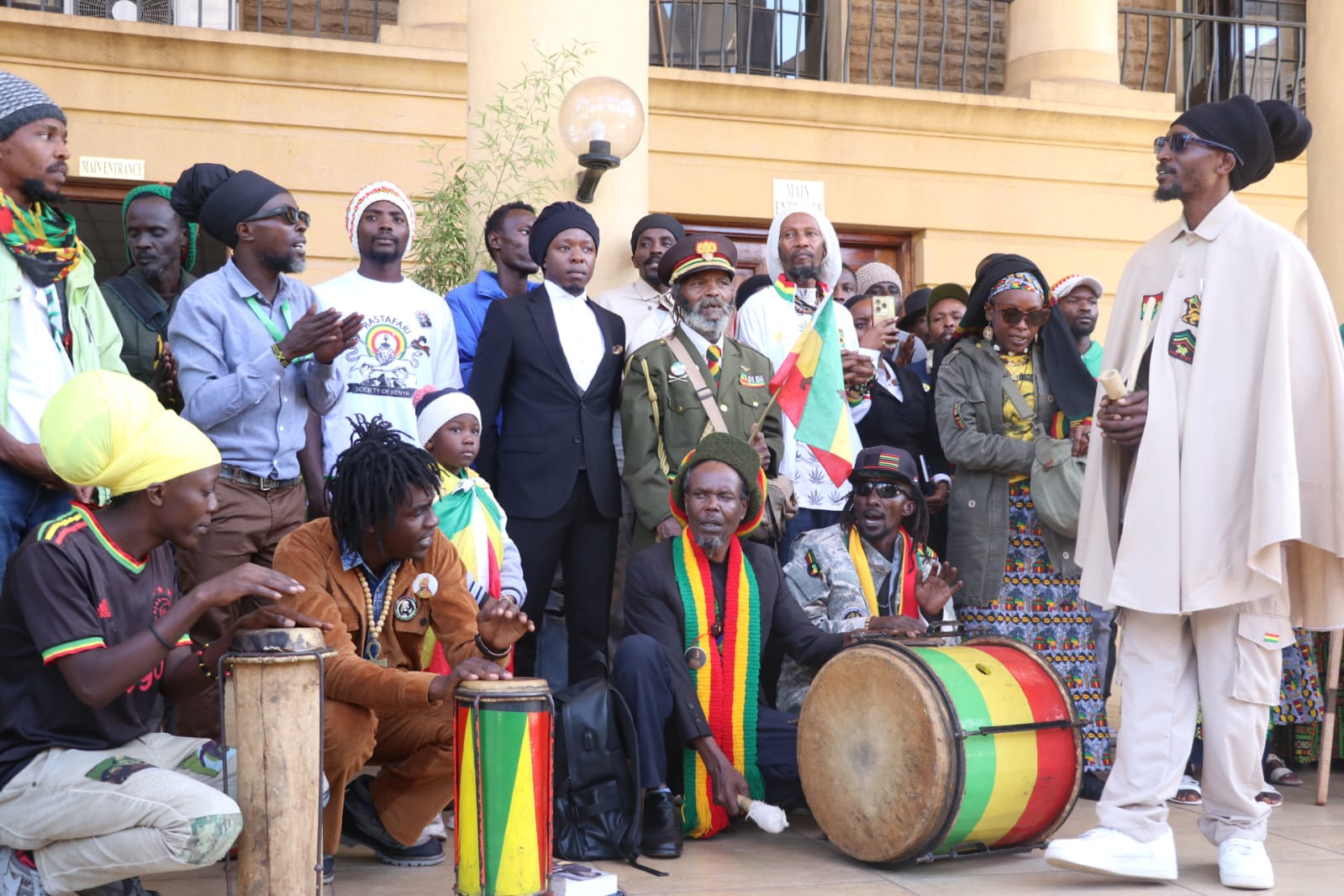
 Rastafarian Society of Kenya addressing the media after appearing before Justice Bahati Mwamuye on a case seeking the legalisation of bhang at Milimani High Court on January 14, 2025/LEAH MUKANGAI
The Rastafari community has informed the High Court that its members are facing increased encounters with law enforcement during the ongoing constitutional case seeking the legalisation of cannabis for religious purposes.
They attribute this heightened scrutiny to the extensive media coverage surrounding the proceedings.
The claims were raised on Wednesday, January 14, 2026, during proceedings in which the court allowed the National Authority for the Campaign Against Alcohol and Drug Abuse (NACADA) to be enjoined as an interested party in the petition filed by the Rastafari Society of Kenya (RSK).
Through their lawyer, Shadrack Wambui, the petitioners argued that publicity surrounding the case had unintentionally exposed members of the faith to heightened scrutiny by law enforcement officers.
Wambui told Justice Bahati Mwamuye that images of Rastafari adherents published by media houses during court appearances had made them “easy targets” for police officers conducting stop-and-search operations.
“There have been concerns that images have been out in public and, as a result, our clients are easy targets by police officers. There have been searches for clients whose images have appeared in media stations,” their lawyer submitted.
The Rastafari community asked the court to issue directions offering temporary protection to its members, particularly where individuals are not found to have violated the law.
“We pray that members of the community be allowed to operate without constant searches and stereotyping,” lawyer Wambui said, adding that the continued encounters risked amounting to harassment and violation of their rights.
The claims arise against the backdrop of a long-running constitutional petition in which the Rastafari Society is seeking recognition of its faith and the decriminalisation of cannabis for religious use.
The society argues that cannabis is a sacrament central to its spiritual practice and that criminalisation unfairly targets its members.
However, the State pushed back against the allegations, arguing that the claims of increased police harassment had not been supported by evidence.
Responding to the application, State counsel Christopher Marwa told the court that no material had been placed before it to demonstrate that any Rastafari member had been arrested, detained or charged with an offence linked to cannabis following the media coverage.
“I am aware of the application, but no evidence has been supported before this court to show that any of the clients has since been detained on account of marijuana,” the prosecutor said.
The State further argued that the interim orders sought by the petitioners were substantive in nature and closely mirrored the final reliefs being sought in the petition, making them unsuitable for determination at this stage of the proceedings.
The judge ultimately declined to grant the orders sought at this stage and urged the parties to make a detailed filing should the need arise.
The judge also rescheduled the hearing, setting new dates for January 30 and February 4, 2026, and reminded the parties that judgment in the matter is scheduled for March 12, 2026.