In front of a large map of continental Africa, Olayinka Olagbegi-Adegbite lifts her hands, pauses, and then begins tapping a quick-paced beat on a West African djembe drum decorated with beads and macrame strings.
“Get up, dance and join me!” she urges the kids surrounding her at the Children’s African Story Hour in Pinney Library on Dec. 8. She takes a brief break from drumming to hand out maracas and shakers. The children shake the instruments as they jump and dance, filling the room with a cacophony of mixed beats and animated giggles.
“Okay, friends,” Olagbegi-Adegbite says as the children’s beats quiet. “Do you know where we are traveling today!?”
“Egypt!” answers one excited child.
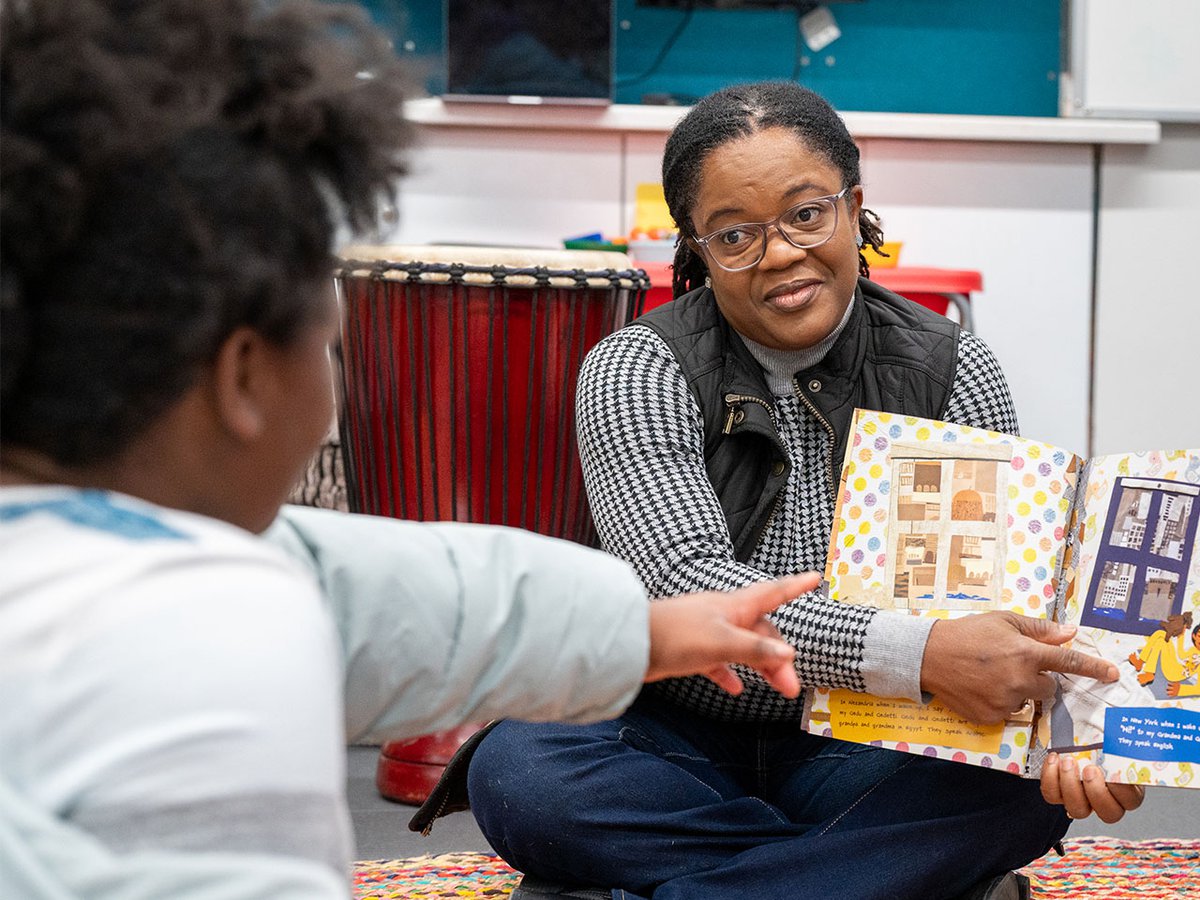
The child’s answer is correct. Guest storyteller Safi Soliman, who is from Cairo, is reading Zamzam, written by Karen Leggett Abouraya and illustrated by Susan L. Roth, which tells the story of a young boy who travels between Alexandria, Egypt and New York City to visit both sides of his extended family.
Children’s African Story Hour is a free event that aims to teach elementary-aged children about countries and cultures on the African continent. The monthly event at Pinney Library spotlights one of Africa’s 54 countries, with a storyteller from the country reading a children’s book that takes place in, or is about, the chosen country. Sierra Leone, Nigeria, Morocco and Malawi have all been featured.
Zamzam, the title character in the book Soliman is reading, uses English to describe his life in New York and beginner-friendly Arabic to describe his time in Alexandria (like “gedetti” for grandma). Nora, Soliman’s eight-year-old daughter, knows the English-Arabic translations and shares them with the other children as they listen to the story.
Olagbegi-Adegbite tells me it’s important for children to understand that Africa is not a singular place. Rather, it’s a vast continent with more than 50 countries, including 12 cities with populations over five million, thousands of ethnic and cultural groups, and where 1,500 to 3,000 languages are spoken.
“Nobody says ‘I’m traveling to North America,’ when they mean the United States, Canada or Mexico,” says Olagbegi-Adegbite, who is from Lagos, Nigeria. “Africa is a concept, not a place. People should distinguish which country they are speaking about.”
Olagbegi-Adegbite is the assistant director of UW-Madison’s African Studies Program, established in 1961, and its outreach manager. She started Children’s African Story Hour in 2022, inspired by a now-defunct program called African Storytelling on Wheels, which she participated in as a student at UW-Madison.
The African Studies Program partners with the African Center for Community Development, the Madison Public Library and University Apartments to present Children’s African Story Hour.
During the reading, Zamzam rides a camel, and one young girl in the audience cracks a joke: “What do you call a camel with three humps?…pregnant!” A grandmother from Sudan, who brought her granddaughter to the story hour, laughs heartily at that.
Soliman takes breaks while reading to share facts about Egypt, which Olagbegi-Adegbite says is why she invites storytellers from the spotlighted country — so they can offer cultural knowledge and share lived experiences.
“Did you know that in Arabic, the official language of Egypt, words are read from right to left?” Soliman asks. And, “Did you know that Egyptians invented early forms of paper by pressing papyrus leaves?”
After Soliman finishes reading Zamzam, she shows the children Egyptian items she brought with her, including model pyramids, a traditional Egyptian coffee kettle (called a dallah), and bookmarks decorated with hieroglyphs, which she passes out for the kids to take home.
While snacking on koshari, a popular Egyptian dish made with chickpeas, fried onions, tomato sauce, rice, lentils and pasta, the children recreate Egyptian hieroglyphs with crayons.
“Children’s African Story Hour makes people more aware,” says Olagbegi-Adegbite, as the children and their caregivers file out of the room at the end of the hour. “It creates an awareness that there is a place called Nigeria, that there is a place called Egypt, and that those places are beautiful and exciting.”
23 million: Population of Cairo, Egypt
1: New story hour location.
Starting Jan. 13, Eagle Heights Community Center, every Tuesday
1.5+ billion: People living on the African continent
2: African countries that are disputed territories (Somaliland and Western Sahara)
10: Children at the Children’s African Story Hour on Dec. 8
64: Number of years UW-Madison has had an African Studies Program
2025: Year that Zamzam was awarded “Best Picture Book” by Children’s Africana Book Awards