COMMENTARY: A journey across Eastern and Southern Africa revealed the Gospel lived with freshness and zeal — a sign of where the global Church is heading.
“Are you a Christian?” a local gentleman had enthusiastically asked, as I was in the midst of a hiking excursion.
“Yes,” I answered, nodding my sweat-soaked head.
He smiled and shook my hand, seemingly delighted to meet a stranger whom he could call a “brother.” This brief encounter would hint at what would ultimately become my lasting impression of my trip to Africa.
I’d gone to Tanzania to see the wildlife, rather than the people. From a Toyota Land Cruiser’s raised roof, I’d snapped images of lions, giraffes, hyenas, elephants, zebras, hippopotami and a cheetah. The natural beauty of such places as the Serengeti and Kilimanjaro Park is indeed among our Creator’s signatures.
My last day in the country was spent in the city of Moshi. Christ the King Cathedral happened to be within walking distance from the hotel where I’d been staying, and so I’d elected to pay it a brief visit.
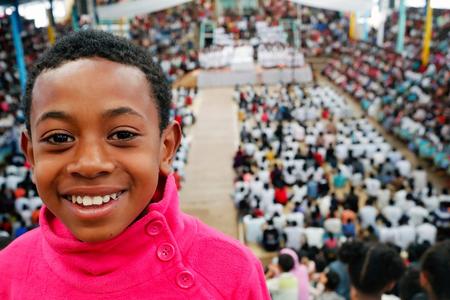
I’d entered through the front gate leading to the cathedral’s grounds, expecting to see rather sparse activity. Raleigh’s Holy Name of Jesus Cathedral tends to be quiet at around noontime on most given Saturdays, after all. What I immediately saw, instead, were countless schoolchildren joyfully running around on the cathedral’s grounds. People could be seen walking around, in every direction, as though some festival had been taking place. Next to the church itself, a rather large Marian shrine was under construction to fill a growing demand.
A schedule of activities was posted by the cathedral’s front door, reflecting a busy church indeed: baptisms each month, confessions each day, three daily Masses during weekdays, and benediction every Sunday.
I saw a priest on the sidewalk, shortly afterward, while walking the streets of Moshi. I suddenly remembered having seen several nuns, some days earlier, walking Arusha’s streets. During a layover in Nairobi’s international airport terminal, the very next day, I’d spotted yet another priest. Rather than having to go to a zoo to see a zebra, or a church to see a person of the cloth, I’d grown accustomed to seeing both out in the open during my stay in East Africa.
I’d visited Cape Town, South Africa, for a few days afterward, and went on a guided walking tour. The wife and son of a pastor of Redeemer Presbyterian Church, my own former community before my being received into the Catholic Church, happened to be in my same tour group. The pastor himself, I’d been told, was in Cape Town, once again, to attend an international gathering of Evangelical ministers.
For years, I’d been hearing that conversion to Christianity in sub-Saharan Africa had been growing like wildfire. It’s estimated that roughly 10 million Christians lived on the continent in 1900, roughly 2% of the world’s Christian population at the time. Today, it’s estimated that upwards of 700 million Christians live in Africa, more than 30% of all Christians.
It was as a tourist, rather than a missionary, that I visited Tanzania. A missionary is usually called to get intimately acquainted with the people and their daily struggles. A tourist, on the other hand, is often guided to places that offer him a more sanitized view of life in a developing country. My own impressions relied on a tourist’s glimpses.
But they were glimpses of an enthusiasm that I wasn’t accustomed to seeing all that often in the West. They were glimpses of men and women who’d either been the first in their families to get baptized, or, at most, only a couple of generations removed from that first to be born again. It was a glimpse of what it’s like to see the Gospel as something very fresh, rather than dismissing the Good News as old news. It was a glimpse of child-like wonder, as compared to an old man’s ambivalence and lethargy. There are, of course, enthusiastic Christians in our own country. There are certainly nominal Christians, as well as atheists, in Africa. But, generally speaking, the African continent has not been Christian long enough to have grown bored with it.
“I’m convinced that when Americans experience the church in Africa, they come back as better Catholics,” explained Father Ian VanHeusen, chaplain at East Carolina University in Greenville, North Carolina, having previously gone on mission trips to both Uganda and Kenya. “It’s safe and it’s welcoming,” he wished to clarify on his experience of both countries.
Western missionaries do still go to Africa, but not necessarily for purposes of evangelization.
“They want to learn from us,” explained Father VanHeusen, whose own trips to East Africa had been primarily for purposes of teaching and building up partnerships with American organizations.
Robert Pape, a Secular Franciscan who’s currently the minister of the St. Thomas More Fraternity in Wilmington, North Carolina, has gone on several mission trips to Kenya, chiefly for purposes of poverty relief. He’s the co-founder of Friends of Kambai Village and Beyond, a non-profit seeking to help bring accessible water to villages where the residents would otherwise be compelled to walk several miles in order to fetch it.
“We have so much in this [our] country that everything is taken for granted,” Pape told me, having personally witnessed the distances many villagers are willing to travel, on very poor roads, to attend an outdoor Mass in which donkeys happen to be passing by in the background.
In a historical irony, it’s now more often the case that an African priest will emigrate to the United States, rather than vice versa, to meet the spiritual needs of a country with a shortage of seminarians. During the recent papal conclave, it was widely speculated that an African man, such as Cardinal Robert Sarah, would be elected as our next pope, the continent having become a demographic center for our Church. Our own country is wealthy, an exporter of countless material goods, yet it now relies heavily on importing priests in order to fulfill our critical needs in the spiritual economy.
During one of his stays in Kenya, Pape visited the house for the Franciscan Servants of Mary Queen of Love, a friary housing many priests and seminarians. “The house is overflowing with seminarians,” he reported, speaking of what appears to be an opposite problem of what we have here: that there were simply too many priests for available assignments in the parishes there.
Vincentian Father Joseph Ita-Sam is a Nigerian-born priest currently assigned to St. Francis of Assisi Church in Raleigh, North Carolina. “There is a lot of energy,” he explained, “a lot of strength coming from Africa.” He spoke to me of the great jubilation that he’d often seen in his own hometown whenever a new priest would get ordained.
“Every African priest who leaves his country is not [doing so] because of poverty,” Father Joseph explained, “but because of the need of the Church.”
There’s no shortage of commentators, especially in social media, who seem eager to press the “panic” button concerning the West’s steady and ongoing decline in weekly church attendance. Perhaps this trend will reverse sometime in the near future. Perhaps it’ll be the case that a practicing Christian will become an endangered species in Western nations, for a time. It can be easy to suppose that the practice of Catholicism is going extinct when one sees a rise in nominalism and atheism, everywhere in their immediate vicinity. But the Church’s future may, in fact, be far more secure than many of us would imagine, because it’s simply the case that the Church will continue to thrive elsewhere.
The Church jealously guards the integrity of the truth, as well as the sacraments, that the West still needs her, very much. But even if most of us Westerners would willingly disregard the Church, she remains perfectly capable of flourishing, with or without us. The truth remains true, regardless of where it’s believed, regardless of who would take it for granted.
Western civilization, as we understand it today, was molded by the Church’s historical influence. Sub-Saharan Africa, on the other hand, has only recently begun its process of being transformed by the Church. There remain many subtle, as well as obvious, differences between the outlook of an American and a Tanzanian, a Spaniard and a Nigerian, a Pole and a Ugandan.
What fresh insights will enrich the Church in the coming years as more theologians bring an African lens? Will profound religious art and architecture be coming from Africa in the coming century, as much came from Europe in past centuries? What does the future hold for a continent that is born again?
We’ll find out, soon enough.
“And this gospel of the kingdom will be preached throughout the whole world, as a testimony to all nations, and then the end will come” (Matthew 24:14).