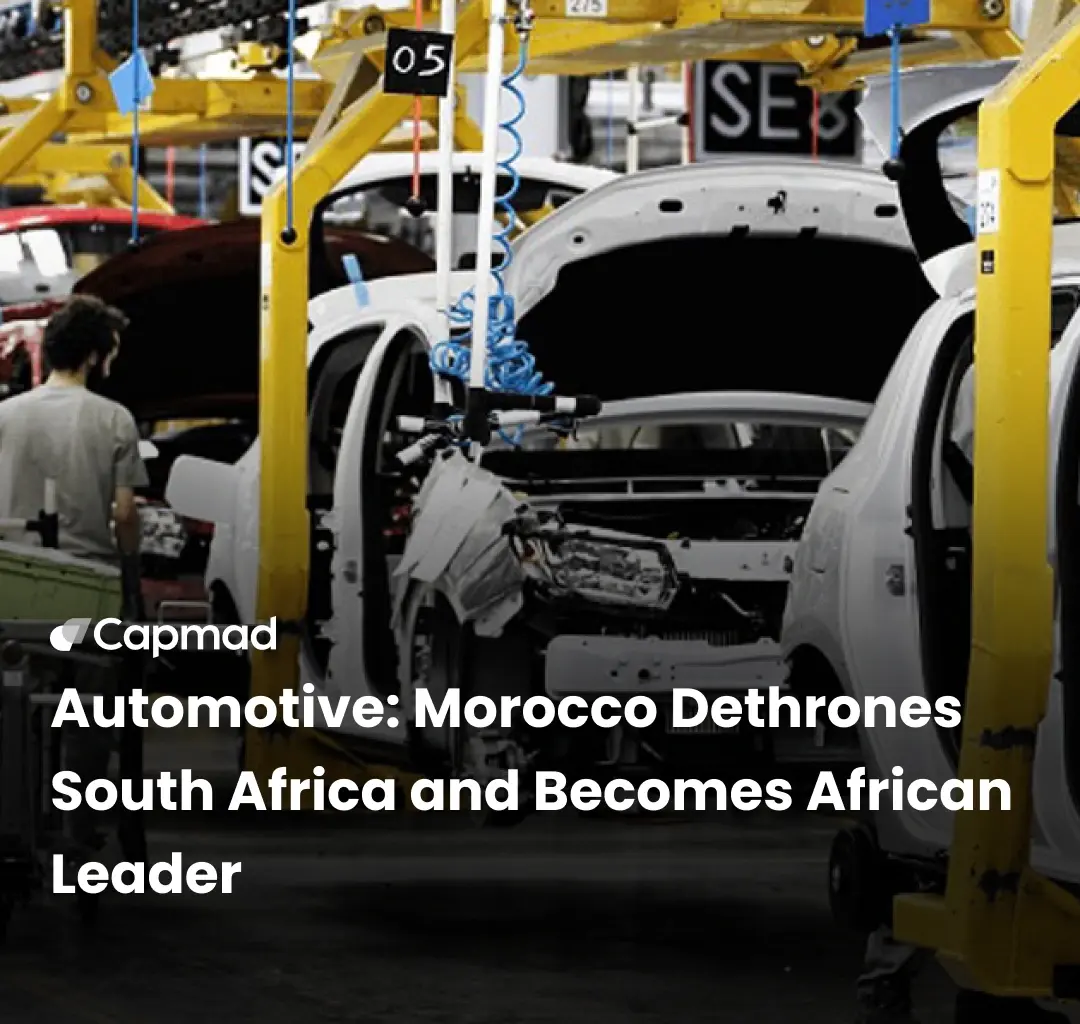
Morocco established itself as Africa’s leading car manufacturer in 2025, surpassing the symbolic milestone of one million vehicles produced and overtaking South Africa, long the continent’s number one, for the first time. This shift confirms the Kingdom as a new African automotive industrial hub, at the heart of global value chains and the transition to electric vehicles.
A Historic Milestone: Over One Million Vehicles
In 2025, the Moroccan automotive platform reached a production volume exceeding one million vehicles across all segments. This level places the country at the top of the African rankings and marks a turning point in the continent’s industrial landscape, where South Africa dominates production.
Production has surged since the 559,645 units of 2024, representing an increase of nearly 79% in one year, according to estimates reported by industry professionals.
The automotive industry has simultaneously become Morocco’s leading export sector, with nearly €15 billion in export revenue projected for 2025.
Renault, Stellantis, and an integrated ecosystem
This performance is based on an industrial ecosystem structured around large assembly plants and a dense network of suppliers. Renault (Tangier, Casablanca) and Stellantis (Kenitra) form the two pillars of this platform, supported by hundreds of local and international suppliers.
The Stellantis plant in Kenitra has begun ramping up production to 535,000 vehicles per year, with a strong focus on small electric vehicles (Citroën Ami, Opel Rocks-e, Fiat Topolino).
The Moroccan strategy aims to increase the local integration rate to over 80%, and even 90% by 2030, thereby strengthening value creation within the country.
Tangier Med and Moroccan Industrial Diplomacy
Beyond the factories, logistics and the business environment play a crucial role in this leadership. The port of Tangier Med and the industrial free zones enable rapid exports to Europe, Africa, and the Middle East, particularly in terms of costs and delivery times.
The Kingdom has built its success on political stability, targeted tax incentives, free trade agreements, and a skilled workforce.
The massive commitment to renewable energies, especially solar and wind power, strengthens the country’s attractiveness to manufacturers seeking to decarbonize their production chains.
The Shift Towards Electric Vehicles
Morocco’s leadership is also playing out in the future: electric vehicles and new forms of mobility. In addition to the production of electric micro-vehicles, the country is investing in batteries, components, and new manufacturer projects.
The development of local electric vehicle product models and the arrival of new international players (including premium brands and Asian equipment manufacturers) are positioning Morocco within the e-mobility value chain.
This momentum is supported by an image of a “green” platform, connected to the European market, which is undergoing a major energy transition.
A new center of gravity for Africa
Morocco’s rise is reshaping the African industrial landscape, shifting the center of gravity of automotive production towards the north of the continent. For African economies, this shift opens the door to new regional collaborations, centered on parts, subcontractors, and logistics corridors dependent on West Africa, the Sahel, and Central Africa.
The Kingdom can serve as a model of industrial policy for other African countries seeking to move upmarket and integrate into global value chains.
The key question will be the ability to spread this success beyond major coastal areas, through South-South partnerships, skills transfers and joint projects for assembly or manufacturing parts.