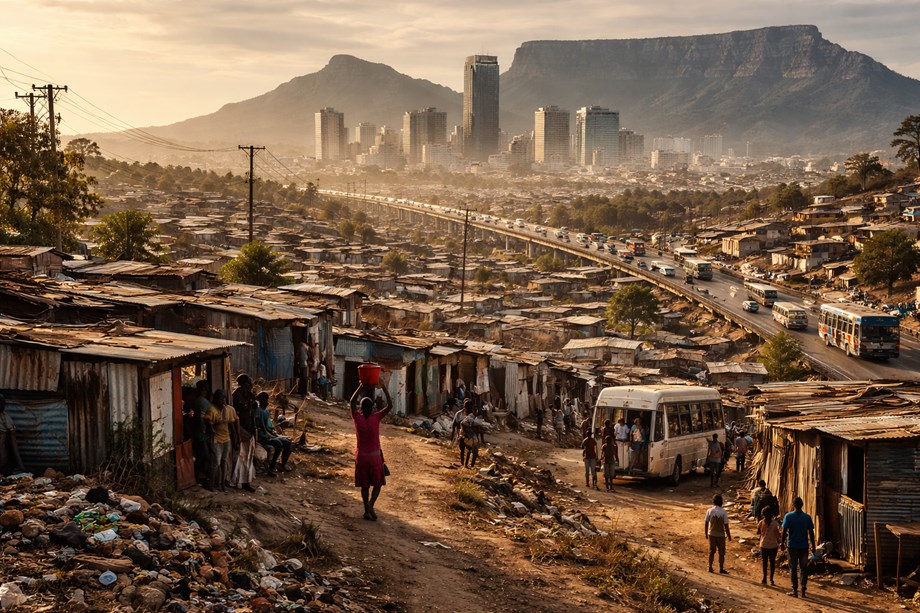
South Africa’s Fragmented Cities: The Unequal Burden of Labor Market Frictions, produced by researchers at the World Bank’s Poverty and Equity Global Department, examines why the country’s major cities struggle to generate jobs despite high urbanization. Authored by Javier E. Baez and Varun Kshirsagar, the study argues that the core problem lies not in cities themselves, but in how they are spatially structured. Using satellite imagery, census data, and administrative tax records, the paper shows that South African cities are physically fragmented in ways that make it difficult for people, especially the poor, to access employment.
An Unusual Urban Pattern
In most cities around the world, people tend to live close to where jobs are concentrated. Population density usually declines as one moves away from business districts. South African cities break this pattern. The study compares five major South African metros, Johannesburg, Cape Town, Durban, Tshwane, and Nelson Mandela Bay, with 20 large cities across five continents. It finds that areas within five kilometers of business districts in South Africa have far fewer residents than expected. On average, these central areas have about 60 percent fewer people than similar areas in comparable global cities. Instead, dense residential neighborhoods are pushed far out on the urban edge, often 10 to 20 kilometers away from major employment hubs.
Poverty and Distance Go Together
This spatial mismatch hits poorer communities hardest. The paper shows that low-income neighborhoods are both more crowded and more distant from jobs than wealthier ones. In Johannesburg, for example, the poorest neighborhoods are almost three times as dense as the richest, yet they are much farther from business districts. Similar patterns appear in Cape Town and other cities. Rather than benefiting from cheaper housing in exchange for distance, poor households face overcrowding, weak services, and long, expensive commutes. These patterns reflect the legacy of apartheid-era planning, which deliberately located Black communities on city peripheries, and post-1994 housing policies that continued to build low-income housing far from economic centers.
Weak Local Job Markets
Distance from city centers is only part of the problem. The study finds that poor neighborhoods are also surrounded by weaker local labor markets. Using spatial tax data on formal employment, the authors show that areas near low-asset neighborhoods have far fewer jobs nearby. In Johannesburg, residents of the poorest areas live near locations with 87 percent less formal employment than those near the wealthiest areas; in Cape Town, the gap is 61 percent. Even low-wage formal jobs are scarcer near poor neighborhoods. Where jobs do exist, they are more unstable, with higher month-to-month volatility, making incomes unpredictable and limiting opportunities for workers to gain experience.
Why This Matters for Policy
High-resolution maps of Johannesburg, Cape Town, and Durban reveal that former townships such as Soweto, the Cape Flats, and Umlazi remain dense, overcrowded, and poorly connected to employment centers decades after apartheid ended. Travel times from these areas to business districts are often two to three times the city average. The paper argues that this persistent separation weakens agglomeration, the economic benefits that arise when firms and workers cluster together, and helps explain South Africa’s stubbornly high urban unemployment. While the study does not claim direct causality, the evidence consistently points to spatial structure as a major barrier to inclusive growth. The authors conclude that tackling unemployment requires more than skills training or economic reforms; it also demands better urban integration through improved transport, denser housing closer to jobs, and targeted investments in the neighborhoods most cut off from opportunity. Without addressing these spatial frictions, South Africa’s cities will continue to limit, rather than expand, economic opportunity for millions of residents.