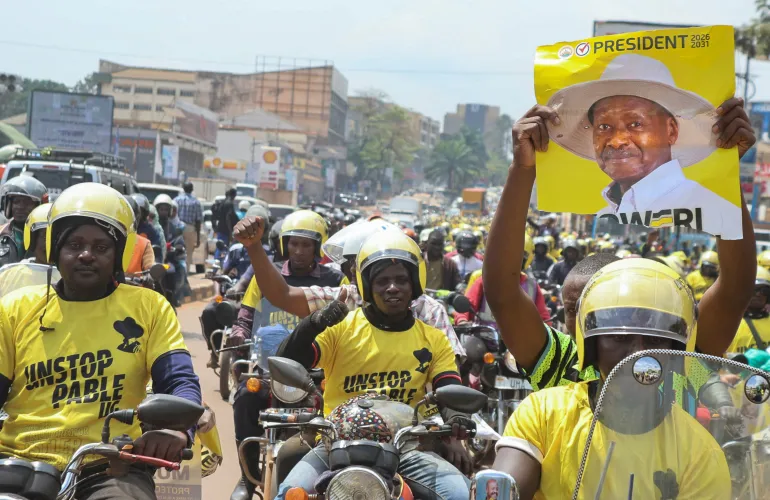
Uganda entered its presidential election period under a nationwide internet shutdown, a move announced by authorities just hours before polling stations were set to open. The government and electoral commission said the suspension was intended to curb misinformation, disinformation, and electoral fraud.
The shutdown comes as President Yoweri Museveni, 81, seeks to extend his rule, which has already spanned nearly four decades. He faces several challengers, most notably opposition figure Bobi Wine, the pop star turned politician contesting the presidency for a second time.
Bobi Wine, whose real name is Robert Kyagulanyi, has positioned himself as a representative of Uganda’s younger generation, appealing to voters frustrated by long-standing political control, restrictions on freedom of expression, and limited political space. His campaign has drawn strong support among young Ugandans, who make up the majority of the country’s population.
Museveni, however, retains institutional backing built over years in power, including strong control of state structures and security forces. Some voters continue to credit him for economic stability and reforms, even as critics point to entrenched governance, constrained opposition activity, and repeated election-related restrictions.
The internet shutdown follows a familiar pattern in Ugandan elections, where authorities have previously imposed communication blackouts during politically sensitive periods. Civil society groups and opposition figures argue such measures restrict transparency and undermine confidence in the electoral process, while the government maintains they are necessary for national security and order.
As Ugandans prepare to cast their ballots, the election highlights a deeper question facing the country: whether political leadership can transition peacefully in a nation where one president has defined governance for most of its post independence history.
Africa’s youngest populations continue to press against some of the continent’s oldest political systems. Uganda’s vote is not just about power today, but about whether political space can expand to reflect a generation that did not build the state but will inherit it. The future remains open, and history shows that change on the continent often begins long before it is officially recognized.
Uganda election 2026, Uganda internet shutdown, Yoweri Museveni election, Bobi Wine presidential race, Uganda presidential vote, Uganda politics news, African elections, Museveni long rule, Bobi Wine opposition, Uganda democracy, internet blackout elections, Uganda youth vote, African leadership transition, Uganda polling day, Kampala elections, Uganda civil liberties, election security Africa, Uganda government internet ban, African politics analysis, Uganda political future, Bobi Wine supporters, Museveni challenger, Uganda opposition politics, African youth politics, election transparency Africa, Uganda internet censorship, Museveni governance, Uganda regime control, East Africa elections, political transition Africa, Uganda voting crisis, Uganda freedom of speech, Africa democracy debate, internet shutdown Africa, Uganda generational divide, Museveni legacy, Uganda authoritarian concerns, African electoral integrity, opposition politics Uganda, youth driven change Africa, Uganda political stability, African leadership accountability, elections under pressure Africa, Uganda campaign restrictions, Museveni security apparatus, Bobi Wine youth movement, Africa political reform, Uganda long serving leaders, digital rights Africa, Africa votes 2026, future of governance Africa, Uganda election observers, Uganda internet freedom, Museveni vs Bobi Wine, African political systems, Africa youth majority, election credibility Africa, Uganda civic space, Africa’s democratic path, post independence leadership Africa, Uganda transition debate, Africa rising voices, governance reform Africa, youth versus establishment Africa, Uganda state power, African political evolution, East Africa democracy, Africa election trends, Uganda power struggle, political change Africa
Related