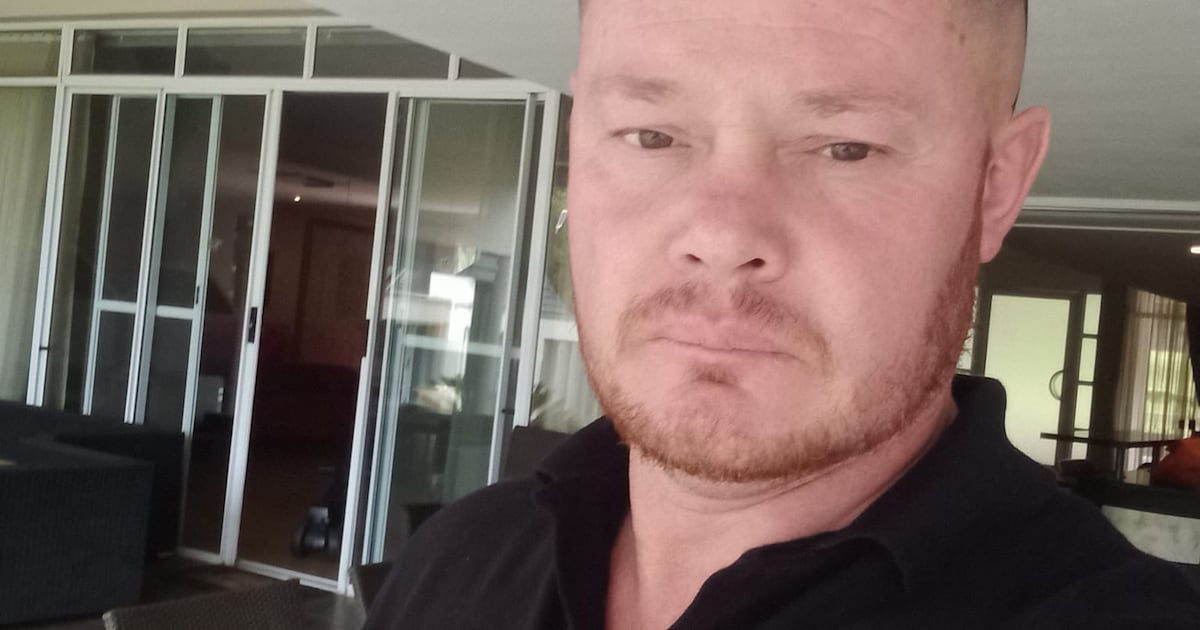
The Madlanga commission’s public hearings closed on a tragic and chilling note. On Friday December 5, as police minister Senzo Mchunu was being questioned late into the night at the Brigitte Mabandla Justice College in Pretoria, the news broke that Marius van der Merwe, more famously known as “Witness D”, had been gunned down in front of his family at his Brakpan home.
Witness D had testified anonymously at the commission in November, describing how, in April 2022, police and private security officers tortured a suspect, who then died. He said senior Ekurhuleni metro police department (EMPD) officer Julius Mkhwanazi was called to the scene and had given instructions on how the body should be disposed of. “Mkhwanazi said that we needed to throw the suspect’s body into a mineshaft or dump it into a dam. As he said this, he looked at me,” said Witness D. He felt that “if I do not comply, then I would probably be next”.
The hit on Van der Merwe led to a public outcry and questions about why he was not protected. Justice minister Mmamoloko Kubayi told the media that he had refused an offer of witness protection.
However, the real questions should be directed to the Independent Police Investigative Directorate (Ipid), because Witness D’s revelations at the commission were not new. Earlier in November, former EMPD deputy police chief Revo Spies testified that as far back as March 2023, he had been told by Ipid of a torture and murder case in which Mkhwanazi had been implicated and in which someone, clearly Witness D, had turned state witness.
When we were informed of this, it was March 2023 … [W]e believed that a murder case that is already running for a year — with witnesses, with a body, with everything already there — we thought it is imminent that he would be arrested extremely quickly thereafter. And yet here we are, 2025, and nothing has yet happened. So, none of those officers has been charged that we know of.
— Revo Spies, former EMPD deputy police chief
“When we were informed of this, it was March 2023 … [W]e believed that a murder case that is already running for a year — with witnesses, with a body, with everything already there — we thought it is imminent that he would be arrested extremely quickly thereafter. And yet here we are, 2025, and nothing has yet happened. So, none of those officers has been charged that we know of,” said Spies.
Spies testified on November 10. When Witness D testified on November 14, still nothing had happened: “Advocate, at this stage, there has been no arrest that is been made,” said Witness D. This was now more than three years after the suspect, Emmanuel Mbense, was killed and more than two years after Ipid told Spies of its investigation. An Ipid spokesperson has reportedly recently said its investigation was in its final stages. However, it is unclear what the death of Van der Merwe, a crucial witness, will mean for the prospects of a successful prosecution.
The commission’s terms of reference do not specifically name Ipid as one of the institutions it must investigate, but they allow the commission to investigate “any other institution and/or organ of state within the criminal justice system”. Given the questions raised by the evidence of Spies and Witness D, the commission may be seeking to hear from Ipid in the new year.
On December 17, the commission said it had delivered its interim report to President Cyril Ramaphosa, “exactly three months after [KwaZulu-Natal provincial police commissioner] Lt-Gen Nhlanhla Mkhwanazi appeared as the first witness on September 17”. The Presidency has indicated that the report will not be publicly released.
The “brutal killing” of Van der Merwe “marked an inflection point for the commission”, it said. The commission would not be intimidated, it said, and was encouraged “by the fact that more witnesses have come forward to assist”.
The commission has, by and large, finished with “phase 1” of its public hearings. Phase 1, according to the plan set out by the evidence leaders at the start, was to gather and lead the evidence in support of Mkhwanazi’s allegations at his bombshell press briefing in July, which triggered the establishment of the commission.
The commission’s terms of reference were therefore broadly framed and included the Tshwane and Johannesburg metro police departments. But with phase 1 mostly complete, the framework of what the commission is investigating is clearer now, and it appears these metros are not part of the picture
When Mkhwanazi spoke in July, the extent of the rot he was alleging was not clear. He named specific people such as police minister Mchunu, deputy national commissioner Shadrack Sibiya and North West businessman Brown Mogotsi. But he also spoke in broad terms of “politicians”, “SAPS”, “metro police”, “correctional services”, “prosecutors” and “judiciary”.
The commission’s terms of reference were therefore broadly framed and included the Tshwane and Johannesburg metro police departments. But with phase 1 mostly complete, the framework of what the commission is investigating is clearer now, and it appears these metros are not part of the picture.
The commission has, so far, heard nine witnesses in “phase 2” — where those implicated answer to the allegations. The phase 1 evidence about the Ekurhuleni metro was damning, and the performance of EMPD officer Mkhwanazi and former city manager Imogen Mashazi under cross-examination did little to mitigate this. If anything, their performance strengthened the case against them.
Mchunu’s evidence was divided into two parts — the first was about his decision to disband the SAPS’s political killings task team (PKTT) and the second was to address “allegations of improper motives”. The first part was heard in December, but the second part, still to come, is the crucial one. This is because the commission’s terms of reference, when it comes to Mchunu, are not about whether his decision to disband the PKTT was a bad idea or even whether it was unlawful. The question is whether Mchunu was “complicit, aided and abetted, or participated in” the alleged infiltration of the criminal justice system.
Here a question that arises is what the commission may have uncovered, or not uncovered, from Mchunu’s devices. In a public statement in November, Mchunu said he had handed these over to the SAPS for the commission.
On the evidence so far, the link between Mchunu and controversial businessman and alleged cartel leader Vusimuzi “Cat” Matlala is Mogotsi. The corroborating evidence is screenshots of Signal chats between Mogotsi and Mchunu, which were extracted from Matlala’s phone and which Mogotsi had sent to Matlala.
Because they are screenshots, relevant parts — what was said before and after the shots cut — are missing. “Of course, if we had access to your Signal chats, all of this would be resolved, but it seems that you no longer have access to your Signal,” said chief evidence leader Matthew Chaskalson SC when he was cross-examining Mogotsi. If these chats were on Mchunu’s devices, important questions may be resolved. If they were not, why they were not may be something he will have to explain.
Key witnesses in phase 2 must still be called, including Sibiya, Matlala and former Hawks head Godfrey Lebeya. Then there is also “phase 3” to come, where the phase 1 witnesses may be called back and the credibility of their allegations will be assessed. This may include cross-examination, which is allowed for in terms of the commission’s rules.
The phase 2 witnesses were allowed to have their say but were then immediately grilled in cross-examination. Not so with the witnesses in phase 1, who were not cross-examined and so were not subjected to the same level of scrutiny.
In legal proceedings, cross-examination is a tried and tested way to get to the truth. Before it, a version may be utterly convincing. After it, it may have been destroyed, or the version may stand. Before the credibility of the phase 1 evidence has been tested, perhaps through cross-examination, it would be premature to draw any conclusions about what the commission will ultimately find.