
Ed DoveJan 17, 2026, 12:43 AM ET
CloseEd Dove is a writer and scout who has a deep and enduring passion for African sport, politics and literature. Instagram: @EddyDove22, Facebook: @EddyDoveAfrica
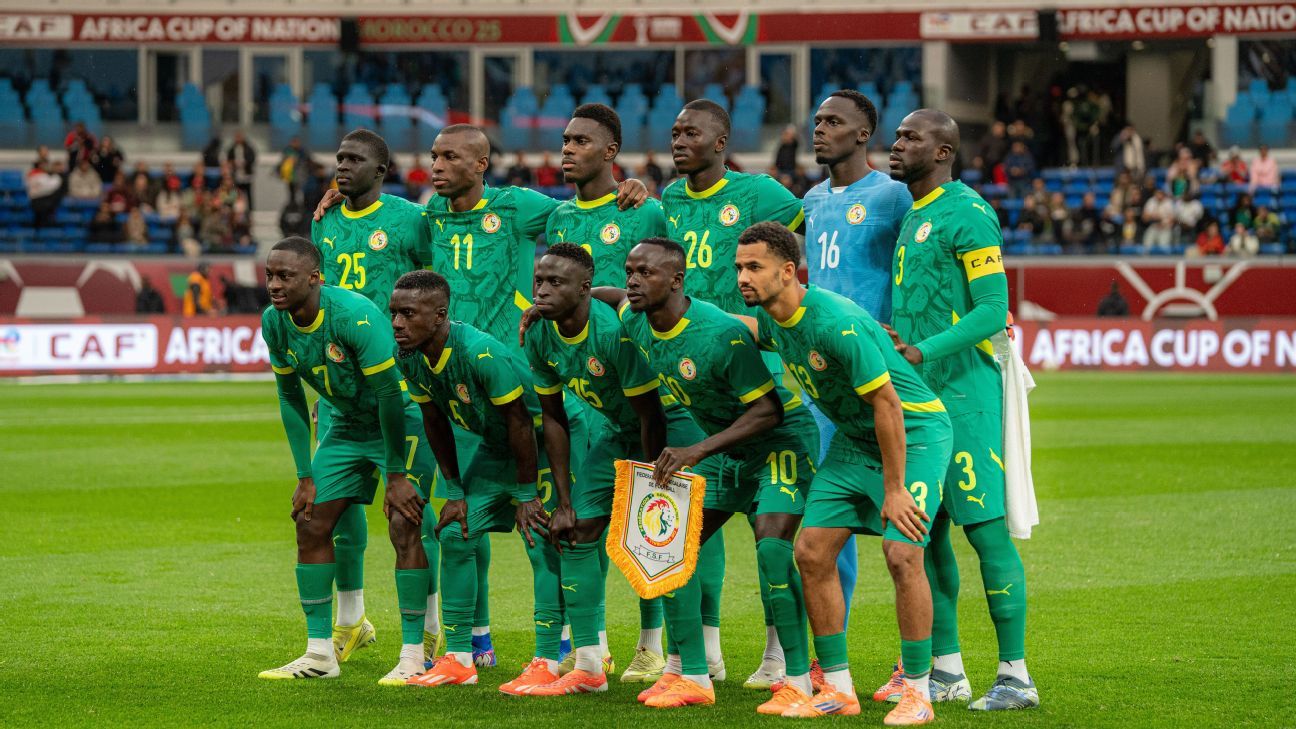
In reaching Sunday’s Africa Cup of Nations final against Morocco, Senegal joined an elite collection of teams to have qualified for three AFCON finals in a decade, and win or lose, it’s certainly time to start considering this Teranga Lions side among the continent’s all-time great generations.
Victory in their semifinal over a poor and unambitious Egypt team ensures Senegal become only the fifth country to have reached 75 percent of finals across a four-tournament cycle.
Egypt themselves have done it twice, beginning with the first three competitions, between 1957 and 1962, although the continent’s footballing and political landscapes then scarcely resembled what they do now.
Editor’s Picks
2 Related
They repeated the feat, featuring in three consecutive finals – and winning each one – between 2006 and 2010, as Africa’s greatest continental cycle achieved what no one else has done.
Cameroon’s team of the late 80s also reached three consecutive finals, winning two, before becoming the first African team to reach a World Cup quarterfinal in 1990, while Ghana also won two of their four-in-a-row title appearances between 1963 and 1970. Beyond that, we have Nigeria, who featured in four out of six finals between 1980 and 1990, including a fifth – with their second title triumph – against Zambia in 1994.
Over the last 30 years, however, in this modern-football era, it’s only been the Pharaohs and their three-in-a-row to have surpassed Senegal’s record of reaching three finals within a four-tournament cycle.
Samah Zidan/Anadolu via Getty Images
It’s worth noting, as well, that during this cycle, the West Africans have also qualified for three consecutive FIFA World Cups, something that Egypt never achieved during their glorious run in the decade before last.
There are four key pillars of the side who returned to the World Cup in 2018 and who remain key elements in the team today: Kalidou Koulibaly has provided leadership and defensive resiliency from the heart of the backline, Idrissa Gana Gueye has offered authority, big-game mentality, immense defensive workrate and occasionally, key goals, from midfield, Sadio Mané offers guile, creativity and a goal threat in the final third, with Ismaïla Sarr one of Africa’s most eye-catching widemen over the last decade.
The quartet first assembled for Senegal at the 2017 Nations Cup – the first overseen by head coach Aliou Cisse – and have been present for each of Senegal’s last seven major tournaments, the only exception being Mane missing the 2022 World Cup in Qatar due to an injury to his right fibula sustained while in action for Bayern Munich a month before.
With this foursome establishing a spine and a consistent offensive threat, Senegal have climbed in the FIFA World Rankings. They were 32nd in October 2016, when the groups were drawn for the 2017 Nations Cup, and reached an all-time high of 17th in spring 2024, remaining consistently in the top 20 in the world in the subsequent years.
Individually and collectively, this spine – along with coach Cisse – have taken Senegal to new heights in terms of consistency, achievement, and global standing.
CHARLY TRIBALLEAU / AFP via Getty Images
Of course, the highlight was the team’s first ever Nations Cup – sealed with a Mane penalty in the shootout against Egypt in Yaounde’s Stade d’Olembe in 2022 – although this group also reached consecutive AFCON finals for the first time, qualified for consecutive World Cups for the first time, and, for an extended spell, were Africa’s top ranked team in the FIFA rankings.
Senegal’s 2002 generation, who reached a first ever AFCON final and then defeated world champions France in their first World Cup match en route to the quarterfinals – then only the second African team to reach the last eight – put the country on the footballing map.
They remain pioneers, one of Africa’s most iconic and evocative sides, but individually or collectively, that team has nothing on the current crop. This may have been a debate for a while, but it’s not anymore.
As individuals, Mane has reached unprecedented heights for Senegalese players, becoming the first from his nation to win the Premier League and the Champions League, the first to win the Prem’s Golden Boot, and to reach 100 PL goals, and his second-placed finish in the 2022 Ballon d’Or puts him second only to George Weah.
The forward twice won the African Footballer of the Year award – equalling El Hadji Diouf’s achievement in 2001 and 2002 – and long since overtook Henri Camara as his country’s all-time top scorer.
play
1:03
Why you always have to ‘expect something special’ from Sadio Mané
Samuel Ogunleye reacts to Sadio Mané’s winning goal in Senegal’s 1-0 win over Egypt in the Africa Cup of Nations semifinal.
“In my eyes, [he’s] the best player in the history of Senegalese football,” head coach Pape Thiaw said after the 1-1 group-stage draw with the Democratic Republic of Congo. “He’s brought so much to this team, he’s an extraordinary player and a real blessing for us.
“He’s always serving the collective, he’s a true example,” he added. “We must salute him now, not wait until he retires. He is loved everywhere in the world and always shows desire and determination.
“As a coach, it’s a tremendous privilege to have Sadio in my squad.”
Koulibaly was an elite centreback during his prime with Napoli and, briefly, Chelsea, while Gueye – a French champion over a decade apart with Lille and Paris Saint-Germain – was also involved in the UCL final, albeit in a losing effort against Bayern Munich in 2020. No other Prem player has completed more top-flight tackles since his arrival in England in 2015, despite returning to France for three seasons!
This core was boosted by the arrival of goalkeeper Édouard Mendy, later to become Senegal’s second Champions League winner, for the successful AFCON campaign, with the France-born stopper a clear upgrade on Khadim N’Diaye or Alfred Gomis.
Of the current squad, the likes of Krépin Diatta, Iliman Ndiaye, Pathé Ciss and Pape Gueye have all been with the team since at least the 2022 World Cup, further ensuring there’s continuity and understanding, while players such as Abdou Diallo, Bouna Sarr and Nicolas Jackson have brought their experience playing for some of the world’s biggest clubs to bear when stepping into the international area.
Gabriel BOUYS / AFP via Getty Images
Under Cisse and then his successor Thiaw, Senegal have established a consistent and clearly defined way of playing, typically a 4-3-3 formation with mobile fullbacks supporting a strong defensive core, protected by a rugged, mobile, dynamic midfield, with Sarr and Mane flanking a classic centreforward, typically a player with the imposing presence and athleticism to occupy two opposition centrebacks.
The football is rapid, physical, with intense pressing, quick recoveries and fluid transitions, with neither Cisse nor Thiaw shying away from an aggressive mindset and execution from their players.
Barring a brief foray to a back three during the AFCON in the Ivory Coast in 2024 – when they were eliminated in the Last 16 – this has been the blueprint for Senegal’s success, with Cisse’s assistant Thiaw seamlessly taking the reins when the former’s contract was not renewed in October 2024.
Realistically, this Senegal cycle must be considered in the top one or two that Africa has seen this century, depending on whether continental dominance (Egypt) matters more than World Cup representation or not.
The coming months could take them to the pinnacle of that pantheon if they win on Sunday – making it two AFCON titles in the space of three editions – and if they return to the quarterfinal of the World Cup later this year.
Give their performances this tournament – they’ve scored 12 and conceded just two across six matches to date – you wouldn’t put it past them, while a World Cup group containing France, Norway and one of Bolivia, Suriname or Iraq gives them a great chance of reaching the knockouts again.
Perhaps they haven’t broken new ground like their 2002 forefathers or Cameroon in 1990, perhaps they haven’t dominated like Egypt did between 2006 and 2010, but in terms of their overall quality, the balance and evolution of the team, and their achievements, they belong right up there with the other cycles mentioned.
Getty
Despite Mane’s productivity at this AFCON – he’s had a hand in five goals in six outings so far – indications are clear that this magnificent cycle is coming to an end.
The two-time African POTY is 33, Gueye is 36, Mendy 33, and Koulibaly, who has received two suspensions during the AFCON and will miss the final after being booked and injured against Egypt, is 34. Certainly, time appears to be taking its toll on the last of these four, while Sarr, at 27, should still have his prime years ahead of him.
Nonetheless, Thiaw has an eye on the future as well as the present, with Mamadou Sarr (20), Habib Diarra (22), Lamine Camara (22), former CAF Young Player of the Year Pape Matar Sarr (23) and El Hadji Malick Diouf (20) all featuring at the AFCON.
17-year-old wonderkid Ibrahim Mbaye, who became the youngest player to score in the AFCON this century when he netted against Sudan, is the most exciting of the lot, and appears primed to be the spearhead of the next 10 years of Senegalese football.
“Mbaye is a future Ballon d’Or winner,” El Hadji Diouf told Le Parisien. “Today, the route that I traced for Sadio, Sadio will trace for him.
“He possesses everything already to surpass us, all of us.”
Expect Senegal to remain one of Africa’s genuine forces, and for the good times to continue, as one glorious Senegal generation fades, and another rises in its place.