In June 2024, the Namibian High Court decriminalised same-sex conduct between male adults (ILGA World, 2024). The country is now one of 21 African states in which consensual same-sex acts are legally protected (Ewokor, 2025). The court found that “singling out homosexual men for different treatment amounts to unfair discrimination” and that “enforcement of the private moral views of a section of the community – even if in the majority – does not justify restricting another’s freedom and make an activity criminal” (Kojoué, 2024).
The court decision came at a time when LGBTQI rights are being hotly debated in Namibian society. In 2023, the Supreme Court declared that, for immigration purposes, it was unconstitutional not to recognise same-sex civil unions that were concluded abroad (Legal Assistance Centre, 2024). The ruling triggered a hostile response from legislators, who passed bills seeking to ban marriage equality and criminalising support for or promotion of same-sex unions. In October 2024, then-President Nangolo Mbumba signed the new Marriages Act, “which specifically excludes same-sex couples from legal recognition, regardless of whether such marriage was solemnised in Namibia or in a foreign country,” effectively bypassing the Supreme Court’s ruling (Busch & Beukes, 2025).
This legislation has facilitated greater attacks on the LGBTQI community, including by religious organisations (Kojoué, 2024; Amnesty International, 2024). Religion and homophobia are well established bedfellows. Using Afrobarometer data, Ananyev and Poyker (2021) explored the long-term effects of colonial-era Christian missions in Africa on attitudes toward homosexuality among indigenous groups. They found that missionaries have historically contributed to homophobic sentiments. Adding to pre-existing views, evangelical churches, particularly from the United States, have spread anti-gay messages across the continent (Okereke, 2023).
Namibia is not immune to this trend. Although the Namibian Constitution is secular, the vast majority of citizens identify as Christians (Pieterse, 2019). This predominance of Christianity has hugely influenced both Namibian society and politics. According to Pieterse (2019), the religious beliefs of policy makers influence how they draft, enact, and implement laws, with the result that the government is explicitly “anti-LGBTQI.”
This dispatch is based on results of Afrobarometer’s Round 10 survey in Namibia, conducted in 2024, including country-specific questions about sexuality and religion not asked elsewhere.
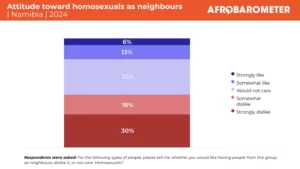
It finds that even though Namibia is one of Africa’s most tolerant countries when it comes to homosexuals, same-sex rights still face an uphill battle. While a slim majority of Namibians say they would like or not mind having homosexual people as their neighbours, nearly six in 10 citizens would reject a friend or family member if they were attracted to individuals of the same gender.
Large majorities of Namibians oppose marriage equality, parenting rights for same-sex couples, and equal rights for individuals who are attracted to people of the same gender.
Two-thirds of citizens say it is impossible to follow their religion and accept people in same-sex relationships. Only one-fourth say citizens ought to be tolerant of those who are attracted to people of the same gender even if it goes against their moral beliefs.
Virtually all Namibians identify as Christian, although fewer than half say they actively participate in religious practices. Highly religious folks are less likely to reject homosexual neighbours than those who don’t practise a religion, though they are equally likely to turn away family and friends who are attracted to others of the same gender.