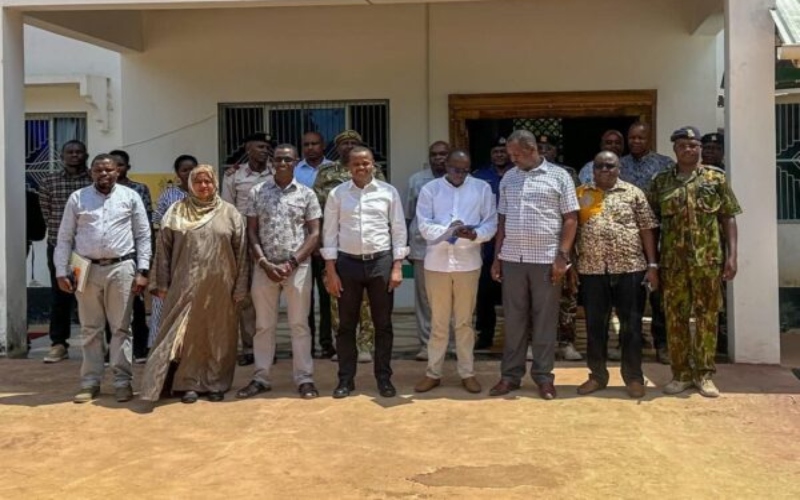
Leaders from Lamu County have stepped up pressure on the national government to complete all components of the Lamu Port–South Sudan–Ethiopia Transport (LAPSSET) Corridor, warning that partial implementation would weaken the project’s economic value and deepen the exclusion of coastal and northern regions.
Members of Parliament (MPs), senators and county officials said gaps in delivery, coupled with unresolved land acquisition and delayed compensation, continue to stall progress on the multi-billion shilling regional infrastructure programme.
They cautioned that leaving out any segment of the corridor could erode public trust, particularly among communities already feeling marginalised.
The concerns were raised during a public participation forum on the South Lokichar Oilfield Development Plan, where leaders from Lamu reiterated the county’s readiness to benefit from the corridor if implementation is fully realised.
Governor Issa Timamy said LAPSSET presented opportunities beyond infrastructure, including skills development and knowledge transfer for local communities. “Despite Lamu’s strategic position, its potential remains largely untapped.”
The governor pointed to the county’s deep-sea port, natural heritage and agricultural output, saying these advantages had not translated into tangible economic gains for residents.
“I urge the government not to squander the oil pipeline opportunity, Lamu is also a leading cotton producer and an emerging economic centre,” he said.
Security assurances were also issued at the forum. Lamu County Commissioner Wesley Koech said the county remained stable and capable of hosting large-scale investments linked to the corridor, dismissing concerns that insecurity could undermine implementation.
Attention was drawn to the port’s capacity, with leaders noting that Lamu Port is already equipped to receive large vessels.
Governor Issa said the facility has modern cranes and can accommodate ships of any size, underscoring its readiness to serve international maritime traffic.
MPs present stressed that the forum was meant to collect public views rather than rubber-stamp decisions.
Julius Mawathe, a member of the Joint Committee on Energy and Petroleum (JCEP), said the South Lokichar Oilfield Development Plan would only move forward after community input was considered.
He added that Kenya must sustain momentum on the corridor, describing Ethiopia and South Sudan as critical partners, particularly for the oil pipeline.
Cost considerations featured prominently in the discussions.
MP Ruweida Obbo said transporting crude through a pipeline would be far cheaper than using road transport, estimating the cost at approximately $5 (Sh644) per unit compared to roughly twenty dollars by road.
“Dropping any part of LAPSSET could create suspicion among communities along the route, the corridor affects an estimated 800 million people across the region,” she said.
Senate oversight was highlighted by Senator Beatrice Ogolla, who said the visit aimed to gauge preparedness for evacuating oil from Turkana’s South Lokichar fields and to listen to concerns from residents.
Officials from the LAPSSET Corridor Development Authority acknowledged that the project faces coordination and financing challenges. The Authority’s chief executive said frequent transfers of the project between ministries had disrupted planning and reduced funding.
He identified land acquisition as one of the most costly and sensitive hurdles, insisting that compensation for affected landowners is a constitutional obligation.
The authority revealed that mapping and design for 821 kilometres of the pipeline have been completed, with construction pending. The pipeline is expected to generate additional income by transporting South Sudanese crude, with projections of about 35 dollars per barrel. South Sudan currently produces around 110,000 barrels per day but lacks an export route due to the conflict in Sudan.
Regional integration prospects were also discussed. MP Elisha Odhiambo cited Ethiopia’s population of about 137 million as a significant market opportunity, while MP Simon Kingara questioned why Uganda was excluded from the corridor and whether the framework could be opened to other East African states.
Closing the forum, Joint Committee Co-chairman Lemanken Aramat said residents’ views had been recorded and pledged parliamentary backing, arguing that equal development should be a priority for all regions.
Leaders maintained that only the coordinated completion of every LAPSSET component from the port and highways to the railway, oil pipeline, resort cities and international airports would deliver the transformation promised for Lamu, northern Kenya and neighbouring countries.