By Melba Chipepo-Kaure.
Former Swakopmund drug addict and ex-convict, Patrick Nashandi (39) recently poured out blessings by giving Christmas packs filled with sweets, juice, chips and cookies to children in Mondesa township through his chairty, the Nash Serenity Foundation.
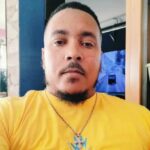 Patrick Nashandi.
Nashandi explained that he has devoted himself to community work at the coastal town’s Mondesa township as a way of giving back and bringing a positive influence to residents.
His journey into drug addiction started as a 10-years-old when he went through a traumatic experience leading him to turn to drugs for comfort.
“I was molested by a teacher. I used to believe that it was my fault and I was too afraid to talk about it. Keeping that pain to myself affected me deeply and influenced many of the decisions I made growing up.”
“By the age of 11, I had started smoking cigarettes and later marijuana, mostly to fit in with older boys in my neighbourhood. It soon became a way to escape emotions I didn’t know how to deal with. Growing up without a father and with very little emotional support made things even more challenging.”
“At age 13, I left home and lived with friends and started living on my own. This exposed me to a life of crime and unhealthy environments. By age 16, I had access to a lot of money and found myself drawn into even harder substances, including mandrax, cocaine, crack cocaine and alcohol.”
“Looking back, my struggle with addiction didn’t begin with drugs, but with childhood trauma, loneliness, and trying to cope without the support and guidance I needed at the time,” Nashandi said.
Transformation Process starts in Prison:
During his late teenage years, he was incarcerated and drug usage played a major role in this. According to him, prison taught him several valuable lessons.
“Prison taught me the value of quiet and reflection. It forced me to start asking myself the right questions. It taught me boundaries and discipline because inside you have to follow the rules and structure. Most importantly, prison became the place where I could finally shut out all the noise so that God could find me.”
“In that space, I learned how powerful prayer is and how strong love can be. My marriage was on the brink of divorce, but we began to rebuild. As hard as prison was, it became the place where my transformation truly began,” he explained.
Community Projects:
As a source of uplifting others through community projects, it is now possible for Nashandi to empathise with those who are going through similar life situations and help them through the projects to be the change he wants to see in his community.
Through the Nash Serenity Foundation he has dedicated himself full-time advocating against substance abuse.
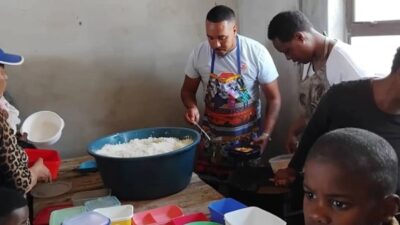 Through the Nash Serenity Foundation, his soup kitchen provides nutritious meals for children.
He is a motivational speaker warning learners about the dangers of drug abuse. He also runs drug awareness campaigns in the community, gives residents (including homeless people) free haircuts to restore their dignity and runs a soup kitchen feeding hundreds of children weekly.
He explained some of the most devastating things drugs do to individuals and society
“From my personal experience, drugs destroy the user mentally long before they destroy them physically. They put lies in their head, attacking their mental health and convincing them that they are useless.
“I reached a point where I took every pill I could find in the house because I truly believed ending my life was the only way out. That is what drugs do that push you into a darkness where you cannot see your own worth.”
“Drugs also change your behaviour in ways you never thought possible. At my worst, I became someone my family could not recognise. I once threatened my own wife just to get money to go use drugs. I sold everything I owned. I became a danger to be around, not because I wanted to hurt anyone, but because addiction had taken full control of my decisions, my emotions, and my actions.”
“On a wider level, drugs tear families apart, lead to crime, and destroy the potential of whole communities. That is how devastating drugs can be. They break the individual first, and then the community around them,” he elaborated.
The Family Man:
Patrick’s wife, Hermien Nashandi described her husband’s transformation.
“As of now, Patrick has changed completely for the better, I am now able to function like a normal human being whereas in the past I had to make sure that I had eyes on him [all the time]. We used to lock everything away because he would sell everything of value without us knowing. So now we can all relax,” she said.
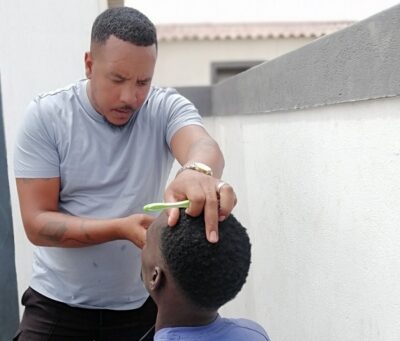 Giving a free haircut to a Mondesa resident.
She said that Patrick Nashandi’s transformation affected the atmosphere at home positively.
“Everyone is happy and relaxed, the children used to live in fear due to his erratic behaviour of being quarrelsome whenever he didn’t get money for drugs. All that is not there anymore.”
Hermien further said that Patrick’s community work has had a lasting effect on young people.
“I am ecstatic over it, I think it gives him purpose and meaning. It is also helping him to stay sober because the community is like his accountability partners.”
Patrick Nashandi envisions a perfect world to be one where no one suffers in silence – one where children feel loved and safe. This world, he says, is only possible in the absence of drugs.