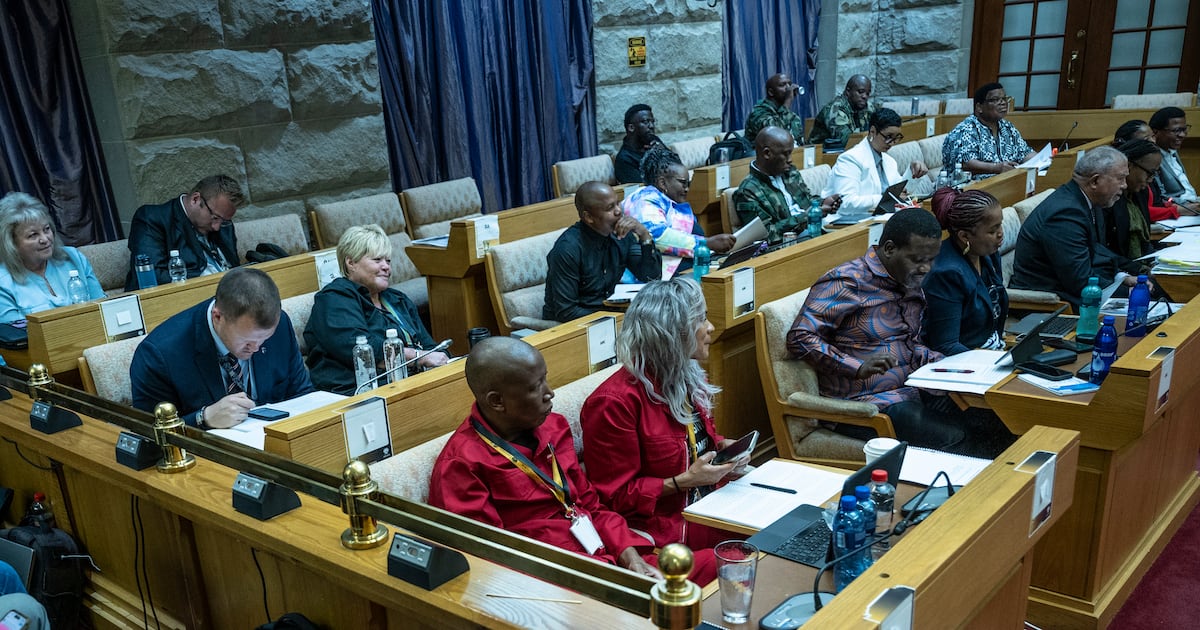
Civil society organisations Accountability Now and the African Policing Civilian Oversight Forum (Apcof) have submitted formal proposals to parliament’s ad hoc committee to assist in its investigation into alleged corruption within the criminal justice system.
The investigation follows a bombshell media briefing held last year by KwaZulu-Natal police commissioner Lt-Gen Nhlanhla Mkhwanazi, who implicated senior law enforcement officials in interfering with police work.
After hearing from several implicated witnesses, the committee turned its focus to the public on Tuesday to receive submissions from civil society.
Advocate Paul Hoffman, director of Accountability Now, addressed the current state of law enforcement, describing the administration as “dysfunctional” due to the alleged corruption.
“The criminal justice administration in South Africa is dysfunctional because corruption with impunity is rampant in the land,” Hoffman said.
The idea of a chapter 9 institution seems to be the most obvious solution. None of these institutions answer to the executive branch; their reporting line would be directly to the relevant parliamentary committee
— Paul Hoffman, Accountability Now
“That is what this committee will have to address from the point of view of parliament which in our submission will involve the revision of the criminal justice administration capacity to deal with corruption effectively.”
Hoffman argued that while various task teams exist, there is no single body outside of executive control dedicated solely to fighting corruption.
He urged the committee to consider two private members’ bills introduced by DA MP Glynnis Breytenbach. These bills propose the establishment of a Chapter 9 Anti-Corruption Commission, which would be constitutionally compliant and independent of the executive.
“The Hawks are not up to the task of dealing with corruption in South Africa. The idea of a chapter 9 institution seems to be the most obvious solution. None of these institutions answer to the executive branch; their reporting line would be directly to the relevant parliamentary committee.”
Sean Tait, representing Apcof, presented two primary suggestions:
strengthening parliamentary oversight; and insulating SAPS operational command from political interference.
Tait referenced Mkhwanazi’s claim that he had previously submitted statements to parliament regarding interference, yet no action was taken — a failure that eventually led to his public media briefing.
“We think there is certainly pause for thought in terms of parliament’s ability to strengthen its responsiveness to allegations or concerns brought to their attention,” Tait said.
It’s beyond an issue of political discretion for the committee. These allegations demand serious and immediate attention and action by parliament
— Sean Tait, African Policing Civilian Oversight Forum
He urged parliament to carry out its duty to respond to allegations brought and address them.
“We believe it’s a critical duty of parliament to respond and address allegations of political interference. It’s beyond an issue of political discretion for the committee. These allegations demand serious and immediate attention and action by parliament.”
He emphasised that addressing political interference was not a matter of discretion but a “critical duty” that demanded immediate action.
Tait proposed several concrete steps for reform:
providing MPs and parliamentary staff with specialised training to keep pace with the rapidly evolving criminal justice environment;imposing sanctions on members of the executive who fail to meet deadlines or provide adequate feedback to portfolio committees;strengthening legislative provisions to ensure transparent, merit-based appointments for senior police leadership; making vetting and lifestyle audits mandatory for all senior SAPS managers and Crime Intelligence officers; andcreating a specialised subcommittee within the portfolio committee on police that could focus on the broader criminal justice system, rather than policing alone.
“We think the system would be strengthened if we are able to require of SAPS leadership.”