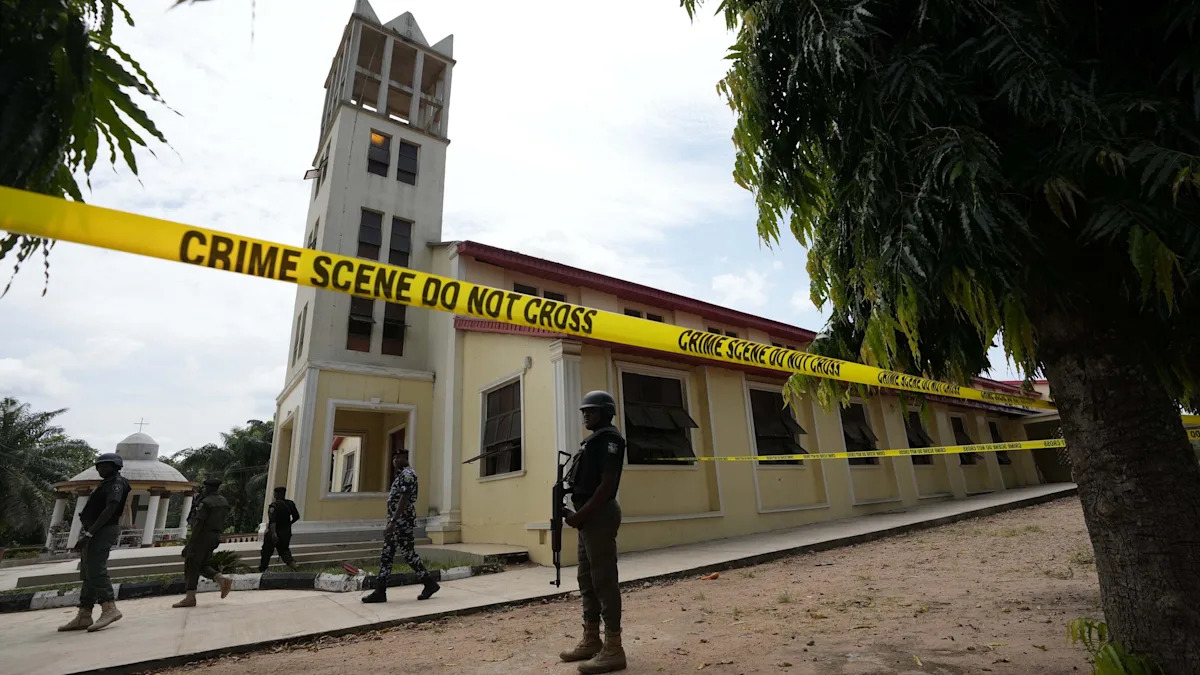
In the wake of U.S. forces bombing alleged Islamic State militants in northwestern Nigeria on Dec. 25, President Donald Trump and his aides have continued to press the Nigerian government to address what they claim is a campaign of systematic persecution against Christians in the country. Trump told The New York Times earlier this month that he could order more airstrikes “if they continue to kill Christians.” And last week, a senior State Department official led a U.S. delegation to Abuja, where she said authorities “must do more to protect Christians.”
The Christmas Day strikes came a month after Trump classified Nigeria as a “country of particular concern,” or CPC, a designation for nations the U.S. government deems to be engaged in or tolerant of religious freedom violations and which the first Trump administration first applied to Nigeria in 2020 before it was revoked by President Joe Biden.
Nigerian officials have said that they welcome any assistance from Washington in tackling terrorism and other security threats but reject the notion that Christians are being killed disproportionately or that the Nigerian state is allowing it to happen.
To explain Trump’s interest in anti-Christian violence in Nigeria, many U.S.-based analysts and commentators have focused on the role of conservative Christians, particularly evangelicals, who are not only an important segment of Trump’s base but have also been a powerful force in U.S. politics for five decades. Conservative media outlets and other commentators, including the talk show host Bill Maher, have added fuel to the fire by amplifying dubious claims and statistics about the systematic persecution of Christians in Nigeria, despite the reality that violence also affects Muslim communities.
To get more in-depth news and expert analysis on global affairs from WPR, sign up for our free Daily Review newsletter.
But attributing the “Christian genocide” narrative in Washington solely to American media and political figures risks ignoring the claim’s deep roots in Nigeria, as well as the synergetic relationship that exists between evangelicals in the U.S. and their Nigerian counterparts, who are among the world’s largest adherents of Pentecostalism, a subset of evangelical Christianity.
Certainly, it is broadly true that Nigeria’s CPC designation and the U.S. airstrikes were preceded by a months-long pressure campaign against the Nigerian government that was led by Republican lawmakers like Sen. Ted Cruz and supported by influential evangelical leaders in the United States.
Much of the information about anti-Christian attacks in Nigeria that filters to Republican politicians and right-wing evangelical groups in the U.S. has usually come from their contacts in Nigeria and the Nigerian diaspora in the United States.
However, the strong links that exist between Christian leaders, churches and groups in Nigeria and their counterparts in the U.S. cannot be overstated as a factor that contributed to the salience of the “Christian genocide” narrative among Republican politicians and right-wing American Christians. Ties between Nigerian Pentecostals and U.S. evangelicals are entrenched and rooted in the parallel origins of their takeoff during the 1980s, when the rapid expansion of independent megachurches and the use of television as a means of proselytizing helped fuel the transformative rise of Pentecostalism in Nigeria and the so-called Moral Majority in the United States.
Many leading figures within the Nigerian Pentecostal movement were influenced by popular U.S. televangelists such as Jimmy Swaggart, Kenneth Copeland, Oral Roberts and Pat Robertson. Prominent Nigerian preachers like Chris Okotie and Paul Adefarasin—the latter of whom has a relationship with the Trump family—received theological education in the U.S. and maintain close associations with church leaders in America.
Nigerian megachurches like the Deeper Christian Life Ministry, Redeemed Christian Church of God and Living Faith Church Worldwide, which claim to have millions of members and followers, have a global footprint that reaches beyond Nigeria’s borders, including in Europe and North America. William Kumuyi, the founder of Deeper Christian Life Ministry, was invited to Trump’s swearing-in ceremony in January 2025 and was one of two prominent Nigerian preachers who took part in events surrounding the inauguration.
Much of the information about anti-Christian attacks in Nigeria that filters to Republican politicians and right-wing evangelical groups in the U.S. has usually come from their contacts in Nigeria as well as others in the Nigerian diaspora in the United States. Christian groups and leaders in Nigeria typically point to the Nigerian state’s failure to prevent violent attacks they say are aimed against Christians on account of their faith as a justification for these international awareness campaigns to pressure the Nigerian government to act.
One such figure is Bishop Wilfred Anagbe of the Catholic diocese of Makurdi in Benue, a state in Nigeria’s Middle Belt region. Anagbe appeared twice last year before the U.S. Congress, where he advocated for the Trump administration to redesignate Nigeria as a country of particular concern due to attacks on majority-Christian communities in Benue by armed men believed to be Muslim Fulani herders.
Another is Emeka Umeagbalasi, a Catholic merchant in the city of Onitsha in southeastern Nigeria. Umeagbalasi founded the International Society for Civil Liberties and Rule of Law, or Intersociety, a nonprofit organization that, according to its website, seeks to “expose perpetrators of heinous crimes … and bring them to accountability.” Evangelical Christian leaders and Republican lawmakers have cited the organization’s statistics to justify their calls for U.S. intervention, even though many analysts have called Intersociety’s data into question. The New York Times interviewed Umeagbalasi and reported that he said he “often does not verify his data” with firsthand accounts, though he later denied that.
All of this is to say that the links between evangelical Christians in Nigeria and the U.S. are undeniable, as is the influence the latter group has on the Trump administration. The same can’t be said about the effectiveness of the airstrikes launched by U.S. forces in Nigeria. Though the military intervention was applauded by many evangelicals in the U.S. and Nigeria, it is unlikely to have a positive impact on the Tinubu administration’s efforts to stem the tide of violence in the country. The inadequacy of those efforts, as well as those of previous Nigerian governments, created an opening for a range of actors in Nigeria, the U.S. and other parts of the world to make claims of varying degrees of accuracy that ultimately led to Trump’s use of force.
If evangelical Christians in the U.S. sincerely wish to protect the lives of their co-worshippers in Nigeria, they would use their considerable influence to effect the reversal of Trump’s decision to drastically reduce U.S. aid to Nigeria and effectively shutter its refugee admissions program, which has helped to save the lives of many Nigerian Christians who have fled persecution over the years. They could also lend financial and material support to civic groups working on the ground in Nigeria to engage in interfaith dialogue and other efforts to bring peace to communities in northern Nigeria and the Middle Belt. Calls for a military intervention in Nigeria will do little to save the lives of Nigerians of any faith, and it would be best for evangelical Christians in the U.S. and Nigeria to put their considerable influence toward causes that are more likely to do so.
Chris Olaoluwa Ògúnmọ́dẹdé is an editor, analyst and consultant who writes about African politics, security and foreign relations, with a focus on West Africa. He was formerly an associate editor at WPR.
The post The Nigerian Roots of Trump’s ‘Christian Genocide’ Narrative appeared first on World Politics Review.