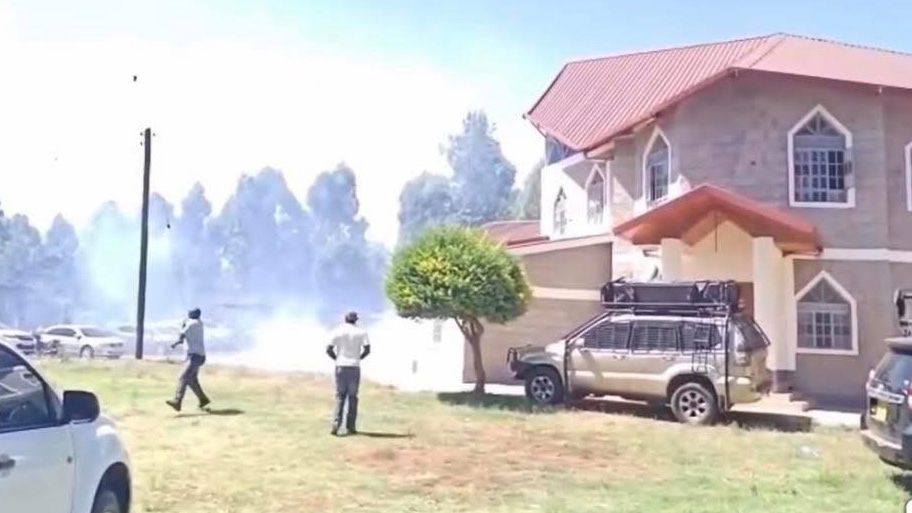
A politically charged tear gas attack on morning services at St. Peter’s Church, Witima on January 25 is drawing criticism from across Kenyan society, including from the church’s primate, who blames it squarely on the nation’s political leaders.
Speaking after unveiling a mental health and wellness handbook for faith leaders in the coastal city of Mombasa, Archbishop Jackson Ole Sapit noted that the tear gas lobbed against worshippers, including opposition leader and former Deputy President Rigathi Gachagua, can only have been in restricted hands.
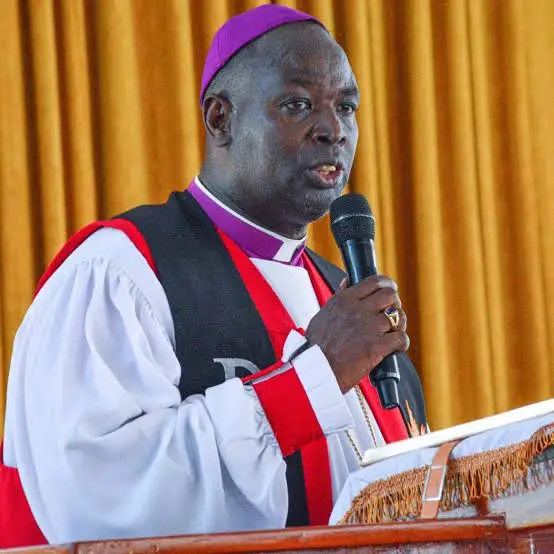 Archbishop Jackson Ole Sapit
“Who has custody of the tear gas in this country other than the security apparatus?” he said.
“If tear gas is used in any installation, we have then no doubt who is using it because it is only used by those people who hold it and have it. So, I want to urge every apparatus and system of this country from the Executive, the Presidency, all the way to anyone who gives orders and particularly the security agencies to give the Church a proper report and an account of what happened.”
In a January 26 devotional, Ole Sapit had already warned that “when violence is carried into worship, when intimidation, destruction, or chaos intrude upon prayer, it is not strength that is displayed, but a tragic misunderstanding of God’s ways.”
“Our call to the Church remains firm and non-negotiable: the sanctity of worship must be preserved. This is faithfulness to the Lord who commands that His house remain holy, and who calls His Church to stand its ground without surrendering its character or imitating the very forces it must, at times, courageously resist,” he said.
He added: “God’s children were hurt within the very place meant to shelter them. Children struggled to breathe where prayers should rise freely. Fear entered a sanctuary meant for peace. The altar of Christ, set apart for worship, repentance, and hope, was violated.”
“As a Church, we condemn these acts without hesitation, and we stand in grief and solidarity with those who were injured, frightened, and shaken. We carry especially our children before the Lord, asking that He heals what their young hearts and bodies were forced to endure.”
Gachagua has accused its President, William Ruto, his former running mate, of attempting to assassinate him.
Law enforcement agencies have pledged to get to the bottom of the incident, which is raising alarm ahead of next year’s General Election.
“Recent spates of political violence give me an eerie feeling. As the 2027 election season dawns, an ominous cloud hangs over us, pointing at a dangerous trajectory if not stopped. The country is counting on us, spiritual leaders, to steady the ship. Yet it is a terrible jeopardy that our holy space has become the theatre of war,” Diocese of Garissa bishop Francis Omondi told The Living Church.
He added: “We may shout our detestation at this violation loud enough to elicit apologies; we may cleanse our sanctuaries with meticulous rituals, but we cannot survive repeated assault as long as we indulge politicians in our holy spaces. Sanctioning political activities in our churches has not worked in the past, for no weight of decree could persuade us to keep the holy space holy and separate. Who can persuade us to honour the Lord in our lives, sanctuaries and country?”
Jesse Masai is TLC’s East Africa correspondent, a longtime journalist and communications professional who has worked in South East Asia and the U.S., as well as in his native Kenya.