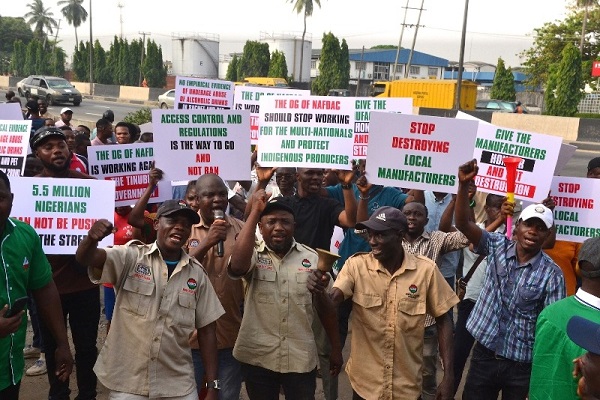
Stakeholders across Nigeria’s food, beverage, distribution and informal retail sectors have expressed concern over the enforcement of a ban on alcoholic beverages packaged in sachets and containers below 200 millilitres by the National Agency for Food and Drug Administration and Control (NAFDAC).
The concerns were outlined in a statement signed by the National President of the union, Jimoh Oyibo, following a recent press release by the Director-General of NAFDAC on the policy.
While acknowledging the shared objective of protecting children, adolescents and vulnerable groups from the harmful use of alcohol, the stakeholders described the enforcement approach as disproportionate, economically disruptive and inconsistent with broader public health realities.
They noted that public health challenges require balanced, evidence-based and enforceable solutions, rather than blanket prohibitions that fail to address underlying causes.
According to the statement, underage alcohol consumption is primarily linked to weak enforcement of age restrictions, limited parental supervision and insufficient public education, rather than packaging size.
The stakeholders argued that global public health evidence shows that behavioural regulation, education-driven interventions and strict age-verification enforcement are more effective than outright product bans.
The union also challenged NAFDAC’s claim that no alcohol-producing companies were shut down as a result of the policy.
It cited reported and documented instances of manufacturers’ depots being sealed during enforcement operations in areas such as Enugu and Abakaliki. Some of these depots, the stakeholders said, have remained inaccessible since January 20, 2026, despite housing products not covered by the ban.
According to the union, repeated representations made by affected businesses have not resulted in restored access, leading to disruptions in distribution and threatening workers’ livelihoods. The group said it has compiled records of the enforcement actions for engagement with relevant authorities.
The stakeholders warned that the ban could have severe economic and social consequences, particularly for indigenous distillers, blenders and distributors.
For many local operators, sachet and sub-200ml packaging forms the core of their business model, designed to serve low-income consumers, informal retail outlets and rural markets where affordability determines demand.
They explained that production lines are dedicated to sachet and small-format packaging, while distribution networks are optimised for high-volume, low-unit sales. Transitioning to larger pack sizes, they said, would be financially unattainable for many small and medium-scale operators, resulting in what they described as an economic shutdown, even if factories are not formally closed.
The stakeholders also warned that the policy could tilt the market in favour of larger multinational companies capable of absorbing retooling costs, while smaller indigenous producers are forced out, raising concerns about unfair competition and market concentration.
In its official response, NAFDAC said the enforcement of the ban is driven by public health concerns, particularly the need to curb alcohol abuse among minors and vulnerable populations.
The agency maintained that it did not shut down any alcohol-producing factories, clarifying that the policy targets only alcoholic beverages packaged in sachets and containers below 200ml, which it described as easily accessible and prone to abuse.
NAFDAC stated that manufacturers and distributors were given prior notice and adequate time to comply and added that enforcement actions were carried out in line with existing regulations. The agency also said it remains open to engagement with stakeholders but stressed that public health considerations must take precedence.
Despite NAFDAC’s position, the union called on the National Assembly, Federal Ministry of Health, NAFDAC, industry stakeholders and civil society organisations to engage in open and evidence-based dialogue to protect public health without destroying livelihoods.
“Public health and economic survival are not mutually exclusive,” the statement concluded.