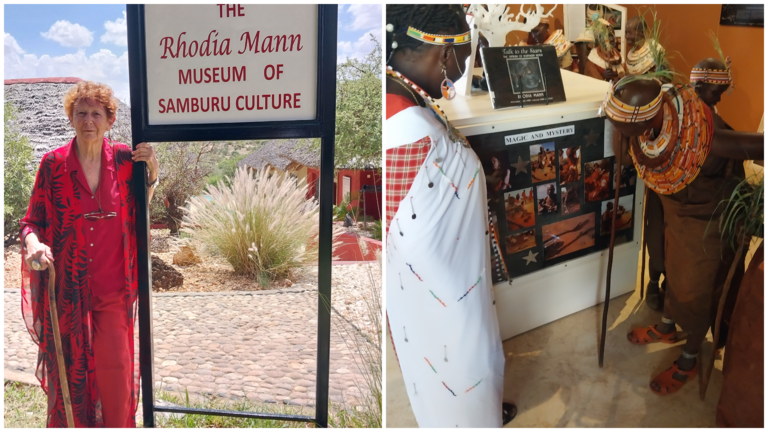
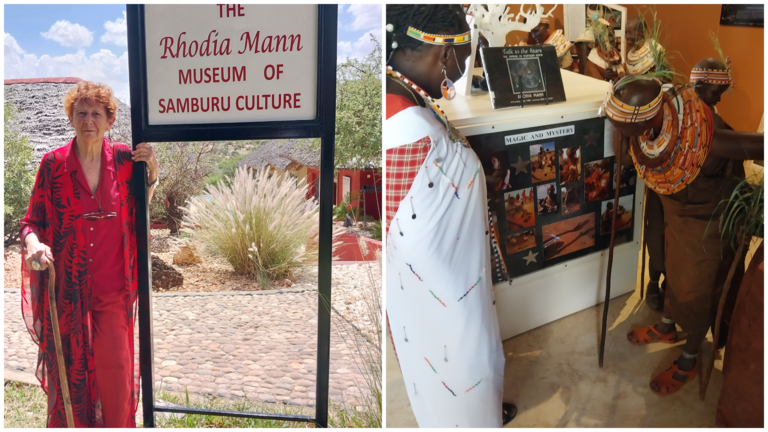
 Rhodia Mann outside and visitors inside the museum / KARI MUTUA jovial mood marked the official opening in December of the first Samburu cultural museum.
The Rhodia Mann Museum of Samburu Culture at the Sasaab lodge in the Westgate Conservancy houses a collection of rare cultural artefacts. They have been donated from the private collection of writer and independent anthropologist Rhodia Mann.
Traditional songs and dancing livened up the occasion, which was attended by Samburu elders, senior women, local leaders and community youth.
During the museum walk-through, guests were visibly impressed by the exhibits, noting the importance of preserving traditional objects and practices as people drifot away from their culture.
“Many people shared how the space challenges the Samburu to reconnect with our roots and remember what our artefacts and even our songs actually represent,” said Stella Napanu, a conservation scientist and youth leader from Samburu North.
“These things are not just fashion or decoration, but expressions of our spirituality and the beliefs our ancestors lived by.”
Following five decades of collecting and documenting, Mann wanted to create a place where the Samburu culture is honoured and respected in perpetuity, even as development and modernisation are inevitable.
“It feels better that these items have come full circle back to where they belong,” said Mann, 83, of her lifelong passion.
SOURCE OF PRIDE
A one-hour drive through Samburu National Reserve takes you to the community-owned Westgate Conservancy, where Sasaab lodge is the only tourism facility.
There is no county museum in Samburu, so the 4Cs Centre for community, conservation, commerce and culture at Sasaab lodge was chosen as a permanent repository for the objects.
“Culture is an important part of engaging the communities in philanthropic and community development,” said Riccardo Tosi, chief development officer at The Safari Collection, the owning company.
Completed in 2024, the museum is set slightly apart from the main lodge and accessible to visitors by appointment.
Tourists, school groups and local visitors are amazed by the beautifully preserved items inside the modest facility.
There are spears, headrests, stools, snuffboxes, household items, beaded jewellery and more than 100 photographs of cultural life.
Every item is labelled with its Samburu name and information gathered from Mann’s many years of research.
A pair of iron tweezers was used to pluck a man’s beard. Different-sized carved gourds were storage containers for milk, water and fat. Blacksmith’s bellows were made of leather and wood, with a clay nozzle.
“The artefacts bring us a sense of pride and connection,” Napanu said. She added that the items highlight the origins of the Samburu and the importance of preserving cultural stories for future generations.
STUDYING THE SAMBURU
Born in Kenya in 1942, Mann is the daughter of Polish and Romanian immigrants to Kenya during World War II.
She first travelled to Samburu in 1952 as a 10-year-old child with her veterinarian father, who worked as a livestock inspector in the Northern Frontier District, as it was known.
There were very few European visitors in those days, so the presence of a White child was very unusual.
“While my father was dealing with the cattle, I was entertained by the women and children. I never forgot the experience,” Mann said.
Later in life, she worked as a safari guide, leading tourists on camping expeditions around the country, including Samburu. In her free time, she visited remote villages in north Maralal, driving hundreds of miles over rough or non-existent roads in a quest to expand her knowledge.
Over time, she had the privilege of witnessing traditional weddings, circumcision ceremonies, divinations, ironsmiths at work and other rituals little known to outsiders. Interactions with spiritual leaders, women elders, blacksmiths and traditional healers, as well as folk stories, uncovered more insights into Samburu life.
“I learned to listen to legends because there is always a grain of truth in oral history,” Mann said.
Together with filmmaker and photographer Clive Ward, she captured many disappearing practices and co-produced a documentary called The Butterfly People.
Mann developed a strong friendship with the family of a senior Samburu woman and was ‘adopted’ as their daughter. Ntaipi, her Samburu mother who had no daughters of her own, gifted her an impressive mporro collar necklace that is traditionally passed from a mother to her daughter at her wedding.
At the museum opening, Mann bequeathed her mporro to Stella Napanu, who has been a strong supporter of the museum.
“I respect and appreciate the work Rhodia has done for my community,” Napanu said when receiving her gift.
TALKING TO THE STARS
In 1996, a meeting with a dying traditional high priest at Mt Ng’iro opened a door to the world of Samburu astrology.
It was the high priest who determined the date of important events, such as the initiation ceremonies held every 15 or so years. He did so by ‘talking to the stars,’ the first time Mann had ever heard about the Samburu connection to planetary systems.
Her findings are documented in Talk to the Stars: The Samburu of Northern Kenya, one of six books she has authored.
One wall of the museum has a picture of the Milky Way galaxy with the constellations written in English and Samburu. According to Mann’s studies, the Milky Way represents all of God’s cattle in the sky, and different people in the community have their particular star guides.
“The circumciser has his star, the warriors have their stars, the married women have their star,” Mann said.
Orion is another significant star constellation, and during a Samburu wedding, the bridal procession is arranged in the same pattern as these stars.
Also in the museum is a collection of antique African beads, Mann’s other passion. A display cabinet contains beads from Mali, Ghana, Ethiopia and India, as well as Turkana necklaces made with land-snail shells and aromatic roots.
Her fascination with beads started at 12 years old, when she found some beads washed up on the beach in Zanzibar. In the early 1970s, Mann became a successful jewellery designer in the US, a career she resumed after returning to Kenya in 1981.
For almost 40 years, she travelled through Africa, Asia and Europe, looking for unusual beads to create her jewellery. Over time, curiosity about the origins of beads superseded the jewellery-making business, and she embarked on a quest to trace the provenance of vintage beads found in Africa.
Ushanga: The Story of Beads in Africa contains 40 years of Mann’s research and illustrations of beads. Maps in the museum taken from her book show how beads were imported from Europe and Asia, carried along ocean and desert routes, then traded in East Africa.
She traced the origins of the red beads on her mporro marriage necklace to Venice, a substantial producer and exporter of beads for centuries.
However, since the mid-1970s, the Czech Republic, with its strong glass-making tradition, has been the primary source of beads used for traditional Kenyan jewellery.
Czech Ambassador Nicol Adamacova was among the guests at the museum opening. She expressed pride in the connection between her country and Samburu culture.
Being a self-taught anthropologist has not been easy for Mann, who has endured scepticism about her research because she is not a qualified academic in her field.
Nevertheless, with the decline in traditional knowledge and practices, the Rhodia Mann Museum of Samburu Culture represents an exceptional repository of cultural heritage.