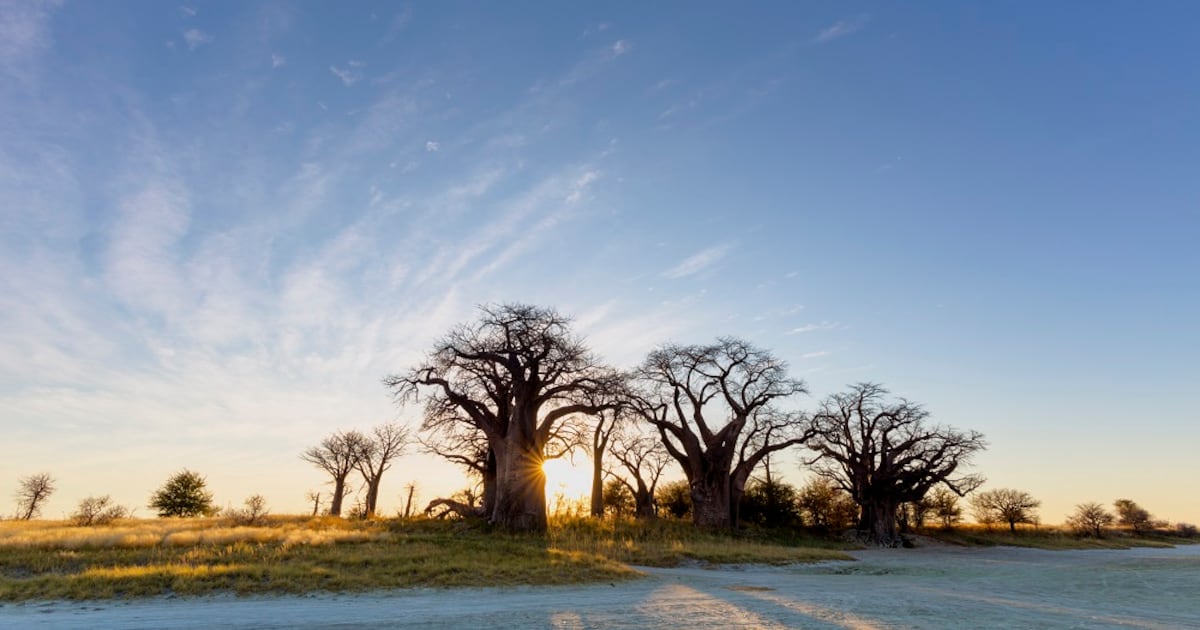
New research has shown that baobab trees, the giant icons of the African savanna, have adapted their flowers in remarkable ways to suit different pollinators, and these vary according to which parts of the continent they grow in.
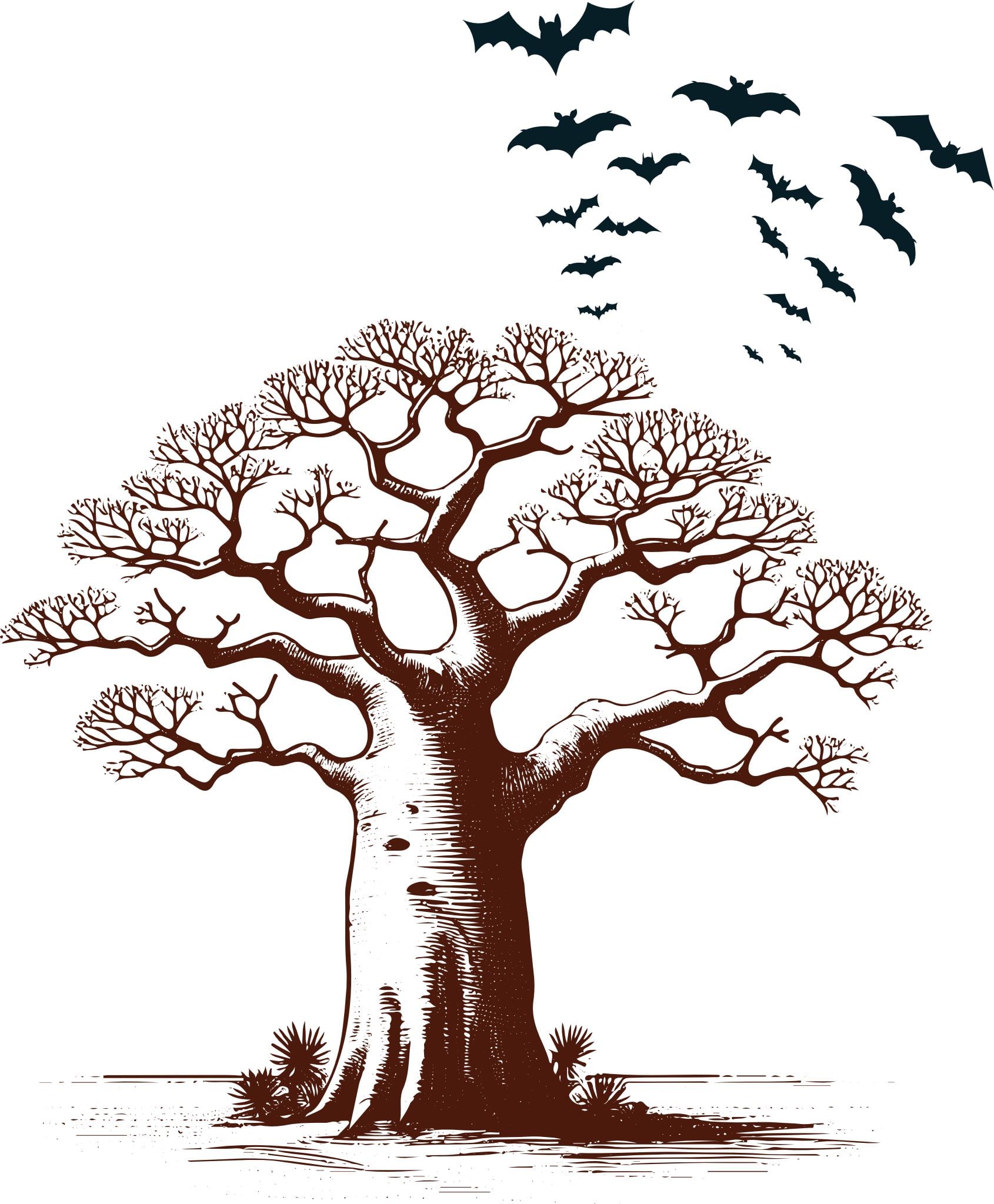 A Baobab tree illustration (Supplied )
Though exactly the same species, Adansonia digitata, trees in West and East Africa are pollinated by bats, and those in Southern Africa by moths.
Over thousands of years baobabs in Southern Africa have evolved flowers that droop, which enables moths to easily feed on small amounts of nectar, while those in West and East Africa have developed strong, firm flowers that enable bats to drink the greater amounts of nectar these trees produce.
For decades nature lovers and scientists were unsure of the pollinators of these trees. A baobab ecologist at Wits University, Sarah Venter, and her team discovered these variations by using cameras stationed at sites in Ghana, Kenya, South Africa, Namibia and Botswana.
The cameras recorded which creatures visited the night-flowering trees. The researchers also caught bats in mist nets and collected pollen from their fur to confirm that they were pollinating the flowers.
In addition to adapting the shape of their flowers to suit specific pollinators, the trees in West Africa emit a strong sulphur-like scent very different to that of their relatives in Southern Africa.
“When I began studying the baobabs in West Africa, I was gobsmacked at how the flowers differed in shape, and how overpowering their scent is compared with the sweeter scent of trees I have studied in Southern Africa,” Venter tells the FM. “It takes thousands of years for these changes to happen, but the divergence of the flowers does not mean they are a different species.
“What it does mean is that these trees have a very close relationship with bats and moths, and if these species go into decline due to climate change or for any other reason, the trees might not reproduce,” says Venter, who has studied baobabs for 18 years. “This could have serious consequences for the baobabs’ long-term survival and for other species dependent on them.”
There are eight species of baobabs in the world, of which six occur in Madagascar, one in Australia and one in the drier savanna regions of Africa.
Sometimes known as “the tree of life”, baobabs — some are 2,000 years old — play an important cultural role in many societies and provide fruit, medicine and fibre.
The leaves are sometimes eaten as a nutritious vegetable, the seeds are a source of cosmetic oils and the pulp of the fruit can be used to make a drink rich in minerals and vitamins. Fibre from the bark can be used for making rope, baskets or mats.
The fruit, bark and roots of the tree are also used in traditional medicine.
Elephants sometimes eat the bark, and a wide range of insects, birds and mammals use the tree for various purposes.
These trees have a very close relationship with bats and moths and if these species go into decline due to climate change or for any other reason, the trees might not reproduce
— Sarah Venter
During their research, Venter and her colleagues recorded details of how the design of flowers varies according to the region the trees grow in and, in turn, influences the pollinators they attract.
“By using camera traps and direct observations, we enumerated the frequency of floral visitors. This enabled comparison of the relative abundance of different flower visitors in and between each region and to gauge their potential importance as pollinators,” the researchers note in their paper, Regional Flower Visitor Assemblages and Divergence of Floral Traits of the Baobab, Adansonia Digitata (Malvaceae) Across Africa, published in September 2025. “We also recorded differences in the foraging behaviour of the different species of bats at the flowers, as this had not been done previously.”
The researchers recorded that in bat pollination regions, the flower petals fold back, which makes space for the bats to land and hang on to the flowers.
“In moth regions, petals droop, encouraging close contact and effective pollen transfer,” they note, adding that “large bats encouraged the development of nectar-rich flowers in West Africa. East African flowers produce less nectar for smaller bats, and Southern African baobab flowers provide only drops of nectar, just enough for moths.”
They observed that the flowers on “West African baobabs have long stalks that suit large bats feeding while hanging from branches [but] in East Africa, shorter stalks reduce wobbling when smaller bats land directly on flowers”.
Venter says baobabs tolerate a wide range of environmental and climatic variations, but more work is needed to understand potential threats to the trees.
“Fieldwork is costly and time-consuming, but we need more research about the animals that pollinate the trees and the delicate partnerships between them,” says Venter. “If we can help protect these small nocturnal animals with wings, we can help protect these giant trees.”