6
Cross-Border Smuggling
By Sello Masilo
Musina —
In a bold display of vigilance, members of the 1 South African Tank Regiment have stopped a dangerous attempt to smuggle commercial explosives across the border from Zimbabwe into South Africa.
The incident, which took place on 02 January 2026 near the Beitbridge Point of Entry, highlights the growing risks of high-stakes smuggling operations that go beyond simple illegal crossings.
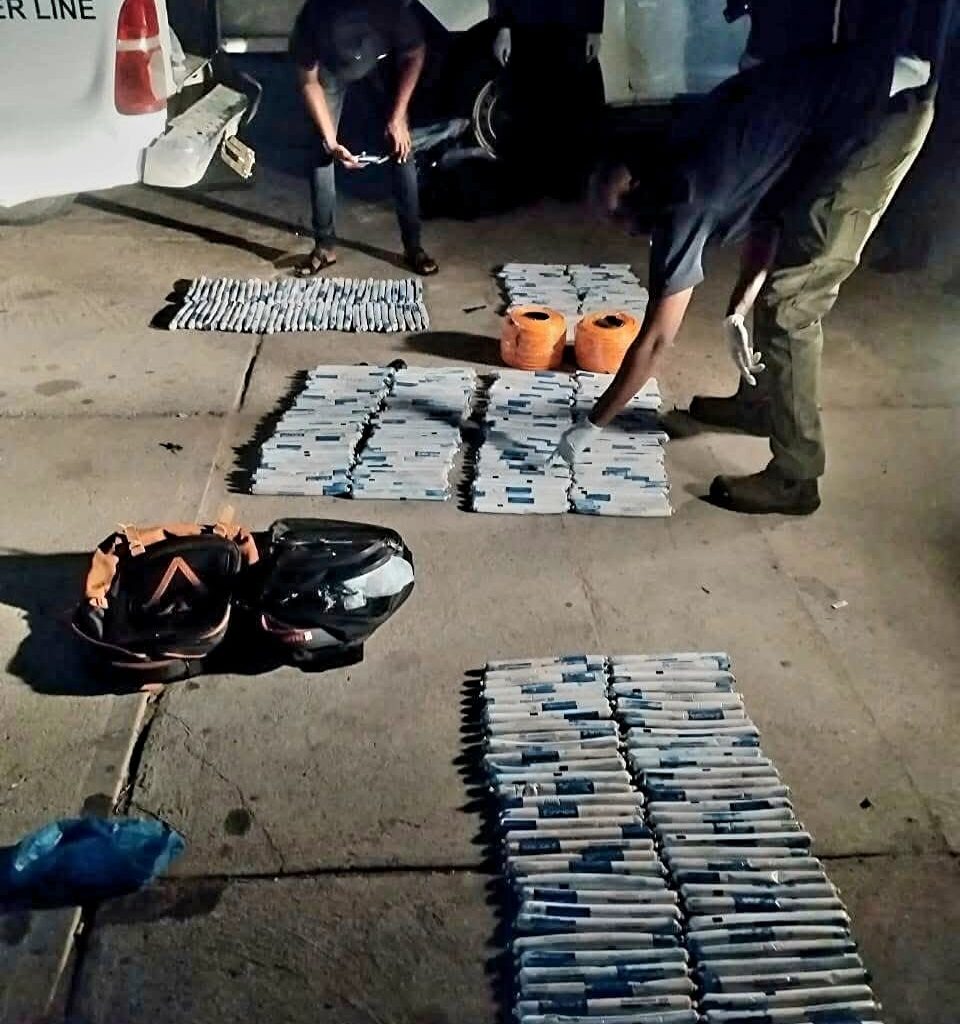
Soldiers on a routine patrol spotted suspects carrying bags filled with lethal materials, leading to the seizure of explosives valued at R82,300. This quick action has been praised as a major win in the fight against cross-border crime, preventing what could have been a serious threat to public safety.
The discovery underscores the challenges faced by security forces along South Africa’s northern borders, where smugglers are increasingly bold in transporting items that could fuel criminal activities like illegal mining or attacks on cash machines.
As unemployment and economic pressures push more people to take risks, authorities are stepping up efforts to secure these porous areas.
The explosives, identified as Superpower 90, are commonly used in legitimate industries but have become a tool for criminals when smuggled illegally.
Details of the Interception and Suspects’ Escape
The operation unfolded during a standard foot patrol east of a support base in Musina, under the command of the Joint Tactical Headquarters Limpopo.
Soldiers from the 1 South African Tank Regiment noticed three unidentified people coming down from the old bridge at the Beitbridge Point of Entry, crossing from Zimbabwe into South Africa.
This bridge, a key landmark at one of Africa’s busiest border posts, has long been a hotspot for illegal activities due to its location along the Limpopo River.
When the suspects saw the approaching troops, they dropped their bags and ran back towards Zimbabwe, using nearby fields for cover. The soldiers quickly searched the abandoned bags and found suspicious items inside.
They called in experts from the South African Police Service Bomb Disposal Unit, who confirmed the contents as Superpower 90 explosives.
These were then handed over to the Musina Police Station for further handling and safe storage. No arrests were made at the scene, but the incident has sparked an investigation into the smuggling network behind it
.
Colonel Dikgabane Herold Tladi, the Officer Commanding Joint Tactical Headquarters Limpopo, commended the team for their sharp eyes and swift response.
He highlighted how such patrols are vital in stopping threats before they escalate.
The regiment, known for its armoured capabilities, often deploys infantry for border duties as part of broader national security operations.
What Are Superpower 90 Explosives and Their Risks?
Superpower 90 is a type of packaged emulsion explosive, designed for heavy-duty tasks in mining and construction. It is a robust, high-strength material that is sensitive to detonators, meaning it can be set off with a simple trigger.
Typically off-white in colour with a firm, putty-like texture, it offers excellent water resistance, making it ideal for wet environments like underground tunnels or quarries.
In legitimate use, it helps with rock blasting in surface excavations, tunnel digging, and other industrial projects where precise fragmentation is needed.
However, when these explosives fall into the wrong hands, they pose a huge danger.
In South Africa, smuggled commercial explosives like Superpower 90 are often linked to illegal mining operations, where syndicates use them to access gold or other minerals in abandoned shafts.
They have also been used in cash-in-transit heists and ATM bombings, where criminals blast open machines to steal money. Experts warn that even small amounts can cause massive damage, injuring people and destroying property.
The value of the seized batch, R82,300, shows the scale of the operation and the potential profit for smugglers.
This is not the first time such materials have been intercepted at Beitbridge.
Over the years, security forces have seized similar hauls, including one in 2022 where explosives worth around R38,000 were confiscated from undocumented individuals.
More recently, in late 2025, authorities sentenced two Zimbabwean nationals to 15 years in prison for trying to bring explosives through the border post.
These cases point to organised networks exploiting the busy trade route between South Africa and Zimbabwe, where millions of people and goods cross each year.
Broader Context of Border Security Challenges
The Beitbridge Point of Entry is a critical gateway for trade and travel in southern Africa, handling thousands of vehicles and pedestrians daily. But its location makes it vulnerable to smuggling, human trafficking, and other crimes.
The Limpopo River, which forms the natural border, is often crossed illegally at shallow points or using makeshift bridges, especially during dry seasons.
Smugglers take advantage of these weak spots, carrying everything from cigarettes and alcohol to drugs and weapons.
The South African National Defence Force plays a key role in patrolling these areas through operations like those led by the Joint Tactical Headquarters Limpopo.
These efforts involve not just foot patrols but also drones, vehicles, and joint teams with police and border management authorities.
In recent months, forces have intercepted over 1,000 undocumented foreigners attempting illegal crossings, along with contraband worth millions of rands.
Just days before this incident, drones helped spot 25 people from Zimbabwe trying to sneak in, leading to their detention.
Economic factors drive much of this activity.
High unemployment in neighbouring countries pushes people to seek opportunities in South Africa, while criminal groups exploit the demand for cheap or illegal goods.
Climate change adds another layer, with droughts making river crossings easier but also increasing desperation among communities.
Authorities stress that while most crossings are for work or family reasons, a small number involve dangerous items like explosives, which could be used in violent crimes.
Implications for National Security and Future Actions
This seizure has raised alarms about a “dangerous shift” towards more serious smuggling, as noted by security officials.
If the explosives had made it through, they could have been sold on the black market and used in attacks that harm innocent people.
Cash-in-transit heists, for example, have plagued South Africa, with robbers using explosives to blow up armoured vehicles and escape with cash.
Illegal mining, known locally as zama-zama operations, also relies on these materials, leading to deadly collapses and gang violence underground.
In response, leaders are calling for better resources, including more personnel, technology, and international cooperation with Zimbabwe.
Joint operations between the two countries have helped in the past, but challenges like corruption and underfunding persist.
The government is also urging communities near the border to report suspicious activities, turning locals into allies in the fight against crime.
For the 1 South African Tank Regiment, this success boosts morale and shows the value of routine patrols.
Captain Moses Semono, who provided details on the incident, emphasised the team’s dedication, while Captain Connie Molwantoa captured images of the operation.
As investigations continue, the focus remains on tracking down the suspects and dismantling the supply chain.
Community Reactions and Calls for Stronger Measures
People across South Africa have welcomed the news, with many praising the soldiers for preventing a potential disaster.
Online discussions highlight fears that the explosives were meant for heists or even to damage infrastructure like bridges. Some question where these materials come from, noting that Superpower 90 might be produced or sourced in neighbouring countries.
Experts advise that to stop such threats, South Africa needs a multi-pronged approach: tougher laws on explosive handling, awareness campaigns for border communities, and economic aid to reduce desperation-driven crime.
As the country grapples with these issues, stories like this remind everyone of the frontline role played by the defence force in keeping the nation safe.
This incident near Musina serves as a wake-up call, showing how everyday patrols can make a big difference in national security. With ongoing efforts, authorities hope to curb the flow of dangerous goods and build a more secure border for all.
🔴Central News Special Edition | Issue 122: Download the Latest Print and E-Edition | Suspended Ekurhuleni Deputy Chief Julius Mkhwanazi Vows ‘I Can’t Go to Jail and Leave My Kids’ Amid Blue Lights Saga Scrutiny 🔴
Download here⬇️⬇️⬇️
Read all our publications on magzter:
https://www.magzter.com/ZA/Central-News-Pty-Ltd/Central-News/Newspaper/All-Issues
Central News also offers Sponsored Editorial Content, Podcasts , Radio / Social Media Simulcast, Video Production , Live Streaming Services, Press Conferences, and Paid Interviews (Video/Audio) etc.
We guarantee exceptional exposure, reach, and engagement, with an excellent return on investment.
Advertisement:
To place your advert on our platforms (Print Newspaper or Digital Platforms) : Please email : sales@centralnews.co.za
For Business Related:
business@centralnews.co.za
Newsroom:
Send your Stories / Media Statements To: newsroom@centralnews.co.za
General Info:
info@centralnews.co.za
Office Administrator:
admin@centralnews.co.za
Whatsapp / Call: 081 495 5487
Website: https://www.centralnews.co.za
Social Media Platforms (@centralnewsza) : Linkedin, Facebook, Tiktok, Twitter, Instagram, Youtube