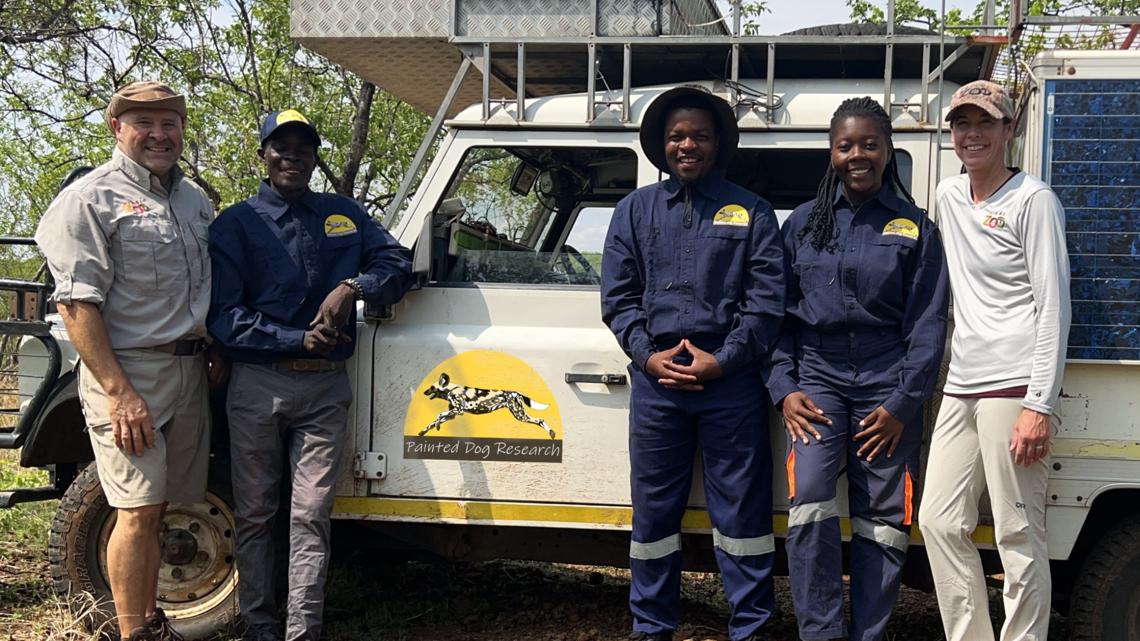
Two of Niabi’s zookeepers are back from Africa after spending several weeks training students and conservationists working with endangered African painted dogs.
COAL VALLEY, Ill. — A nearly decade-long conservation partnership between Niabi Zoo and a nonprofit in Zimbabwe took local staff halfway across the world this winter, as two Niabi employees returned from weeks of hands-on education and research aimed at protecting endangered African painted dogs.
Joel Vanderbush, Niabi Zoo’s curator of conservation and education, and Jessi Lench Porter, the zoo’s lead carnivore keeper, traveled to Zimbabwe in November and December to work alongside Painted Dog Research, a field-based conservation organization Niabi has partnered with since 2018.
Wild African painted dog populations have dropped from roughly 500,000 to fewer than 7,000 across the continent, largely due to habitat loss, disease and human conflict. Niabi Zoo has housed painted dogs since 2023, but Vanderbush said the relationship goes far beyond exhibits.
“We started our partnership in 2018, but 2019 is when we really started contributing some of the expertise that we have to offer to their education team,” Vanderbush said.
Lench Porter, who made her first-ever trip to Africa, spent about two weeks in Zimbabwe, while Vanderbush remained for just over a month. Together, they assisted with field research, collected camera traps and helped lead “bush camps” which are multi-day conservation programs for local children.
“We collected different camera traps to collect field research,” Lench Porter said. “We also helped their bush camps, so we got to teach different children all about conservation and the different aspects of it.”
Those camps have grown significantly in recent years. Vanderbush said when he first traveled to Zimbabwe, Painted Dog Research had a single education staff member. Today, the organization employs 13 educators, many trained with guidance from Niabi Zoo.
“They were running one bush camp per month throughout 2024,” Vanderbush said. “About 20 kids come for a three-day experience.”
With new grant funding from the Jane Goodall Institute, that effort has now doubled.
“Now we have upped that to two bush camps per month, and that’s why we had to go and train more educators for them,” he said.
Vanderbush emphasized that education is a critical part of long-term conservation success.
“The field research is very important, but if no one knows anything about it and knows how important it is to help conserve endangered species, they won’t do anything about it,” he said. “So the education side plays a huge part in making the conservation side really work.”
The experience also highlighted a key difference between conservation work in the U.S. and Zimbabwe: there are no zoos in the country. During one bush camp, Vanderbush and Lench Porter led a presentation explaining how zoos contribute to conservation in the wild.
“None of the kids that were there had ever been to a zoo,” Lench Porter said. “To show them different graphics and videos and stuff that we do with our painted dogs here about enrichment and different things, it was pretty cool to see the excitement.”
For Vanderbush, one of the most memorable moments came around a campfire, when local students helped create a new tradition.
“We realized, you know what we need? We need a Painted Dog Research camp song,” he said. “They wrote a camp song that had both their local language and English and combined traditional dances and lyrics into one song specifically for that bush camp.”
Lench Porter said simply seeing wildlife in its natural habitat was unforgettable.
“Elephants and giraffes and anything from tortoise to lizards,” she said. “It’s crazy just to be able to see all that in their natural habitat and know that we’re making a difference.”
Vanderbush said the work abroad helps strengthen Niabi Zoo’s mission at home, especially as the zoo prepares to open its Conservation in Action exhibit this year.
“When people understand that the zoo is out there doing conservation work, it actually makes the ambassador animals that we hold at the zoo even more important to the story,” he said.
While future international trips are already being planned, including projects in Zimbabwe, Mexico and Paraguay, Vanderbush stressed that conservation doesn’t stop at the border.
“Conservation happens right in your backyard too,” he said, pointing to Niabi’s ongoing pollinator and prairie restoration efforts across the Quad Cities.
More information about Niabi Zoo’s conservation programs and education classes is available on the zoo’s website.
Tune into The Current from 4 to 5 p.m. on weekdays to catch live interviews impacting you, your family and your hometown as well as all of the biggest headlines of the day.