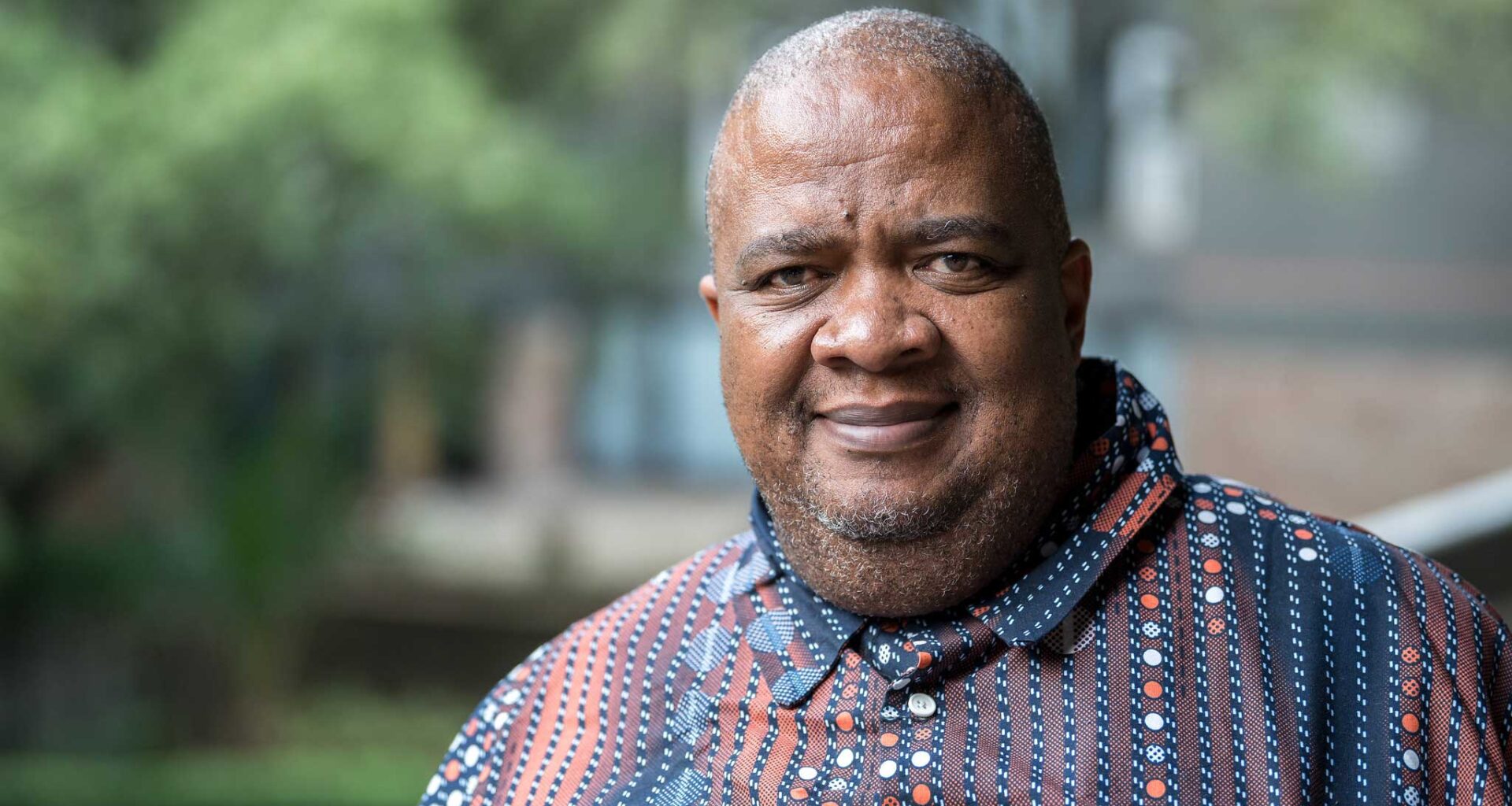
Uhuru Dempers of the Evangelical Lutheran Church in the Republic of Namibia
(LWI) – His full name is Ignatius Michael Uhuru Dempers, but most people know him only as Uhuru, meaning ‘freedom’ or ‘independence’ in Swahili. His mother and grandmother were farmers in southern Namibia, selling a few goats to pay for school uniforms for him and his four siblings. His father was a respected teacher who died when Uhuru was just two years old.
Growing up in the village of Gibeon, far from the capital Windhoek in the 1970s, he attended the local church primary school and was considered a good candidate to attend seminary, training for ministry in the Evangelical Lutheran Church in the Republic of Namibia (ELCRN). Sometimes, he says, he regrets not following that path, because “decision making roles can be limited for lay people in the church.”
Instead, he embarked on a very different journey, rising to leadership in the youth league of Namibia’s national liberation movement, battling against apartheid and colonial rule by neighboring South Africa. Just a few years ago, he received a ‘Most Distinguished Order of Namibia (First Class)’ award from the country’s president for his “contribution to the national liberation struggle.” More importantly, in his eyes, the award was also for his “promotion of socio-economic development of the country” in the 35 years since then.
Today, Dempers heads his church’s Desk for Social Development, as well as coordinating the work of socio-economic justice for the influential Council of Churches in Namibia. He is advisor to the Lutheran World Federation (LWF) Council, a board member of the Africa Peer Review Mechanism and part of a high-level national committee to monitor implementation of reform and restoration of ancestral rights for those dispossessed by German and South African colonial rulers.
Uhuru, tell us about village life in those early years?
There were five of us, three older sisters, my brother and me. My mum was a farmer, but also a church elder, part of the women’s union, doing all the unpaid community work, and she had a big influence on me growing up. When my father died, she had the pension money and bought the goats to help pay for our schooling. I remember others who didn’t have any animals and who couldn’t finish their high school education.
The church played an important role and I used to do the prayers or make announcements during services in our congregation, so the parish elders thought I would make a good candidate for the seminary. But at 14, I went to secondary school in the capital, staying with my eldest sister there and that’s how I got involved in the liberation movement.
It was a dramatic time as the struggle against colonial rule intensified – what do you remember most about it?
We were living next door to the movement’s regional headquarters and, as young boys, we would hide in our houses banned materials that the security forces would come searching for. I got involved in the leadership of the Namibia National Students Organization and, in 1988 when I was 16, we planned a huge uprising. The security forces came hidden in trucks and arrested 45 of us as we were meeting with our teachers and parents to discuss the strike. We were taken for interrogation and four of us were held in prison for a month.
I remember being stripped and forced to sit on the grass before sunrise in freezing temperatures, our teeth chattering so badly we couldn’t speak. On the day of my arrest, they kept asking me how old I was and hitting me when I said I was only 16. I suppose they knew I had rights under the Children’s Act, but I told them I cannot lie.
The unions organized a workers’ strike, with the support of the churches, demanding our release and my mum went on hunger strike, refusing to eat until she had news of my whereabouts. We also decided to go on hunger strike which lasted for four days before we were let out. We were forced to sign papers saying we wouldn’t participate in any political activities but of course, that didn’t happen.
You continued to lead the student movement, didn’t you?
Yes, the protests were spreading all across the country. In October, after our release, we organized another massive rally with about 10,000 people. I was tasked with telling students that we would not sit our final exams due to the disruptions. As I was addressing the crowds from the stage, the security vans were moving in, so some of the elders managed to get me away in secret to a church school where I had to stay for a month to avoid arrest again. Many other students left the country until the following year when we got a UN brokered peace plan, leading up to elections for an independent Namibia.
What was that moment of the election like for you?
Well, I was too young to vote. But I was sent to the south of the country to be part of the campaign to ensure that the liberation movement won the election. People had never had a vote before, so we had to teach them how to exercise their rights. We went house by house and mobilized around 50,000 people. The elections were held in November 1989 and on 21 March the following year, we were a free country.
What did you do after that?
I went back to finish my high school education after two years of absence and then went to study at university, first in Namibia, then in Bangladesh and then in South Africa. Since then, I’ve worked in the civil society sector, with many roles in development, education, poverty eradication and land reform.
I started a family as well and my three boys, Madiba, Gandhi and Luther would come with me sometimes as I travelled around different communities, to develop a consciousness about poverty and the struggle for justice in our country. I am grateful to their mother, Martha, who takes care of them when my work takes me away for long periods of time.
What is your message to them and to other young people in Namibia?
My hope is to inspire and empower others, especially the youth, as we advocate for job creation, housing, food security, agricultural development and recovery from COVID-19. During the time of the pandemic, I registered as a frontline worker and travelled around, seeing families of six or more living in just one room, unable to go out and sell vegetables to earn a living.
In October 2021, I was granted a private meeting with our president to talk about a basic income grant and especially about housing, which is one area where we can make real progress. We are the second least densely populated country in the world, yet 40 percent of people live in informal settlements or slums. Over the past five years, we have helped the government to design a very progressive housing policy, increasing the budget from 50 million to 700 million dollars, but we need to follow up and monitor its implementation.
I also work with young people on heritage preservation and oral history initiatives. I’ve started a project called the Restore Dignity Foundation, because up until the 1970s there were no official records of the deaths and births of black people, only the church kept details of these things. My family is directly descended from survivors of the first genocide of the 20th century in Namibia from 1904 to 1908, which was officially recognized by Germany in 2021. I want to create awareness about these victims, as well as about our country’s struggle for independence.
What does it mean for you to be part of a global communion of Lutheran churches?
It is very important to me. I work closely with LWF on many different human rights and social justice issues, including the UN’s Universal Periodic Review mechanism and its Financing for Development process, as well as the ecumenical panel for a New International Financial and Economic Architecture, of which LWF is a founding member.
After the last Assembly in Kraków in 2023, I was elected as a Council advisor, serving on the Public Voice and Advocacy committee. I am grateful that I can continue to bring my expertise and my grass roots experience from southern Africa to work for change and to inspire young people in other parts of the communion as well.