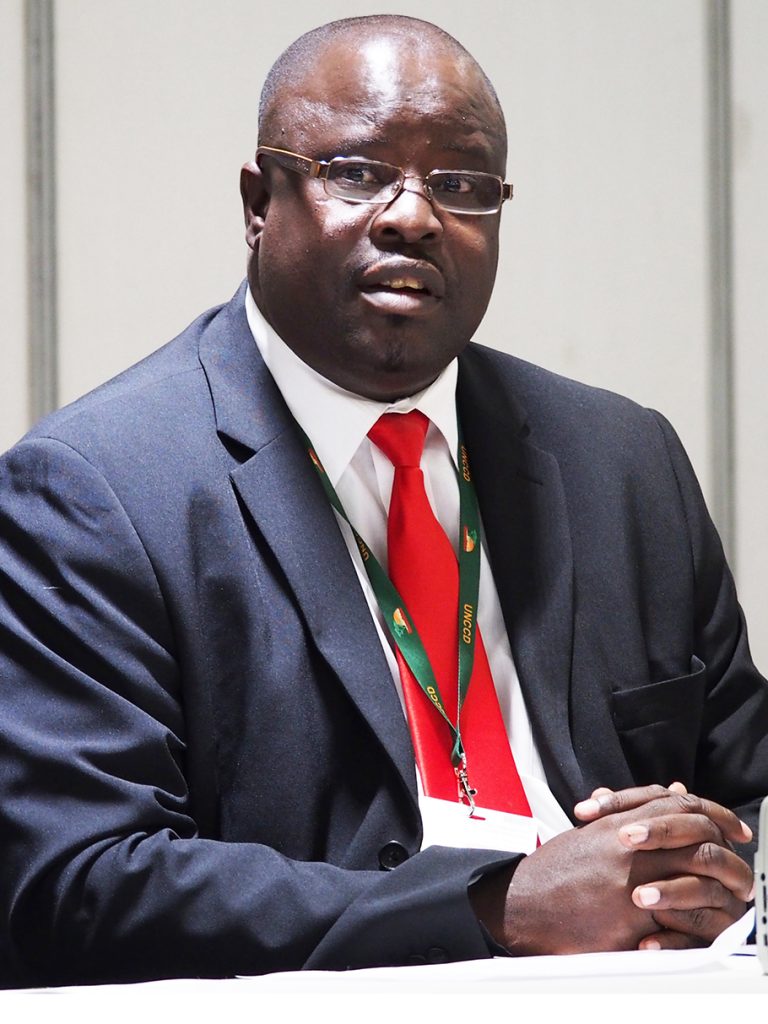
SWAPO deputy secretary general Uahekua Herunga has defended a politburo directive instructing regional and local councillors to elect certain candidates to leadership positions.
He was responding to criticism that the governing party has displayed “undemocratic” tendencies by dictating how its councillors vote, which he says ensures that people with the required skills and capabilities are placed in positions to implement the party’s mandate.
Herunga yesterday told The Namibian that this was done to satisfy the needs of Namibians.
“Those responsibilities must be carried out to satisfy Namibians. The party has leadership and is to direct the activities of the party, including leaders deployed in government,” he said.
The comments follow a directive issued by Swapo’s politburo in December, instructing regional council and local authority councillors on which party candidates to appoint as regional council chairpersons, National Council members, mayors, deputy mayors and members of local authority management committees.
The decision was communicated in a letter by secretary general Sophia Shaningwa addressed to the party’s regional coordinators.
“In terms of rule 49 of the Swapo rules and procedures for the election of party office-bearers and party representatives at legislative and government levels, the political bureau or an appropriate party structure is explicitly and unequivocally mandated to direct and take charge of the deployment of all Swapo elected representatives,” the letter reads.
Along with this rule, Shaningwa further refers coordinators to the party’s rules 50 and 51, stating that deployment decisions are binding and must be implemented without delay, with defiance classified as misconduct.
The directive was defied in December 2025 by Swapo councillors, the majority of whom voted for Jesaya Hanghuwo as chairperson of the Onandjaba Village Council.
Shaningwa ordered Hanghuwo to resign as chairperson and remain an ordinary councillor. She argued that he was not the person elected by the politburo.
Political analyst Henning Melber yesterday criticised Swapo for this move.
“While Namibia is considered a democracy which respects democratic principles, its forms of governance simultaneously display highly undemocratic features,” he said.
According to Melber, this approach has shaped both the party and state structures since independence.
“The principles which have impregnated Swapo since its early days are often characterised as democratic centralism,” he said.
He added that this concept of authoritarian rule has permeated all levels of the state as governed by the party since independence.
“It is a euphemism for a totalitarian top-down approach. It is the centre of power which sets the rules and acts accordingly on the basis of a command and obey culture without control or any other balance of power,” he said.
Melber added that this culture is not new to Swapo.
“Since the late 1960s/early 1970s any criticism from the grassroots, asking for transparency and accountability of the Swapo leadership, was met with repression, culminating in the elimination of numerous critics, labelled as traitors.”
He said while this legacy has not resulted in the killing of people since independence, the internalised concept of power remains intact.
“It is personified as an executive head of state with almost unlimited power to rule,” he added.
In an age of information overload, Sunrise is The Namibian’s morning briefing, delivered at 6h00 from Monday to Friday. It offers a curated rundown of the most important stories from the past 24 hours – occasionally with a light, witty touch.
It’s an essential way to stay informed. Subscribe and join our newsletter community.

The Namibian uses AI tools to assist with improved quality, accuracy and efficiency,
while
maintaining editorial oversight and journalistic integrity.
Stay informed with The Namibian – your source for credible journalism. Get in-depth reporting and opinions for
only N$85 a month. Invest in journalism, invest in democracy –
Subscribe Now!