
For 24 hours, developer Theo used a mystery model inside Cursor to audit his open-source cloud product, Lake Bed, before its first public release. The model correctly identified which launch-blocking issues remained unresolved, disambiguated confusingly numbered tickets, generated two pull requests in a single run, and even responded to new review comments through Cursor’s automated babysitting feature. When Theo screenshotted feedback from another agent and pasted it as an image, the model read the screenshot and made the requested changes.
Then he found out what he’d been testing: Grok 4.5, the new model from Elon Musk’s xAI, built in partnership with Cursor. “I had no ergonomic issues with 4.5 here at all,” Theo said on the t3.gg podcast. “It was actually very pleasant to work with. I kept making my responses worse and worse almost intentionally just to see where it would stumble and it didn’t.”
The surprise wasn’t that the model worked — it’s 2026, models work. The surprise was the price.
A New Price Anchor for Frontier-Capable AI
Grok 4.5 is an entirely new base model: 1.5 trillion parameters, triple the size of the previous Grok, trained across tens of thousands of NVIDIA GB300 GPUs. Cursor contributed trillions of tokens of developer-interaction data — capturing how real engineers and agents interact with codebases and tools — and jointly ran a reinforcement-learning pipeline spanning hundreds of thousands of multi-step software engineering tasks.
The pricing is where the disruption lives. Under 200,000 tokens of context, Grok 4.5 charges $2 per million input tokens and $6 per million output. Between 200,000 and 500,000 tokens, those rates double to $4 and $12. Compare that to Anthropic’s Fable 5, which charges $10 per million input and $50 per million output across all context lengths, or even OpenAI’s mid-tier GPT-5.6 Terra at $2.50 and $15.
ModelInput per million tokensOutput per million tokensMax contextGrok 4.5 (<200K)$2.00$6.00500,000Grok 4.5 (200K–500K)$4.00$12.00500,000GPT-5.6 Sol$5.00$30.00200,000+GPT-5.6 Terra$2.50$15.00200,000+GPT-5.6 Luna$1.00$6.00200,000+Fable 5$10.00$50.00200,000+Opus 4.8$5.00$25.00200,000+
But per-token pricing only tells half the story. The real difference is token efficiency.

The Efficiency Advantage Nobody Saw Coming
On the Artificial Analysis coding suite, Grok 4.5 averaged just 2 million tokens per task. Fable 5 consumed 7.2 million. Anthropic’s Opus 4.8 burned through 9.2 million. Even GPT-5.5’s medium setting used 3.5 million. Translation: Grok 4.5 does the same work with roughly one-third to one-quarter of the tokens its rivals require.
Multiply token count by per-token price, and the per-task costs become stark:
ModelAvg tokens per taskAvg cost per taskGrok 4.52.0 million$0.31GLM-5.2~2.5 million$0.37Kimi K2.6~2.8 million$0.35GPT-5.5 (medium)3.5 million~$1.20Opus 4.89.2 million~$2.50Fable 57.2 million$2.75
Grok 4.5 delivers roughly Fable 5-competitive results at less than 12% of the cost. Elon Musk himself conceded the performance gap, posting on X: “In fairness, Fable is definitely better than Grok 4.5, but most tasks don’t require Fable-level capability.”
That framing — good enough for most work, dramatically cheaper — is what makes this release dangerous for Anthropic and OpenAI.
On standard benchmarks, the positioning holds. Grok 4.5 scored 54 on the Artificial Analysis intelligence index, placing fourth globally behind GPT-5.5 and Fable 5, and just ahead of Sonnet 5. On Terminal Bench 2.1, it hit 83.3, a fraction behind GPT-5.5 at 83.4 and just over a point behind Fable 5 at 84.3. On DeepSWE, it ranked third among agentic coding models.
These are not “we beat everyone” numbers. They are “we’re close enough that the price difference changes buying decisions” numbers.
The Benchmark That Doesn’t Count Anymore
There is one benchmark Grok 4.5 would have dominated: the Cursor Bench, a test suite built from real problems in Cursor’s internal engineering work. It scored slightly higher than Fable 5 High while costing $1.51 per task versus $8.77.
Then xAI and Cursor disclosed why: “they accidentally put Cursor’s actual code in the training data,” as Theo put it. An earlier snapshot of Cursor’s codebase was unintentionally included in Grok 4.5’s training set. Since the Cursor Bench tests models on problems drawn from that same codebase, the model had an inherent advantage. The contaminated data has been removed from future training runs, but the Cursor Bench results are now meaningless as an impartial evaluation.
Theo praised the disclosure itself. “Other labs may have done similar things,” he noted, but few have admitted it publicly. The transparency sets a standard — one that competitors whose training data pipelines have had their own quiet leaks have not matched. Third-party benchmarks like DeepSWE, Terminal Bench 2.1, and Artificial Analysis remain unaffected and serve as the reliable scorecard.
What Grok 4.5 Actually Feels Like to Use
Benchmarks measure capability in controlled conditions. Theo’s hands-on testing measured how the model behaves when you’re actually trying to ship software.
The Lake Bed audit revealed clear strengths. When given a pull request that partially addressed three launch-blocking issues, Grok 4.5 correctly identified which two were only partially closed and what remained. When Theo asked follow-ups about ambiguously numbered tickets across two different lists, the model disambiguated without needing clarification. It generated two separate pull requests in one run, answered remaining questions, and produced a prioritized to-do list. When review comments arrived on those PRs, it addressed them. When Cursor’s built-in “babysit” skill monitored both PRs for new comments, the model continued responding correctly.
The model interpreted a screenshot of another agent’s feedback and made the requested code changes to the correct pull request. Theo found most — though not all — of the issues that Fable 5 and GPT-5.6 would catch in the same audit, though its code quality was less thorough than GPT-5.6’s output.
Then came the wall.
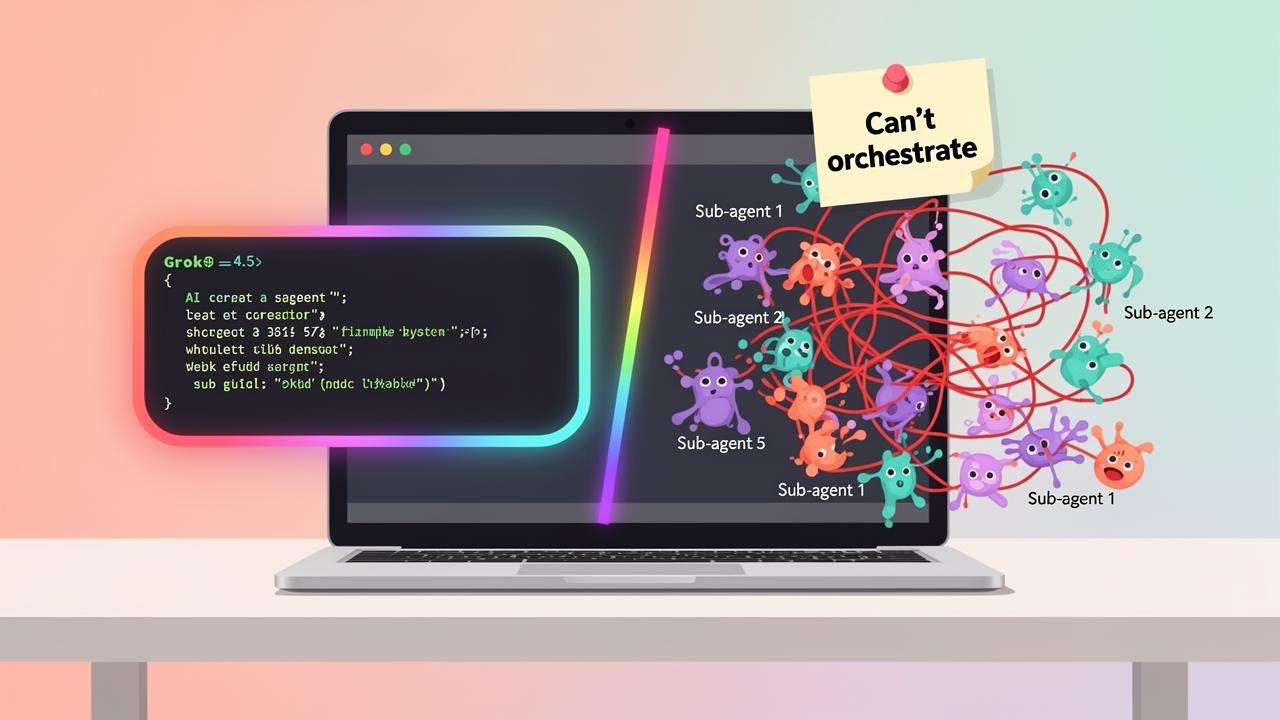
When Theo tried using Grok 4.5 to orchestrate sub-agents — decomposing work, delegating tasks to child processes, managing the lifecycle of those sub-processes — it failed. It lacked the nuance to split work intelligently and would hang when a sub-process stalled, never cleaning up. This is not a minor missing feature. It is the defining capability of what Theo calls the new generation of models.
“If you were to think of this in gaming,” he said, “they just put out the best PS2 game ever, but the PS3 has been out for two months.”
The One Area Where Grok 4.5 Surprised Everyone
Not all the surprises were about its limits. When Theo tested Grok 4.5 on creating a 3D aquarium game in Three.js — converting a 2D prototype into a full 3D environment — the output was unlike anything he’d seen from other models. The model generated original geometry for multiple aquatic creature types, bottom-of-tank terrain, and even an enemy model for invading aliens.
The controls had bugs. A went right and D went left. The scene layout was misaligned. But the raw creative output, Theo said, was “so far ahead anything I’ve gotten from any of the other models.” He called Grok 4.5 “the first model to be almost decent at 3D modeling in game engines like Three.js.”
This is an unexpected bright spot — a capability that doesn’t show up on standard coding benchmarks but matters for a growing class of developers building interactive experiences. A follow-up prompt fixed the pointer and clicking controls but left the directional inversion unresolved.
The PS2 in a PS3 World
Theo’s generational framework is the most useful lens for understanding where Grok 4.5 fits. Models like Fable 5 and GPT-5.6 represent a third generation defined by orchestration: stepping up a level, prompting sub-agents, breaking large tasks into parallel chunks, and managing the lifecycle of those child processes. Grok 4.5, for all its efficiency and benchmark scores, belongs to the second generation. It excels at direct, single-agent tasks — find this bug, write this function, audit this PR — but cannot coordinate.
“Grok 4.5 is on the line between last gen and this gen in a lot of ways,” Theo said. It is, by his assessment, “the largest jump any lab has ever made, other than maybe DeepSeek” — going from essentially irrelevant in the frontier conversation to a viable competitor in roughly two and a half months. Theo had predicted in April 2026 that xAI could stage a comeback in 6 to 12 months; the actual timeline was far shorter.
The model’s limitations define its role. Theo calls it “a weirdly good default code model” — the system you use for 80% of your work, reserving Fable 5 or GPT-5.6 Sol for the hardest problems that require orchestration or deeper thoroughness. It compares favorably to Anthropic’s Opus 4.8 in feel, and given the cost difference, functionally replaces it for most developers.
The Cursor Angle
The business story behind the model is as significant as the technical one. SpaceXAI acquired Anysphere, Cursor’s parent company, in an all-stock deal valued at $60 billion in June 2026. Grok 4.5 is the first product milestone from that combination, and it solves a strategic problem for Cursor.
Before the acquisition, Cursor competed against AI labs that could subsidize inference costs through high subscription fees. Cursor lacked its own models to subsidize. Now it has Grok 4.5 — a jointly trained model it can offer to individual users at near-zero marginal cost, while competitors pay retail API rates for their own inference. That structural advantage didn’t exist three months ago.
xAI’s broader ambition, per internal documentation, extends beyond coding. Grok 4.5 is designed to handle complex legal document parsing, financial quantitative analysis, and regulatory compliance tasks, with enhanced cybersecurity layers for enterprise deployment. The company recently joined the Nasdaq-100 Index, providing a higher profile among institutional investors and signaling market appetite for pure-play AI assets.
The open question is whether xAI can bridge the orchestration gap. If its next release closes that gap while maintaining Grok 4.5’s cost discipline, the competitive picture shifts meaningfully for Anthropic and OpenAI. If not, Grok 4.5 settles into a durable but bounded role: the cheap workhorse that handles most tasks, leaving the premium frontier models to fight over the hardest 20% of engineering work. Either way, the days of charging $2.75 per task for capabilities that can be delivered at $0.31 are numbered.