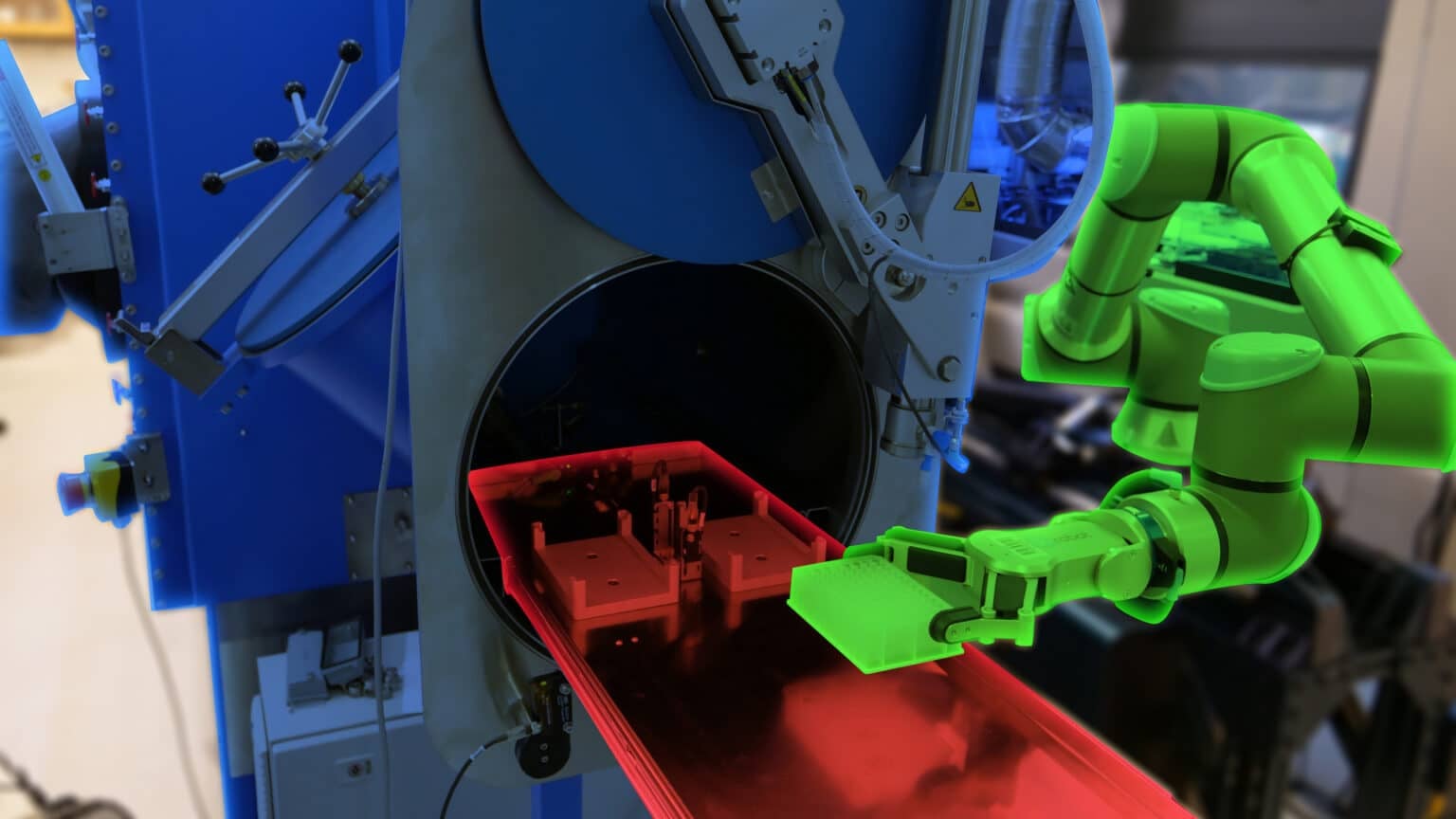
 SPEED’s robots coordinating AI-driven synthesis and characterization of small molecules. (Image credit: Milad Abolhasani/NC State)
NC State University, UNC-Chapel Hill and the Massachusetts Institute of Technology (MIT) will work together as part of a new National Science Foundation-funded effort to establish a nationwide network of artificial-intelligence-enabled automated laboratories across the United States.
The project is part of the NSF’s Directorate of Technology, Innovation and Partnership’s Programmable Cloud Laboratories (PCL Test Bed) program.
NC State will lead the effort with a four-year, $20 million award from NSF to support the SPEED Lab, which stands for Self-Driving Platforms for Experimental co-Design in Chemistry and Materials Science, led by Milad Abolhasani. UNC-Chapel Hill will be a partner institution in the NSF grant-funded project, with Alex Miller in chemistry leading a team that also includes Jillian Dempsey and Erik Alexanian (chemistry) and Ron Alterovitz (computer science).
The effort will be part of the research portfolio of UNC’s Sustainable Energy Research Consortium, based in the College of Arts and Sciences, and led by Miller.
A key tenet of SPEED is advancing “self-driving labs” where human scientists are directing research goals, while smart robotics carry out the procedures. A major goal of the project (and the broader PCL Test Beds initiative) is to enable remote control of automated laboratory instrumentation.
One of UNC’s major roles is to help build those capabilities by developing new access/control interfaces and by piloting a broad range of different chemical reactions. The promise of SPEED, according to Miller, is making cutting-edge research questions more accessible to researchers all across the country.
“The development of hardware and software tools that enable users that don’t have access to advanced instrumentation to test their research ideas could be revolutionary,” Miller said. “The individual self-driving lab modules within SPEED can accelerate the process of moving from lead discovery to optimized outcome dramatically — by 100 times or more — by performing experiments in parallel and using machine learning methods to predict the most promising next set of experiments. This combination of accelerated discovery and broad accessibility is really exciting.”
The UNC team will be instrumental in implementing the project’s science drivers on the automation infrastructure at NC State. These science drivers include enabling more efficient synthetic pathways to produce high-value specialty/fine chemicals and accelerating the translation of next-generation materials into manufacturing for more energy efficient digital displays and other technologies.
“The automated robotic experimentation capabilities that have been developed at NC State over the past few years provide an extraordinary opportunity for accelerating the discovery and improvement of chemical reactions that can benefit society,” Miller added. “Our UNC team will expand the scope of reactions being studied in the self-driving labs and bring new tools for robust remote communication with the instruments.”
Read more about the new NSF-funded AI-programmable cloud laboratories.
Read more about the project and the SPEED Lab in this NC State story.
By the College of Arts and Sciences