AMD Skills: Your Agent’s Way Into ROCm.AI
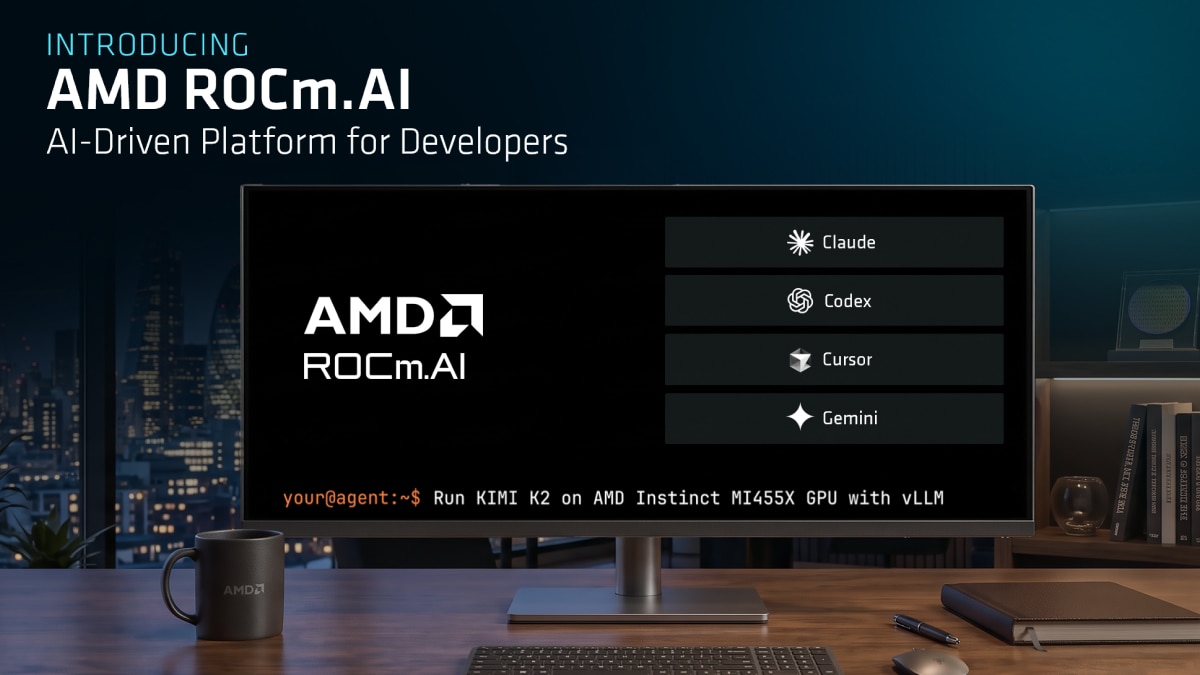
AMD Skills is the primary way in which ROCm.AI interfaces with the agents developers already use. They bring AMD-validated ROCm knowledge directly into Claude, Cursor, Codex and other leading assistants, so guidance is tailored to AMD hardware, ROCm versions and supported software paths.
Rather than searching documentation, stitching commands together, or relying on generic examples, developers can state their intent and let the agent draw on AMD Skills to guide the workflow.
AMD Skills are available today through official integrations with coding assistants. Developers can install them from the Codex Plugins catalog, the AMD page in the Cursor Marketplace, or by searching for amd-skills in Claude Plugins.
Sample AMD Skills
serving-llms-on-instinct – Deploy production LLM endpoints on AMD Instinct GPUs with vLLM on ROCm.
tracelens – Turn PyTorch profiler traces into actionable performance reports for faster inference and training.
local-ai-use – Route image, speech, and text-to-speech to a local server on AMD client hardware, private and cloud-cost-free.
local-ai-app-integration – Embed on-device AI into your own apps across NPU, iGPU, and dGPU.
ROCm CLI : Execution Layer
It gives users a trusted command-line path to install ROCm software, examine the environment and serve models, update components, and generate diagnostics. It is designed for developers, platform engineers, enterprise admins, CI/CD teams and secure environments that need repeatable execution. The CLI is deterministic and scriptable. A developer can run it directly. A script can call it in CI. A coding agent can invoke it with permission. ROCm Console can surface its state.
rocm install
rocm doctor
rocm serve qwen3
rocm update
ROCm Console: Telemetry and Diagnostics
ROCm Console provides visibility into system and workload state. It surfaces telemetry, logs, runtime status, and diagnostic context so users can understand what is happening on the machine. That visibility matters when teams are working with sensitive workloads, clusters, or performance data that should remain inside their environment
ROCm Hyperloom: Workload Optimization
ROCm™ Hyperloom helps developers boost performance with an autonomous agentic system designed to optimize end-to-end inference workloads on AMD GPUs, targeting both host code and GPU kernels by using AI agents and profiling tools to analyze a workload, identify bottlenecks, apply targeted optimizations and validate both performance and correctness. It brings together low-level GPU profiling, trace collection, trace analysis and iterative kernel and code optimization to reduce the manual effort traditionally required for GPU tuning.
Hyperloom helps developers move from a running workload to a better-optimized deployment by profiling the workload, identifying and planning around bottlenecks, exploring optimization options, benchmarking changes and generating a report with proposed improvements and expected performance gains.