
MITCHELL — Timm Johnson wants to make artificial intelligence less intimidating for South Dakota businesses.
Through his Mitchell-based company, Dakota Intelligence, Johnson builds AI systems that answer phones, automate paperwork and organize records. Before recommending any technology, he starts with a conversation.
“Everything starts with a 20-minute phone call,” he said.
Johnson isn’t interested in selling flashy software or replacing employees with machines. Instead, he sees himself as a translator, helping local business owners understand the technology before investing in it.
Away from his computer, Johnson returns to his farmstead outside Mitchell to feed goats, horses, ducks and chickens.
“I feed chickens in the morning and build AI systems in the afternoon,” he said with a laugh. “I’m the robot in the cornfield.”
That unlikely combination has become the foundation of Dakota Intelligence, an artificial intelligence consulting company Johnson officially incorporated March 6.
While AI conversations often revolve around Silicon Valley startups or multinational corporations, Johnson believes rural South Dakota deserves a seat at the table — and someone who can explain the technology without the buzzwords.
Johnson said the company’s name reflects his belief that local businesses should have local guidance as artificial intelligence becomes more common.
“The order of the words matters,” Johnson said. “Dakota comes first.”

Timm Johnson practices tricks with his goat, Big Mac, on Friday, July 10, 2026, at his farm outside Mitchell. Johnson operates Dakota Intelligence, an artificial intelligence consulting company that helps businesses adopt AI tools.
Jennifer Leither / Mitchell Republic
Operating from Mitchell, Dakota Intelligence focuses on helping farmers, small businesses, local governments and professional offices understand where artificial intelligence can improve daily operations — and where it cannot.
That educational approach comes from Johnson’s own lifelong fascination with technology.
He built his first computer when he was 13 years old and describes himself as largely self-taught. He attended college for philosophy and library science before leaving school following the deaths of his parents in a car accident. Since then, he has earned multiple artificial intelligence certifications through Anthropic Academy while working at Dakota Counseling Institute as a behavioral tech intake specialist and electronic health records super user.
The idea for Dakota Intelligence took shape while Johnson recovered from knee replacement surgery in late 2024 and early 2025.
During nearly three months at home, he immersed himself in artificial intelligence, studying developments and how those tools could benefit rural businesses.
Rather than launching another generic technology company, Johnson wanted something distinctly South Dakotan.
“Mitchell is my town,” he said. “This is what I do here.”
Within a month of opening, Dakota Intelligence had secured customers ranging from agricultural operations to a tribal mental health program and other businesses looking to automate repetitive office tasks.
The company builds AI-powered phone receptionists, appointment booking systems, workflow automation and digital operations dashboards.
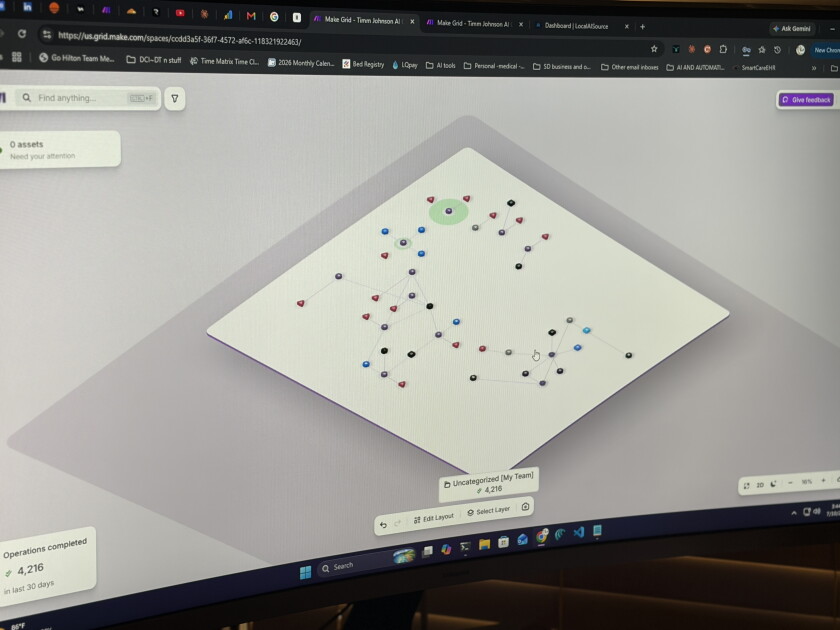
A Make grid displays an interactive map of Timm Johnson’s artificial intelligence and no-code automation ecosystem. The tool provides a visual overview of how his AI systems and workflows connect.
Jennifer Leither / Mitchell Republic
One of Johnson’s most visible creations is “Ava,” an AI receptionist that answers Dakota Intelligence’s own business line. Rather than serving as a demonstration, Ava handles real customer calls every day, scheduling appointments and forwarding transcripts directly to Johnson.
Another project, called Echo, processes data locally instead of relying on cloud-based systems, an approach Johnson says better protects sensitive business information.
Privacy and safety are central to Johnson’s approach. He requires clients to establish an internal AI policy before implementing automation. He also insists every system include what he calls a “human in the loop,” meaning people still review important decisions or content generated by artificial intelligence.
“AI does not need to replace your staff,” he said. “It can free them up to do other things, and that’s the way it should be built.”
Johnson estimates most small businesses are curious about artificial intelligence but uncertain where to begin or worried about issues like privacy, misinformation and security.
Rather than dismissing those concerns, he starts by addressing them.
“I sit down with them and have an honest conversation,” he said. “They’re afraid for a reason.”
Education has become a significant part of the business.
Earlier this summer, Johnson hosted an AI Lunch and Learn through the Mitchell Area Chamber of Commerce, drawing a full room of business leaders interested in practical applications. The presentation focused on practical uses of AI, data privacy and developing workplace policies before implementing new technology.
Instead of relying solely on a PowerPoint presentation, he built an interactive online learning hub participants could continue exploring after the event. The free materials remain available for anyone wanting to better understand artificial intelligence.
Johnson said the timing is especially important because the South Dakota Department of Labor and Regulation is accepting applications for its AI Adoption Workforce Funding program, which reimburses eligible employers for AI training through Aug. 7. Businesses choose their own trainer and can apply for reimbursement to help offset the cost of adopting AI in the workplace.
Johnson hopes businesses take advantage of the opportunity but encourages them to focus first on understanding the technology rather than chasing trends.
“I’m not here to sell you anything,” he said. “Teach first, then implement once they’re ready.”
Johnson also argues there is value in businesses working with consultants who understand rural South Dakota.
He knows planting seasons affect project timelines. He understands how family farms operate, how Main Street businesses make decisions and why practical solutions matter more than expensive technology.
“In South Dakota, word of mouth is the real broadband,” he said.
That local focus has already attracted attention beyond Mitchell.
Dakota Intelligence has been listed in Local AI Source, a national directory of verified artificial intelligence implementation professionals. Johnson also will participate in the 2026-27 Leadership Mitchell class.
Johnson recalled a farmer who once called asking for AI for his cow, meaning artificial insemination rather than artificial intelligence. Johnson instead helped him find a local veterinarian, an interaction he said reflects the neighbor-first approach behind Dakota Intelligence.
Johnson said the story reflects what Dakota Intelligence represents: making technology approachable, whether helping a CPA, municipality or farmer.
“I raise goats on a farmstead outside Mitchell, and I build AI tools for a living,” Johnson said. “Those two things aren’t as far apart as people assume. Good technology should work like a good neighbor — show up, do the job and not make a big fuss about it. That’s what I’m trying to build here.”