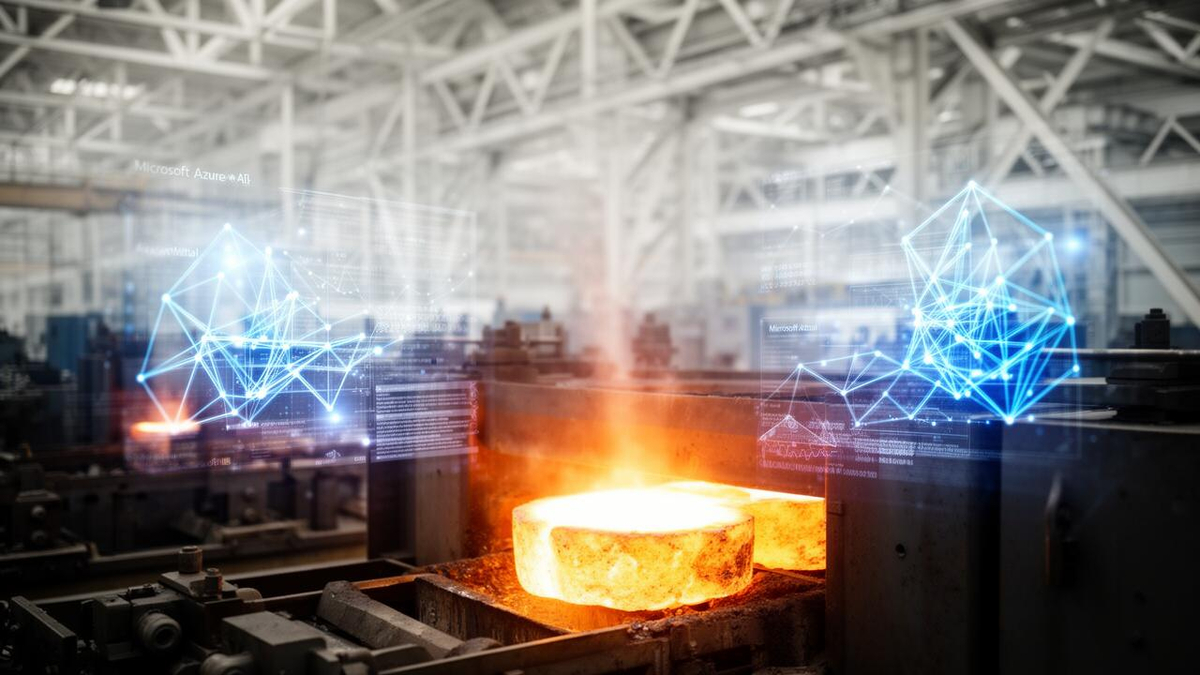
The heavy industry sector is rapidly shedding its low-tech image as steel giant ArcelorMittal (MT) deepens its strategic alliance with Microsoft (MSFT) to place artificial intelligence at the core of its production and cybersecurity infrastructure. The world’s second-largest steel producer has designated Microsoft Azure as its primary cloud platform, a move designed to transform legacy systems into a unified data-driven engine that sharpens decision-making on the factory floor and in the boardroom.
ArcelorMittal confirmed the expanded partnership in a statement, outlining plans to migrate its traditional IT backbone to Azure while layering on advanced analytics, data governance, and AI capabilities. “Together, these advances will empower ArcelorMittal to turn data into a strategic asset, enabling faster, smarter decisions and sustained competitive advantage as the company advances its long-term digital transformation,” the company said.
The Luxembourg-based manufacturer is not merely updating servers; it is deploying a suite of Microsoft’s enterprise tools to harden its defenses and refine its massive industrial operations. The steelmaker will integrate Microsoft Fabric for data analytics, Microsoft Purview for data governance and risk management, and Microsoft Foundry to accelerate AI-driven innovation. A key objective is to bolster cybersecurity across a sprawling global network that spans flat steel, long steel, automotive components, and mining activities.
This industrial pivot to the cloud comes as AI agents increasingly handle sensitive operational data, a parallel challenge Microsoft is tackling across its enterprise ecosystem. In a separate but related security development, Microsoft shares edged higher on the back of a new integration with cybersecurity firm Darktrace. The deal funnels behavior-based risk signals directly into Microsoft Agent 365, a centralized portal where enterprises manage the identities, permissions, and security controls of their AI-driven digital agents.
As AI agents gain wider access to business software and sensitive records, Microsoft is positioning Agent 365 as a critical governance layer. The Darktrace integration adds behavioral context by learning normal operating patterns of each customer’s agents and flagging deviations—such as permission misuse, unusual data access, or unexpected operational changes. Security teams can now compare Darktrace alerts alongside native Microsoft signals in a single dashboard, eliminating the blind spots that often plague fragmented monitoring tools.
By combining identity verification with behavioral analysis, the system aims to close the gap between what an agent is technically allowed to do and what it actually does. This is crucial for a company like ArcelorMittal, where a compromised or malfunctioning AI agent in a production environment could have massive physical and financial consequences.
For ArcelorMittal, the digital overhaul is the latest chapter in an aggressive playbook written by founder Lakshmi Mittal. Since the 2006 merger of Mittal Steel and Arcelor, the company has grown into a diversified industrial powerhouse valued at roughly $54.4 billion. Mittal built the empire by acquiring ailing, often bankrupt steel mills across North America, Europe, Latin America, Kazakhstan, and Africa, then modernizing them into profitable assets. His family still maintains majority control of the shares.
The company’s product portfolio touches nearly every corner of the global economy, from construction and infrastructure to renewable energy, shipbuilding, and railways. Crucially, its deep European roots position ArcelorMittal as a strategic Western hedge in steel procurement, a market where China exerts massive dominance.
Investors have rewarded the strategy. ArcelorMittal’s American Depositary Receipts (ADRs) have surged 62% year-to-date, reflecting optimism around infrastructure spending and the company’s operational discipline. The stock also offers a modest dividend yield of 0.74%.
The Microsoft partnership signals that ArcelorMittal is betting its next phase of margin expansion will come not just from volume or price, but from efficiency gains unlocked by AI. By using Azure Machine Learning and data analytics, the company can optimize energy consumption in electric arc furnaces, predict equipment failures before they halt production, and fine-tune the chemical composition of high-strength steel in real time.
While the financial terms of the cloud deal were not disclosed, the strategic alignment places ArcelorMittal among an elite group of traditional manufacturers attempting to build a competitive moat through digital intelligence. The move also deepens Microsoft’s foothold in the industrial sector, where cloud rivals are racing to digitize supply chains and factory floors.
For the broader market, the twin narratives of ArcelorMittal’s cloud migration and Microsoft’s AI agent security expansion highlight a maturing enterprise AI landscape. The conversation is shifting from mere adoption to governance, security, and tangible return on investment. As AI agents move from experimental chatbots to autonomous actors with access to corporate checkbooks and critical machinery, the infrastructure that monitors their behavior becomes just as important as the algorithms that power them.