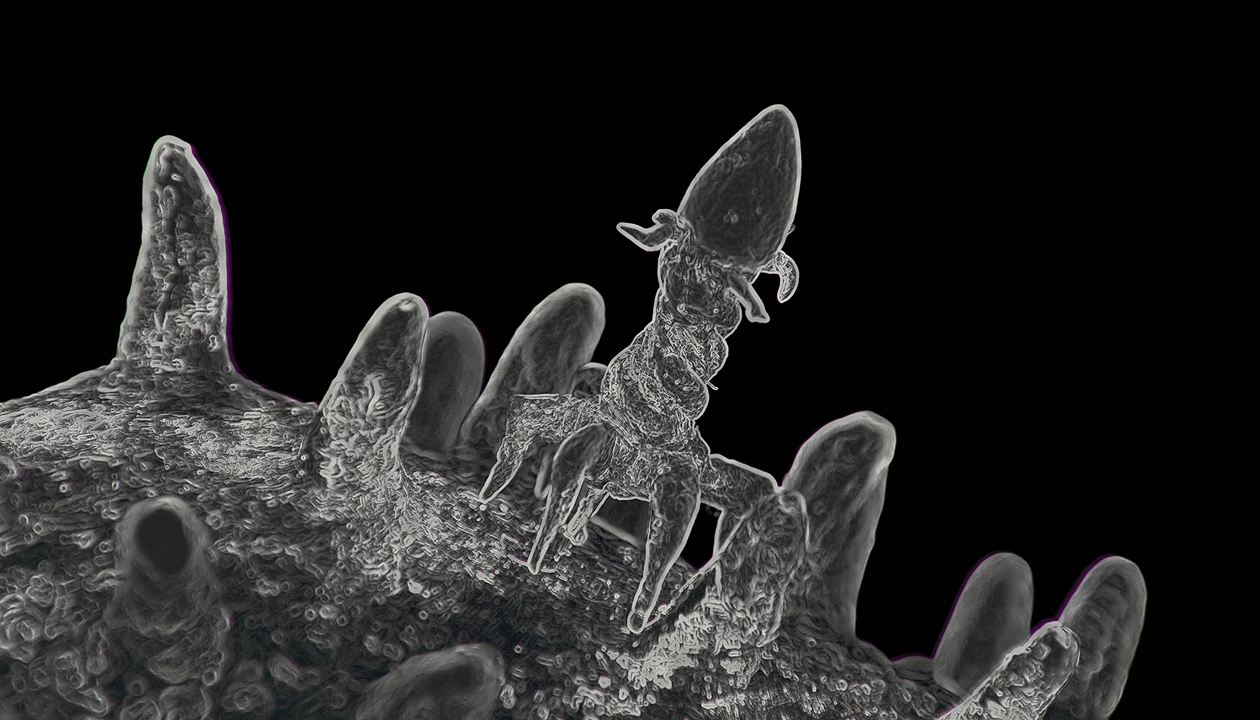
Researchers at Stanford University have shown that entire genome bacteriophages can be generated with an AI-guided program.
The team used programs Evo1 and Evo2 to generate new bacteriophages based on the ΦX174 family of phages, which target Escherichia coli (Science 2026, DOI 10.1126/science.aec2657).
The models were trained on large swaths of existing genomes, and then they were prompted with the help of a consensus sequence that was present in every ΦX174 phage present in the training data.
The large amounts of training data provide insight for the models into what sequences have been evolutionarily conserved, which guides the design toward a genome that produces a viable phage. There are many possible combinations of nucleotides that could make up a gene or a genome, says Brian Hie, an assistant professor of chemical engineering at Stanford and the senior author on the paper. “But only a much smaller subset of those sequences are biologically plausible or fit into the biological world.”
When the researchers got usable sequences, they could then order and insert them into E. coli bacteria. The program produced 16 viable, novel phages in total.
The work acts as “a proof of concept of what’s possible for genome design guided by AI,” says Samuel King, a postdoctoral researcher in Hie’s lab.
The group intends to continue developing the phage program. Hie says that the program’s ability to incorporate evolutionary diversity could make phage therapy more effective as an alternative to antibiotics, in the case of antibiotic-resistant bacterial infections.
