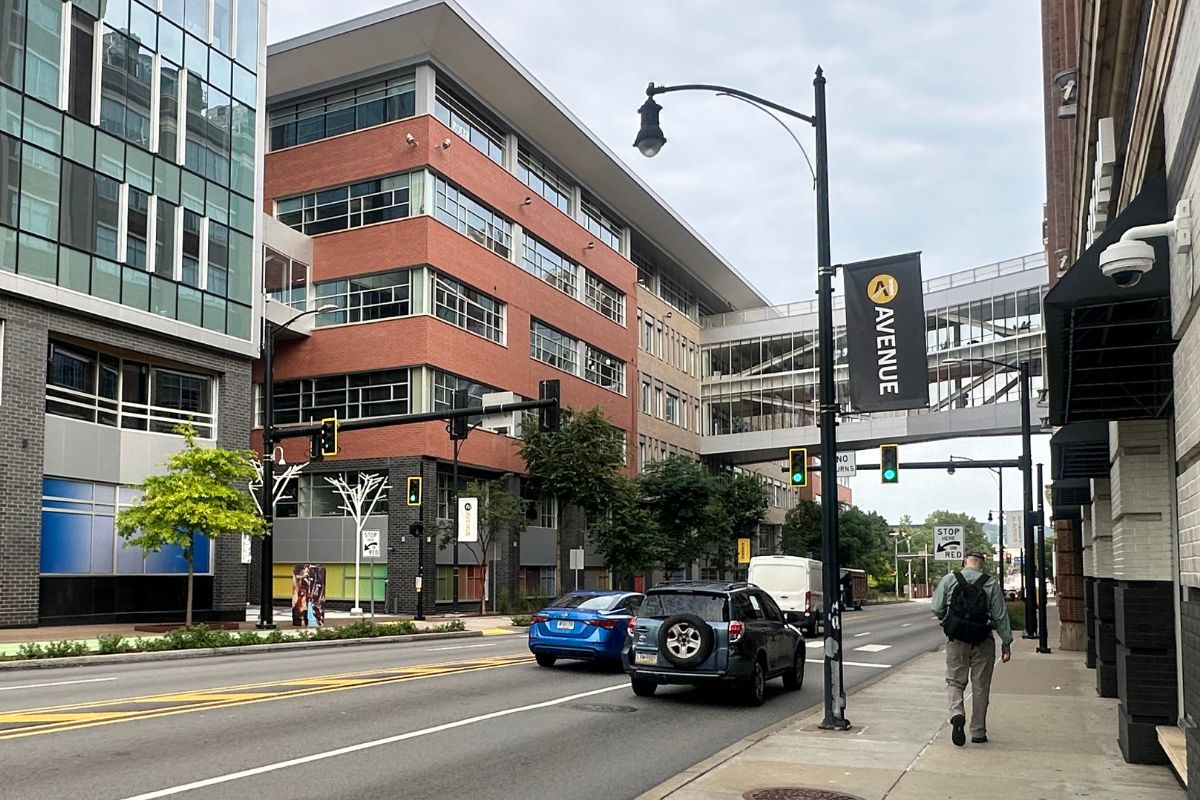
East Liberty and Larimer small businesses want in on the local AI boom. Two years into the AI Avenue project, they’re still figuring out how to get involved.
AI Avenue leaders say they hope bringing tech businesses to the corridor benefits the neighborhoods around it. Local businesses say that while they share that goal, some are still waiting for clearer opportunities to connect. The plans outlined by developers in 2024 has yet to take shape in ways they can see.
“It has to be a sustained engagement with the community — a listening of what the community needs, creating a plan and benchmarks of execution over a three- to five-year period.”
Brad Young, Steel City Squash
“For the community, I’d say anyone you talk to here would say they have no knowledge,” Donna Jackson, executive director of the volunteer-led Larimer Consensus Group, which represents residents in development decisions, told Technical.ly. “We can’t assume people know what’s going on just because it’s happening in their neighborhood.”
Of the six neighborhood outreach organizations and small businesses Technical.ly spoke with, the consensus was that sustained engagement and a clear communication plan about what the groups behind the project — Walnut Capital and the AI Strike Team — hope to achieve would go a long way.
The joint redevelopment initiative has formed some community partnerships with Larimer schools and outlined plans for community-benefit projects, including a workforce development hub and a soon-to-be-announced K-12 AI initiative, according to AI Strike Team Executive Director Joanna Doven.
It’s still early to measure AI Avenue’s broader effect, though.
Todd Reidbord, founding partner and president of Walnut Capital touts AI Avenue as a way to create local hiring opportunities and bring more workers and customers to the area. These changes often take time, sometimes decades, to materialize.
“Is it a plan? Is it something that we have written down? No,” Reidbord said. “But I think organically, who’s the best employee that we can hire? That’s somebody that lives close by.”
What is written down, in a 2024 blog post on the Bakery Square website, is Walnut Capital’s stated “vision” for community empowerment. The post highlighted potential benefits for East Liberty and Larimer residents, including workforce development and a Main Street revival.
Ben Ryan of Nova Design and Construction, a construction and robotics company new to the area, believes the arrival of more tech workers on AI Avenue could boost his business.
“People in tech, they are paid a better wage, and they’re going to be the people that buy an older home in Pittsburgh, or need design services or the construction aspect,” Ryan said. “I think it’s positive, personally.”
Closing the gap between vision and action
A draft planning document from the AI Avenue Working Group, convened in mid-2024 by the AI Strike Team’s Doven, outlines ideas to train residents and help small businesses adopt AI tools.
That plan included a Workforce Development Hub supported by Partner4Work. The hub remains in the “concept” stage and needs capital, according to CEO Rob Cherry, who said he consulted existing neighborhood partnerships to inform the project’s plan.
Walnut Capital has a history of community benefit agreements and partnerships with nonprofits like The Kingsley Association, but there don’t yet appear to be any formal hiring mandates or CBAs surrounding AI Avenue.
Instead, Reidbord suggested, companies will intrinsically want to hire local people. He cited Walnut Capital’s history of hiring nearby residents for concierge services and security positions.
“I believe more in organic growth, and I think that’s something that we can be proud of in the neighborhoods around East Liberty, Bakery Square, Larimer and those neighborhoods,” Reidbord said.
Though AI Strike Team’s draft planning document included some hyper-local benefits, the group sees itself as a regional connector rather than a neighborhood development organization, per Doven.
“We are not the convener of economic development for small business,” she said, explaining that the Strike Team launches broad programs, then relies on traditional economic entities with existing resources to execute them on the ground.
Still, the Strike Team has helped bring together Pittsburgh’s first small business AI accelerator program with Google and advocate for the East Liberty Chamber of Commerce’s effort to place streetlights along the corridor.
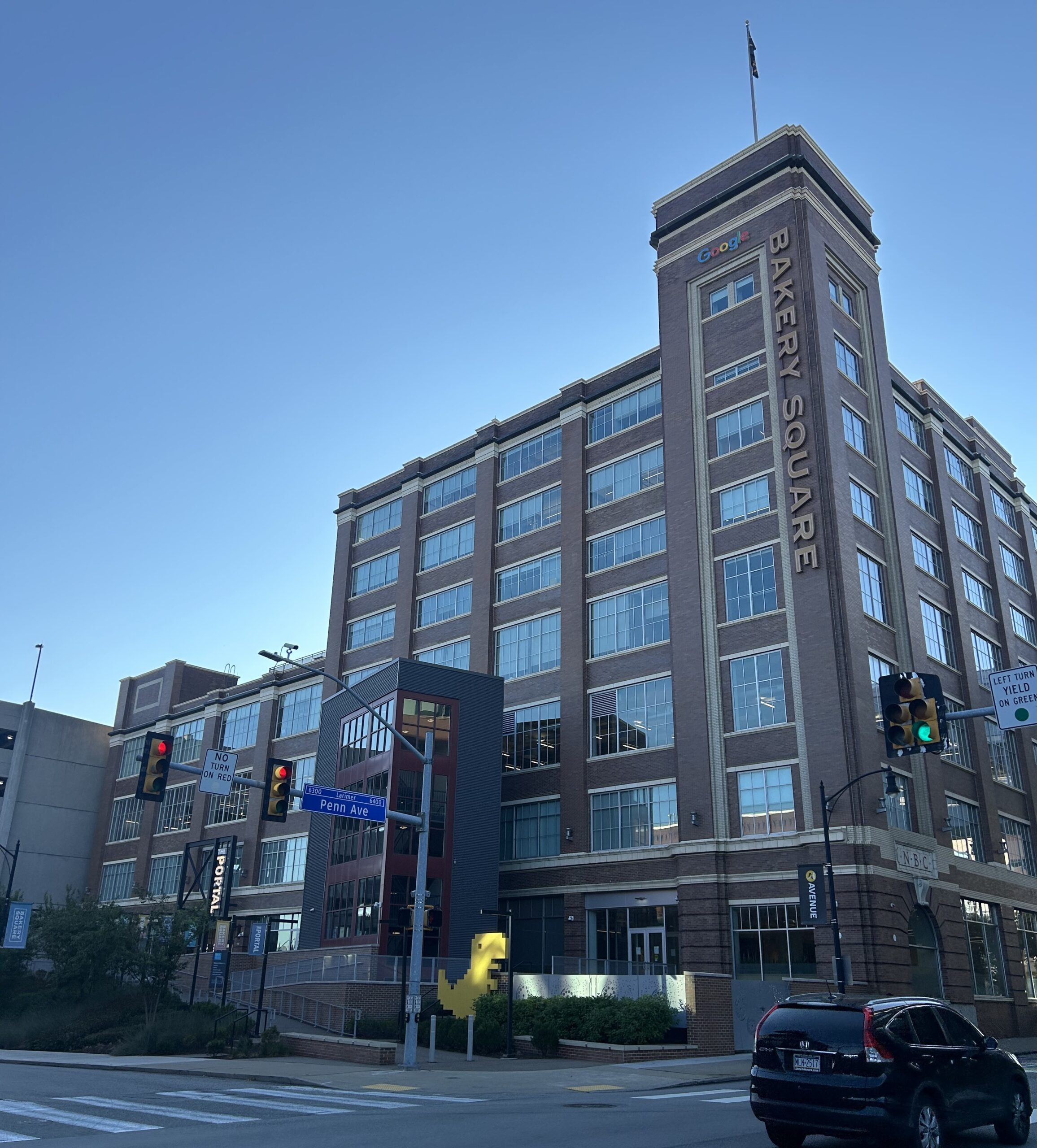 Google’s HQ at Bakery Square (Katie Malone/Technical.ly)
Asked whether Walnut Capital tracks main street rejuvenation, workforce development and other features of AI Avenue, Reidbord said those measures were outside his area of expertise. “I’m not sure we track that specific issue,” he added, referencing community engagement goals.
As far as development gains spreading to local businesses, “a rising tide lifts all boats,” Reidbord said, “and I truly believe that, particularly in the retail and office communities.”
Business leaders near AI Avenue like Brad Young, executive director of local fitness and community center Steel City Squash, agrees tech expansion can enrich the neighborhood, but only if corporate promises come with commitments.
“It has to be a sustained engagement with the community — a listening of what the community needs, creating a plan and benchmarks of execution over a three- to five-year period, and then being accountable to it,” Young said.
A larger community meeting could prove helpful for understanding how the tech corridor might impact the surrounding population, said Grant Wentzel of East End Cooperative Ministry, an organization helping people facing the impact of poverty.
“[I appreciate] just having that opportunity to connect face to face in some capacity to hear what the strategy behind that implementation process is, and what the goals are coming out of that would be,” Wentzel said.
‘We’re trying to do a better job for community engagement’
Small businesses and outreach organizations want engagement and transparency. Developers want AI growth in the area and are open to connections with local people. The question lies as to where the gap gets bridged.
Walnut Capital could “always do a better job” with outreach, Reidbord said, but he calls it a shared responsibility with residents.
“There’s always a subset of people that claim they don’t know anything about it, and I understand it and we’re trying to do a better job for community engagement,” Reidbord said, “but I think people that want to be engaged in the community also have an obligation to reach out a little bit on their own.”
On creating more ways for residents to learn about AI Avenue, Doven said she’s open to anyone who wants to reach out to the Strike Team.
To Jackson from the Larimer community group, the way forward is ultimately a shared responsibility between organizers from the community and tech side. A “reconnect” between tech companies and the communities whose space they occupy, she said.
“I think it’s definitely a collaboration,” Jackson said. “In doing this work for the years I’ve been doing it, it’s always been a partnership and a collaboration to execute the things that you need to get done.”