

Google’s flagship AI pipeline is facing another major shakeup. A report from research firm SemiAnalysis claims that Google has officially shelved its long-delayed Gemini 3.5 Pro model. Rather than pushing through the deployment bottlenecks and performance hurdles that have stalled the flagship for months, Google is reportedly shifting its core engineering resources directly toward Gemini 4, leaving the recently deployed Gemini 3.6 Flash to serve as a high-speed stopgap.
The report paints a stark picture of Google DeepMind’s standing in the frontier model landscape, sparking intense debate across the artificial intelligence industry.
Performance Struggles and Stiff Competition
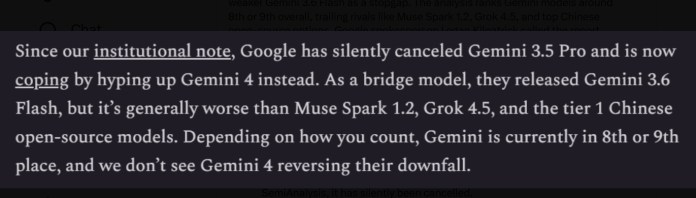
According to SemiAnalysis, internal testing and external benchmarks placed Gemini models around 8th or 9th overall in frontier capability rankings. The analysis notes that Google has struggled to keep pace with top-tier competitors, trailing behind rival frontier systems including Muse Spark 1.2, Grok 4.5, and leading Chinese open-source models that have rapidly closed the reasoning and coding gap.
While Gemini’s lighter architectures—such as Gemini 3.5 Flash and Gemini 3.6 Flash—have earned praise for raw inference speed and token efficiency in agentic workflows, the heavier Pro tier has faced persistent friction. Last-minute deployment glitches, edge-case reasoning errors, and infrastructure scaling bottlenecks repeatedly pushed back the launch date.
As detailed in NokiaPowerUser’s previous coverage on Gemini 3.5 Pro delays, post-training hiccups and internal testing feedback under the Google Antigravity framework hinted that the model was struggling to outperform existing benchmark leaders like Claude Fable 5. Facing a diminishing return on investment for a delayed mid-generation model, leadership chose to cut losses on 3.5 Pro and double down on next-generation pre-training.
Google’s Response: “Superficial Analysis”
Google was quick to push back against the narrative that its AI division is faltering. Responding to the claims, Google spokesperson Logan Kilpatrick dismissed the SemiAnalysis breakdown as “superficial,” highlighting the massive technical strides the team continues to make across the ecosystem.
Kilpatrick praised the ongoing work of the Google DeepMind engineering teams, pointing to the rapid rollout and developer adoption of Gemini 3.6 Flash as evidence of strong execution. Furthermore, pre-training for Gemini 4 is already underway on Google’s custom TPU clusters, signaling that the tech giant plans to leapfrog current limitations rather than fight incremental battles with legacy architectures.
The Road Ahead: All Eyes on Gemini 4
Skipping a mid-cycle flagship generation isn’t entirely unprecedented for Google. The company previously bypassed a public 3.5-class Pro release when transitioning from the 2.5 architecture into the 3-series family. By relying on Gemini 3.6 Flash (and rumored upcoming iterations like 3.7 Flash) to handle high-frequency developer requests, Google buys critical runway for Gemini 4.
However, the pressure remains immense. With rivals constantly raising the bar on long-horizon reasoning and autonomous coding agents, Google’s decision to jump straight to Gemini 4 turns its next launch into a high-stakes moment. Whether Gemini 4 delivers the major leap forward Google needs will determine if the search giant can reclaim the top spot in the AI race.
 Add NPowerUser as a preferred source on Google News