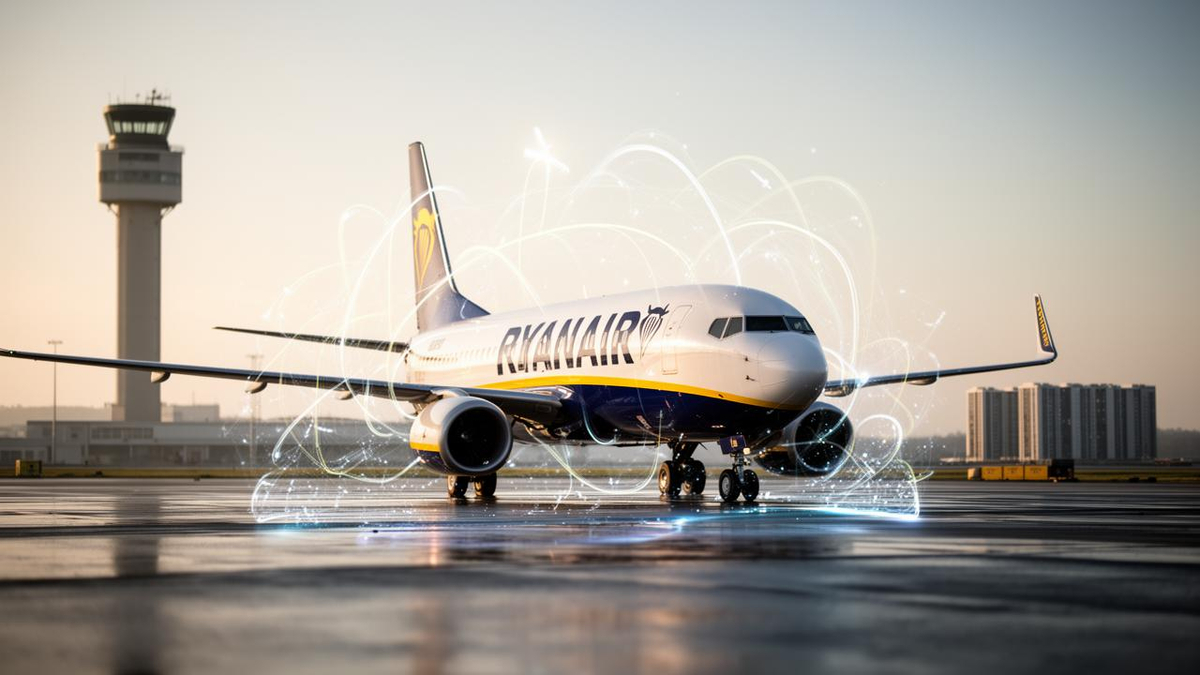
Europe’s largest low-cost carrier, Ryanair, has officially announced a five-year strategic partnership with Google Cloud, planning to integrate Alphabet’s Gemini artificial intelligence tools and DeepMind models into its daily operations at scale. The initiative aims to optimize crew scheduling, enhance decision-making efficiency, and support the airline’s ambitious goal of exceeding 300 million passengers annually by 2034.
Under the agreement announced on August 12, Ryanair will roll out Google Workspace and Google Cloud services to approximately 35,000 employees across its global network. The Ireland-based airline explicitly stated that this collaboration is not intended to replace existing systems but rather to form a complementary “dual-cloud” strategy alongside its current use of Amazon Web Services (AWS). The objective is to diversify risk and reduce the potential for large-scale operational disruptions caused by a single technology platform failure.
Ryanair CEO Eddie Wilson stated in the announcement that to support future explosive growth, the company must ensure superior infrastructure resilience. Wilson emphasized, “Our new dual-cloud strategy is designed precisely for this, and we need a technology partner that can match Ryanair’s pace of development and shares our commitment to efficiency.”
In terms of specific AI applications, Ryanair plans to use Gemini Enterprise to develop proprietary, custom AI agents. These digital workers will be tasked with automating certain complex operational decisions, particularly optimizing crew scheduling systems that have historically relied heavily on manual processes, and proactively addressing potential flight disruptions through predictive analytics.
More notably, Ryanair intends to integrate Google DeepMind’s cutting-edge models to strengthen fleet management. This includes two highly significant technologies: AlphaEvolve, designed for solving complex scheduling and evolutionary computation problems, and WeatherNext, which specializes in high-precision weather forecasting. By combining these two technologies, Ryanair expects to plan aircraft maintenance schedules more accurately and significantly reduce weather-related flight delays and cancellations across its weather-sensitive European route network.
Maureen Costello, Vice President for the UK, Ireland, and Sub-Saharan Africa at Google Cloud, commented that the agreement demonstrates how deploying generative AI at scale can help industry leaders expand securely, lower operational costs, and redefine the travel experience.
While neither party disclosed the specific financial terms of the five-year deal, market observers widely believe that the cloud costs and customization expenses for integrating top-tier AI models will be substantial for a low-cost carrier with a massive fleet and dense route network.
According to research from aviation technology provider SITA and the International Air Transport Association (IATA), the airline industry has been accelerating the expansion of AI into areas such as customer service, operations management, and aircraft maintenance in recent years. Ryanair’s major move is the latest case in this wave, reflecting a post-pandemic trend where airlines, under the dual pressures of soaring labor costs and surging passenger demand, are turning to AI technology breakthroughs to maintain their low-cost competitive advantage.