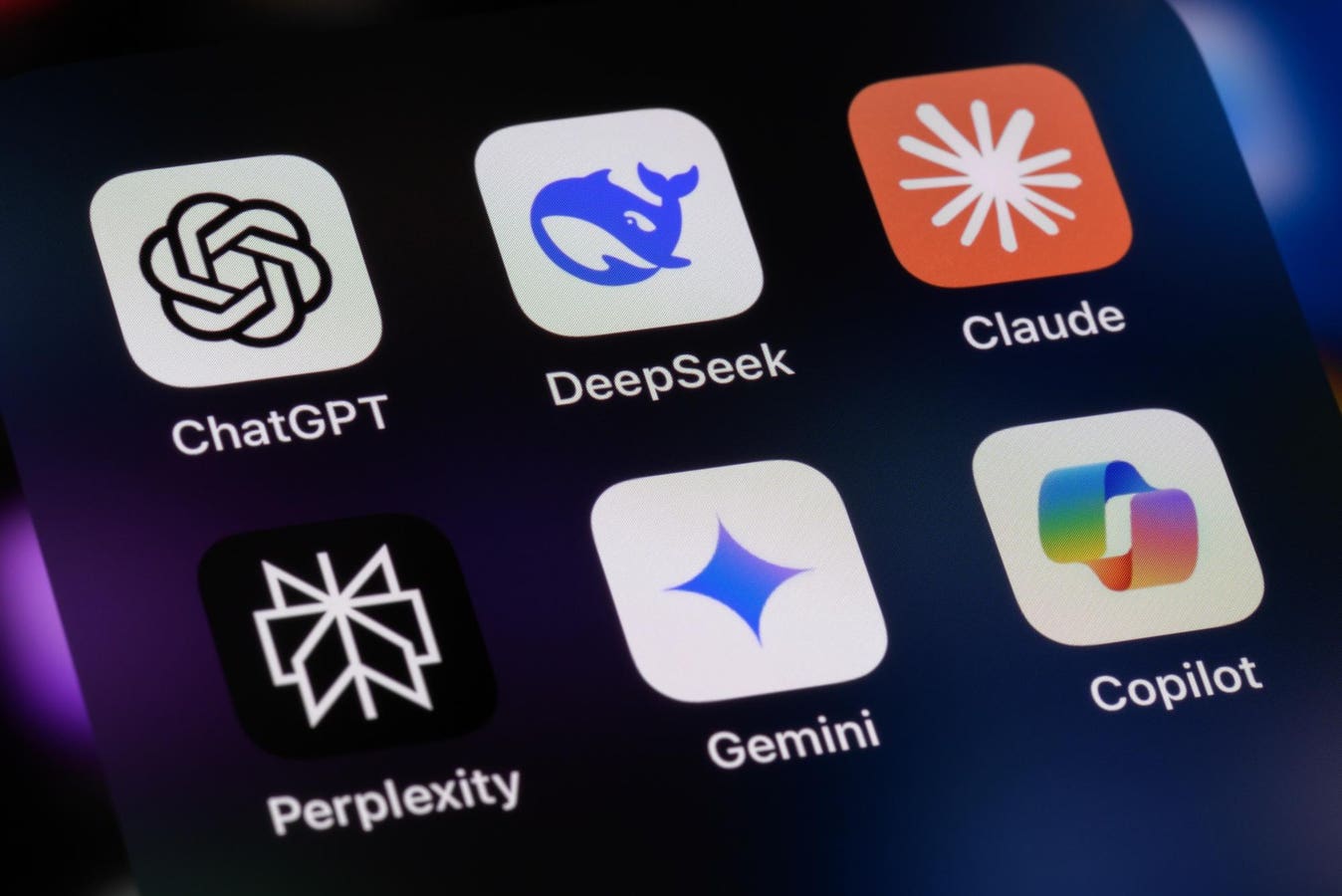

Toronto, Canada – January 27, 2025: Popular AI virtual assistant apps on a smartphone – ChatGPT, DeepSeek, Anthropic Claude, Perplexity, Google Gemini, Microsoft Copilot.
getty
The Anthropic IPO may become the point when investors finally have to separate the extraordinary growth of artificial intelligence from the economics of owning an artificial intelligence company. Anthropic has already built one of the fastest-growing companies I’ve seen. Its annualized revenue run rate jumped from $14 billion in February to more than $47 billion in May, and its private valuation soared from $380 billion to $965 billion in about the same time frame. Investors are now discussing a $2 trillion-plus IPO valuation. Those numbers deserve attention, but they also mean public investors could arrive with an extraordinary amount of future success already reflected in the price.
Anthropic confidentially submitted a draft registration statement on June 1, allowing it to go public once the SEC completes its review and market conditions permit. The $965 billion valuation is still the latest private-market valuation and not an announced public offering valuation because the company has not yet set the number of shares or IPO price. The company has not announced an IPO price or final timing, although recent reporting has pointed toward an autumn listing, with the Financial Times reporting that backers are discussing an October float at $2 trillion or more. Prospective investors have been grilling management on cheaper Chinese AI models, political tensions, and opposition to data center expansion.
I find those questions more compelling than whether the shares eventually price above or below $965 billion. For the first phase of the AI boom, investors were largely trying to decide how important technology could become. That question is becoming easier to answer. The much harder question is where the profits will eventually settle.
The Anthropic IPO Will Test More Than Growth
It is difficult to question the demand Anthropic has created. In February, the company said more than 500 customers were spending at least $1 million annually on Claude, and eight of the Fortune 10 were customers. Claude Code had already passed a $2.5 billion revenue run rate, more than double where it began in 2026. Three months later, Anthropic said overall run-rate revenue had crossed $47 billion.
That is remarkable growth. It also means investors considering the Anthropic IPO are not discovering a neglected company before everybody else notices. The noticing has happened.
Anthropic’s private valuation went from $380 billion in February to $965 billion in May. If its backers are right about a $2 trillion IPO, the valuation could more than double again within months. The business is growing extraordinarily quickly, but expectations may be moving even faster. It needs to grow into expectations that have moved almost as quickly as the business itself. Public investors will be buying a company that must continue expanding while defending its technological position, attracting scarce talent and committing enormous amounts of capital to the infrastructure required to stay near the frontier.
I have been making a version of this argument around IPOs for years. With Arm in 2023 and, more recently, SpaceX, the issue was never whether either company had strategic importance. The danger was confusing access to an admired and scarce company with an attractive entry price.
Anthropic is a different business with a different ownership structure, but the discipline is the same. A company can become one of the defining businesses of its generation while the stock still disappoints if investors pay today for too much of what happens tomorrow.
The Anthropic IPO Will Expose The Cost Of Staying At The Frontier
The number I would watch most closely after revenue is the amount of capital Anthropic needs to keep generating it.
The company raised another $65 billion in May partly to expand compute capacity. Anthropic has agreements with Amazon for up to five gigawatts of new capacity, another five gigawatts with Google and Broadcom for next-generation TPU capacity, and access to GPU capacity from SpaceX. AWS remains its primary cloud provider and training partner. Reuters has also reported that Anthropic committed to spending more than $100 billion over 10 years on Amazon cloud technology.
Revenue can grow at an extraordinary rate while the cost of maintaining technological leadership grows with it. If each generation of models requires more compute, larger clusters, and greater infrastructure commitments, the eventual return to shareholders depends on how much additional capital has to be put back into the business to produce the next dollar of revenue.
This situation is where I think the AI boom gets much more interesting from an investment perspective.
Anthropic is only one claimant on the AI profit pool. Semiconductor companies are earning attractive economics supplying the hardware, while Amazon, Google, and Microsoft are investing heavily in the cloud capacity required to train and run models. Data centers and energy providers need returns on the infrastructure underneath it all. Model developers such as Anthropic want to retain pricing power, software companies expect AI to improve their economics, and the customers paying for the technology ultimately expect it to become cheaper and more productive.
All of those assumptions can be directionally right. I do not think every participant can keep taking an ever-growing share of the same economic pool.
Somewhere along that chain, competition should transfer part of the value away from producers. That may happen through lower model prices, cheaper inference, stronger bargaining power for enterprise customers, or applications becoming more important than the underlying model.
For Anthropic shareholders, that matters far more than whether AI continues getting better. The technology can become indispensable, while the economics available to individual companies become more competitive.
Who Actually Keeps The AI Profit Pool?
Anthropic enters this debate from a strong position. Claude has gained significant traction among enterprise customers and developers, and Claude Code gives the company a product for which customers are already demonstrating a willingness to pay. This is not an IPO built around a distant promise of revenue.
The more difficult question is how durable those economics become.
Investors at Anthropic who have been meeting ahead of the IPO are already asking about lower-cost Chinese systems. Management has reportedly argued that customers will continue paying for the most capable frontier models available. That may prove correct, particularly for difficult enterprise workloads where capability matters more than price.
But competition does not have to make Claude irrelevant in order to change the economics. A rival model that is merely adequate can improve the customer’s position when contracts are renegotiated. If enterprises can move workloads between models more easily, they find it harder to defend pricing power. If applications rather than models own the customer relationship, more of the value can migrate up the stack. At the same time, higher costs for chips, power and compute can push economics in the opposite direction toward infrastructure providers.
That leaves the model developer sitting in the middle of a particularly interesting squeeze.
The company can continue to grow. The market can continue to expand. Claude can remain one of the best products available. Yet the percentage of that economic value that Anthropic ultimately retains remains uncertain.
That is why I would resist valuing the company primarily based on its revenue trajectory. Growth tells us customers want the product. It does not tell us what the mature margin structure looks like, how much capital must be reinvested to defend the franchise, or what returns that capital ultimately earns.
At a much lower valuation, investors could afford to be wrong on some of those questions. At something approaching $1 trillion, there is considerably less room.
The Anthropic IPO Could Change How Investors Think About AI
For much of the AI boom, exposure itself has been rewarded. Investors wanted the chipmakers supplying the infrastructure, cloud companies building capacity, utilities providing the power, and software companies promising productivity gains. Rising capital expenditure was often treated as confirmation that the opportunity was becoming larger.
The next phase should require more discrimination.
Chipmakers are being valued for strong margins. Cloud companies are spending as though enormous AI workloads will justify their infrastructure investment. Model developers are being valued for rapid growth and future pricing power. Software businesses expect AI to improve their margins, while their customers expect the technology to reduce costs.
There is a tension in those expectations that I do not think investors can ignore forever. Eventually the market has to decide who earned an acceptable return on all the capital being deployed.
Anthropic could force that discussion into the open because the numbers are already substantial. The company raised $65 billion at a $965 billion private valuation only months after raising $30 billion at $380 billion, and it is now preparing to ask public investors to place a market price on the next stage of its growth.
I would therefore spend much less time worrying about whether the stock jumps 20% on its first day and considerably more time studying what happens after the excitement settles. How much revenue eventually becomes cash, how much has to go back into compute, what happens to pricing as competing models improve and whether Anthropic can earn attractive returns on the capital required to remain at the frontier will determine far more than the opening trade.
These are not arguments against Anthropic. They are the questions that come with a valuation of this size.
Anthropic may ultimately justify a valuation approaching $2 trillion. Its growth means investors have to take that possibility seriously. But public shareholders will not be buying Anthropic when investors valued it at $61.5 billion in early 2025 or even at $380 billion this February. They will be buying after an extraordinary amount of success has already happened, which changes where the investment risk sits.
For years, the easy question around AI was whether technology would matter. The Anthropic IPO arrives just as investors need to answer something harder: after the chips have been bought, the data centers built, the power supplied, and the competing models improved, who keeps the economics? Anthropic may become one of the great companies of the AI era. Public investors still must decide whether the price they are asked to pay leaves enough of that future for them.