On August 14, 2026, Google’s legendary engineer Jeff Dean announced his departure from the company after nearly 27 years, co-founding Discovery Loop with Oriol Vinyals, Sanjay Ghemawat, and Quoc Le, with the goal of automating the scientific research process itself. Months earlier, AlphaFold co-inventor and Nobel laureate in chemistry John Jumper had already joined Anthropic. Silicon Valley’s top scientists are voting with their feet. But Cao Yuan—former senior research scientist at Google DeepMind and now co-founder of Unreasonable Labs AI—offered a far more sober assessment on the Silicon Valley 101 podcast: the AI for Science (AI4S) breakout is real, and so are its bottlenecks. The biggest bottleneck right now is not compute, not data—it’s verification.
I. Jeff Dean’s Departure: An Era Hasn’t Ended; Priorities Have Shifted
Cao Yuan’s reading of Jeff Dean’s exit operates on three levels. At the organizational level, the Gemini project consolidated previously independent DeepMind teams into a “concentrate resources on big goals” structure, making internal friction inevitable. At the product level, between April and July 2026, the performance of Gemini 3.5 Flash and 3.6 Flash was “mediocre,” lagging behind Anthropic, OpenAI, and Chinese open-source models; the 3.x Pro was repeatedly delayed, and the pivot toward a coding-agent business model was also struggling. But the most important signal lies at the third level: what Discovery Loop aims to do—enabling AI to autonomously conduct knowledge discovery and automated research—is itself the natural next extension once mathematical and coding capabilities have matured.
Cao Yuan explicitly rejects the “end of an era” narrative. Google is one of the few companies with all the full-stack elements: TPUs, infrastructure, data centers, toolchains, models, talent, data, and distribution channels. “It’s not that Google can’t do it well; it’s that priorities and resource allocation need adjustment.” He further explained that DeepMind’s current top priority is getting Gemini to SOTA (state-of-the-art) levels, and under that pressure, “you can’t possibly make everyone happy.” In Jeff Dean’s first entrepreneurial talk at Stanford after leaving, he described the goal as teaching AI to have a “Bayesian moment”—letting yesterday’s experiments genuinely update today’s priors—which aligns almost exactly with Cao Yuan’s vision of an automated research loop.
“How to use AI to automatically advance science and technology—this is an enormously important topic, not just for an organization, a company, a society, or even a country. The development of human society is ultimately driven by science and technology.” —Cao Yuan
The talent exodus has structural causes. Cao Yuan reviewed Jeff Dean’s résumé—MapReduce, Spanner, BigTable, Brain Team, TensorFlow, TPU, and Gemini—along with his habit of coding with Sanjay Ghemawat on a fixed day every week. The departure of this cohort is a natural outcome of long-term collaborative chemistry. Meanwhile, Demis Hassabis’s transition from DeepMind CEO to chairman, continuing to oversee the “AGI and Science” division, suits his scientific temperament. Isomorphic Labs remains Google’s independent chess piece for AI4S commercialization, but in the near term, resources will inevitably tilt toward Gemini. After Meta brought in Alex Wang to join Meta Superintelligence Labs, both Muse Spark and coding models have improved—though going “from 80 to 100” is far harder than “from 0 to 80.”

II. First, Clarify Three Terms: AI4S, AI4AI, and RSI
In public discourse, AI4S, AI4AI, and RSI are often conflated, but Cao Yuan’s definitions are crisp. Both AI4S and AI4AI are tasks that treat “AI as a researcher”; the difference lies only in the target: the former tackles scientific problems, while the latter studies AI itself—for example, improving training efficiency under a fixed GPU budget or searching for architectures beyond the Transformer. RSI (recursive self-improvement) is not a task but a method: letting a model iteratively improve based on feedback from its own outputs, applicable to both AI4S and AI4AI.
Why did this only explode in 2026? Cao Yuan identifies two prerequisites: first, large models’ reasoning capabilities in mathematics and coding have been validated; second, agent harness infrastructure—the “harness” system that strings workflows together step by step—has matured, including memory management, tool calling, and failure iteration. Once these two capabilities are transplanted onto scientific problems, models can propose the next experimental hypothesis, write code to analyze data, and correct themselves based on anomalous results. Cao Yuan says the speed advantage of AI in science is structural: “If you can let AI do it itself, it can probably try many new ideas and new experiments much faster than humans.” Before him, AlphaFold, RoseTTAFold, and other models had already laid extensive groundwork.
But don’t imagine AI as omnipotent. Cao Yuan emphasizes that AI currently plays two roles: one is the “co-scientist”—tools like Claude Science that accelerate scientists’ own analysis and experimental design; the other is the “autonomous discoverer”—such as AlphaEvolve discovering new algorithms or AlphaFold predicting protein structures. Problem definition still has to come from humans—”AI currently cannot claim to have the taste to identify the right problems”—but AI can structure problems. At this point, host Chen Xi summarized the timing: “So now we have the right time, the right place, and the right people—it’s time for us to use AI for Science.”
III. Picking the Right Battlefield: The Market Never Pays for AI Narratives, Only for Verification Speed
The most capital-attractive domain for AI4S is biopharma, but Cao Yuan cautions that the fundamentals here have nothing to do with AI: “Traditionally, biotech, life sciences, and drug discovery represent a huge market—and that has nothing to do with AI.” New drug development routinely takes years and costs hundreds of millions of dollars; experimental workflows are standardized and data-rich, so whether AI accelerates intermediate steps or reduces failure costs, the value is enormous. Materials science also has a large market, but its value chain is extremely fragmented—metals, leather, biomedical materials, semiconductors, rare earths each have their own upstream and downstream—making it hard to capture AI-created value through a single standardized process. As a result, AI’s priority in materials is relatively lower.
DomainMarket & Value Chain CharacteristicsProcess StructureValue AI Can CaptureBiopharma / Drug DiscoveryMassive market; new drug development takes years, costs hundreds of millionsStandardized, data-richTargets, molecular structures, and other intermediate outputs already commercializableMaterialsLarge but highly fragmented (metals, leather, semiconductors, rare earths, etc.)Application-dependent, hard to standardizeValue chain too fragmented to capture holisticallyChip design, batteries, quantum, etc.Emerging exploratory stageNot yet formedMostly early-stage research
For selecting problems suitable for AI research, Cao Yuan offers three criteria: computable, cleanly modelable, and rapidly verifiable. AlphaFold is the canonical example—input an amino acid sequence, output a three-dimensional structure; the problem is well-defined and verification is relatively easy. On the essence of representation, he puts it in one sentence: “If you can’t measure it, you can’t represent it.” A general-purpose model acting as a “lab manager” can internalize multimodal inputs in any format; vertical models are merely domain-expert tools that accept only specific formats. “What experiment to do next” is fundamentally a search problem: each candidate is a node on a search tree, the model evaluates potential returns using a value function (intuition score), then adds a penalty for “how many times this path has been sampled,” striking a balance between exploiting the known and exploring the unknown.
IV. The Brake on the Scientific Loop: Verification
If experiment selection is the engine of the loop, verification is the brake. Coding agents are currently the most successful commercial loop precisely because you know immediately whether code is right or wrong once it’s written; scientific problems don’t work that way—whether a drug works may not be known until it reaches the market. Cao Yuan’s judgment leaves no room for ambiguity:
“The hardest part, for AI for Science, is definitely verification. It is a bottleneck. Once this bottleneck is broken, you can iterate very quickly.” —Cao Yuan
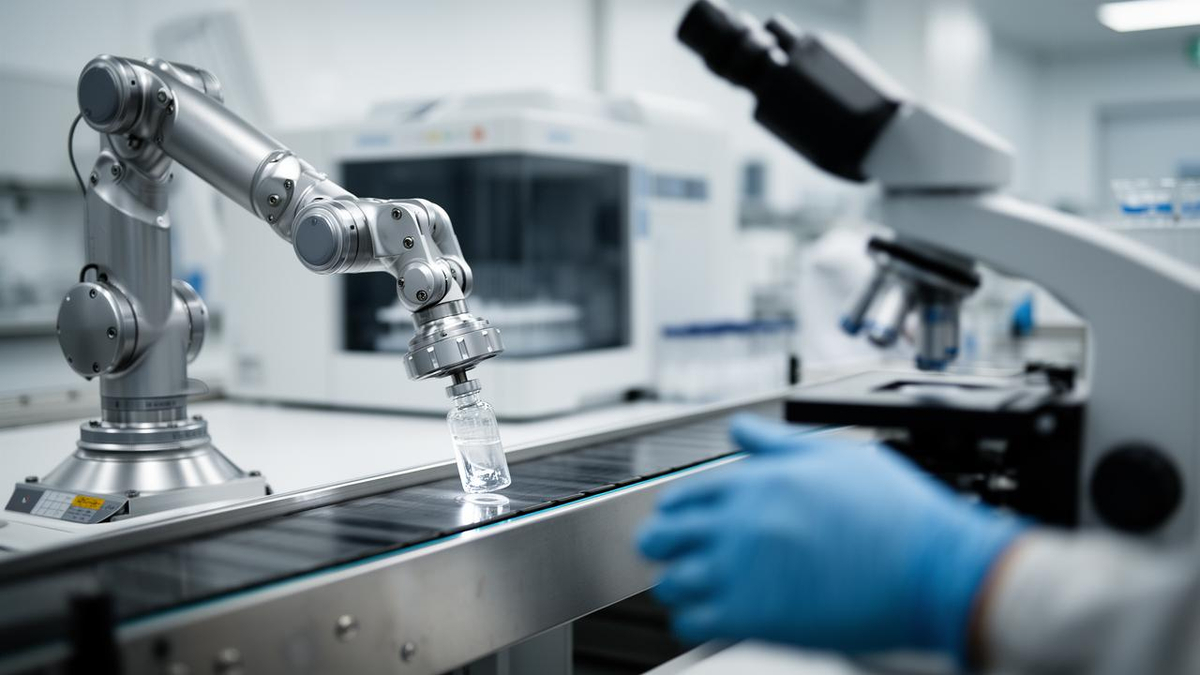
He offers an ideal test: if you could get one experimental verification per minute, AI4S would degenerate into a data-generation problem—the model could generate hypotheses infinitely, verify them in real time, and update in real time. On the physical-world side, two paths run in parallel: one is automated labs (AutoLab/Cloud Lab), handing standardized processes to robots; the other is improving the model’s own intelligence so that each physical experiment is more likely to hit, reducing reliance on wet-lab work. The concrete progress on the former is A-Lab, a collaboration between Google DeepMind, UC Berkeley, and Lawrence Berkeley National Laboratory: 353 experiments executed in 17 days, synthesizing 36 of 57 target materials. The latter demands stronger reasoning, plus memory and analysis of failure experiences.
OpenAI’s collaboration with Cambridge, Massachusetts-based robotics lab Ginkgo Bioworks—using GPT-5 to propose thousands of protein formulations and automatically execute experiments and collect data—is what Cao Yuan calls one of the “most convincing closed-loop experiments” to date. But the current bottleneck for automated labs lies in robotic manipulation precision and speed; by contrast, in silico simulation, because progress is easy to measure, is advancing far faster than the physical side.
Beyond verification, there is an even more hidden gap: causality. Causal modeling has a long history (Judea Pearl’s Do-Calculus), but Cao Yuan considers language models “unreliable”—their understanding of causality depends on input wording and word order, and training data only covers the most common phrasings. Change the wording or introduce a counterfactual intervention, and the model may fail. He agrees with Yann LeCun’s judgment: we need world models so that understanding is independent of linguistic representation. Cao Yuan also adds a frequently overlooked element in the loop: meta-recursion—the model must improve not only hypotheses but also the workflow itself, including when to update its own code and how to adjust the agent harness.
Even if the verification bottleneck is broken, a deeper problem remains. Nobel laureate and CRISPR scientist Jennifer Doudna, after using AI, found that none of the AI-generated proposals were things her team didn’t already know. Cao Yuan quotes her:
“We also use AI, but among the proposals AI gave us, none was something we didn’t already know.” —Cao Yuan quoting Jennifer Doudna
The reason lies in Cao Yuan’s earlier statement: “A language model’s entire universe is determined by its training data.” AI’s current “discoveries” are mostly recombinations within the existing knowledge space. Satisfying both “novelty” and “feasibility” simultaneously is an unsolved challenge in current model capabilities.

V. The Big Three’s Calculations and the Startup Window
The three major AI labs differ markedly in their AI4S investment strategies.
CompanyDepth of InvestmentRepresentative MovesStructural ConstraintsGoogle / DeepMindEarliest, deepest, broadestAlpha series, Co-Scientist, Isomorphic Labs, A-LabGemini must reach SOTA first; resources tilt toward near-term productsOpenAIAggressively catching upGPT-5 white paper, GPT-Rosalind, GPT-5 + Ginkgo closed-loop experiment, Astra math model, 2027 autonomous AI scientist goalProduct line too long; AI4S team merged into Codex, betting on general-purpose modelsAnthropicLate entrant catching upClaude Science platform, vibe physics, BioMysteryBench, poaching John JumperThe only one of the three without a vertical scientific model yet
OpenAI’s details are the most intriguing. The GPT-5 launch white paper already covered mathematics, computer science, and biology; GPT-Rosalind adapts GPT models to biological and chemical reasoning; the newly released Astra model claims to have solved 10 frontier math problems, though Cao Yuan notes the scientific community disputes its reliability. The more critical management variable: Kevin Weil, who originally led AI4S, departed around April–May 2026, after which AI4S was merged into the Codex team—effectively betting that “a general GPT model plus agents will naturally solve scientific problems.” Anthropic’s Claude Science launched less than a month ago; it essentially layers Claude with biological and chemical databases and tools, tailoring the interface to scientists’ workflows. The episode’s opening also mentioned that Anthropic’s unreleased research-grade Claude reportedly pushed the lower bound on zeroes related to the Riemann Hypothesis from 41.6% to 67.2%. With John Jumper on board, the outside world expects Anthropic to finally fill the missing piece of a vertical biomedical model.
But in Cao Yuan’s view, AI4S is not the top priority for any of the three right now: commercializing coding agents and going public is, and the rapid progress of Chinese open-source models is pressing Anthropic and OpenAI to move faster. This is precisely the startup window. AI coding company Cognition AI reportedly raising a new round at a valuation of up to $40 billion proves how crowded this already-proven track is. Big companies face the “innovator’s dilemma”—once a clear commercial path is carved out, it’s hard to immediately redirect resources toward long-term scientific investment; yet AI4S is a strategic direction no one dares to truly fall behind on. Jeff Dean’s Discovery Loop and Cao Yuan’s Unreasonable Labs AI are both trying to position themselves in this gap.
VI. AI and Mathematics: Proving Is Easy; Inventing Concepts Is Hard
Zooming into specific scientific domains, Cao Yuan names two AI mathematics startups—Axiom Math AI and Harmonic AI—with similar methodologies: language models first propose proof strategies, which are then automatically formalized into Lean (a formal proof language), with the compiler verifying correctness—once it compiles, the result is necessarily correct. This pipeline has three bottlenecks: the language model’s mathematical capability itself, the efficiency of automatic translation from natural language to Lean, and the coverage of mathlib, Lean’s mathematics library.
Whether Lean is necessary depends on the difficulty of the mathematics. International Mathematical Olympiad (IMO)-level problems can be proved in natural language, because they test construction and creativity, and the exam itself can be human-verified within two days. But Cao Yuan points out that Google’s IMO solver took three days just to convert natural-language proofs into Lean—exceeding the two-day time limit contestants have. For professional-mathematician-level proofs spanning hundreds of pages, natural language simply cannot guarantee correctness; Lean is the only trustworthy path. He cites a case: 2018 Fields Medalist Peter Scholze couldn’t be certain of the correctness of one of his own major proofs, and repeated discussions with collaborators yielded no conclusion. Eventually, the relevant theorems, definitions, and lemmas were all manually formalized into Lean—taking about one to two years, completed around 2025—and only on the day it compiled was the proof confirmed correct. “Even the most elite scientists, when dealing with extremely complex mathematical problems, still find it very hard to determine whether something is actually correct. You can only trust logic and computers.”
LevelProblem TypeInvestment Scale1PhD student practice problemsMonths2Standard journal levelOne to two years for a professional mathematician3Top-four math journal levelYears of sustained effort4Fields Medal level (e.g., Wang Hong’s 2026 solution of the Kakeya conjecture)Major breakthrough5Beyond Fields Medal levelMajor advances alone merit awards
What truly separates mathematicians from AI is “concept invention”: the concept of number, eigenvalues, Riemannian metrics—without these abstract definitions, derivation cannot even begin. Cao Yuan believes that if a problem doesn’t require creating new mathematical objects, then no matter how hard it is, it’s essentially a search problem; as long as the model is strong enough and the search intensity is high enough, a proof can theoretically always be found. “This is, I think, the most beautiful part of mathematics, and also the part that requires the most insight”—even “not necessarily a computable process.”
Terence Tao’s proposed era of “proof surplus” turns this question from theory into reality: across numerous websites, problems that humans have long failed to solve are now piled with dozens of AI-generated solutions, but no human expert is willing to take on the burden of verification. Cao Yuan’s response: a correct result does not equal a valuable one. “It only has partial meaning. Correctness of the result doesn’t mean it’s automatically right—you need to understand it, and then judge it.” He uses the analogy of a robot playing piano—even if the key pressure and timing are perfect, you know it’s a robot playing, and you don’t want to listen. A correct but boring proof (like the exhaustive enumeration of the Four Color Theorem) is useful at the tool level but contributes limited value at the level of mathematics itself.
This thread of discussion touches on an ancient debate in the philosophy of mathematics: is mathematics invented or discovered? Cao Yuan leans toward “invention,” grounded in Gödel’s incompleteness theorems: any sufficiently powerful formal system contains propositions that are “true but unprovable.” If the universe corresponded one-to-one with formal logic, that would imply the universe itself contains inconsistencies—which is hard to accept. “The universe is a thing-in-itself; it is an existent entity that doesn’t need to be described. Mathematics, as a logical system, has these irreconcilable contradictions precisely because it is a human-invented logical system.”
VII. AI and Physics: Stepping Outside the Logical World Is Where Discovery Truly Begins
Mathematics can live entirely within logical space; physics cannot. In Cao Yuan’s view, the most fundamental difference between AI for Physics and AI for Math is this: you must step outside the logical world and into the material world—you must verify. Current AI applications in physics include solving partial differential equations, deriving new conclusions from formal logic (such as Anthropic’s vibe physics), and building vertical world models for fluid dynamics like PhysicsX. But developing entirely new physical theories cannot bypass experimental verification.
The randomness of discovery makes this even more subtle. Host Chen Xi offered two examples: Newton being hit by an apple (more accurately, observing an apple fall, and only after long-term accumulated research), and the immunosuppressant cyclosporine, originally discovered as a fungus randomly found in Norwegian soil. Cao Yuan’s view: random events themselves don’t produce knowledge; what produces knowledge is “abductive reasoning”—inferring causes from phenomena, then generalizing the explanation to other phenomena. AI is currently best at deductive reasoning; abduction requires abstraction, imagination, and a world model—”this is something AI currently cannot do, and I think it won’t be able to do for a very long time.”
Does AlphaGo’s “divine move” (Move 37) against Lee Sedol count as a discovery? Cao Yuan’s answer: “It is also a discovery—it definitely is a discovery… but it doesn’t mean it created a new concept.” It was merely an uncommon winning-probability path that was sampled—a recombination within the existing representation space, involving no new concepts.
Frontier physics is already openly using AI. Chen Xi mentioned that string theory pioneer Edward Witten recently posted a paper on arXiv with a footnote stating that a certain passage was thought up by Claude. Cao Yuan believes such phenomena will only become more common. Faced with anxiety about “pure mathematics, art, philosophy—these useless beauties,” he responds with the concept of “the great use of the useless”: humanity’s best creations begin with curiosity and the pursuit of beauty. “It is actually useful too—it’s just that this usefulness is not something you can immediately perceive.”
VIII. Black Boxes, Symbolicism, and the Irreplaceable Human Element
Faced with the limitation that language models “can only recombine existing knowledge,” Cao Yuan’s own company, Unreasonable Labs AI, proposes a hybrid approach: “large language models + symbolic reasoning.” Symbolicism is AI’s early tradition—encoding prior knowledge as rules (If-Then, transitivity), precise but brittle; connectionism (neural networks) learns distributed representations from data, capable of handling ambiguity but opaque. His idea is to add a symbolic layer outside the language model: extracting the conceptual and inferential relationships between papers into a rule skeleton, providing the model with inspiration “outside its probability range.” The bottleneck lies in balancing novelty and feasibility—”making a model innovate is easy; the problem is that the idea must be feasible and reasonable.”
He predicts the final form is not a symbolicist revival but a hybrid of roughly 98% connectionism and 2% symbolicism. AI for math is already the template: neural networks generate proofs, and Lean—a purely symbolic system—handles verification.
The black-box problem directly relates to trust and economic cost. Cao Yuan acknowledges that if model outputs are not interpretable, it creates many problems: AI-written code, even when correct, is hard to maintain; engineers can’t understand it and can’t debug it, so only the AI can debug itself—but based on random sampling, the second generation of code may be completely different. This uncertainty destroys trust. If AI truly takes on 80% of economic activity and every output requires human verification, the overall economic cost actually rises. “If the results are not fully interpretable, this will cause many difficulties.” Therefore, humans will not exit the loop for the foreseeable future.
He extends this discussion into the history of philosophy: Plato’s world of Forms corresponds to humans conceiving of a perfect circle despite never having seen one; empiricism (the mind as a blank slate, input determining everything) corresponds to today’s trillion-token-trained large models; rationalism and Kant’s twelve categories correspond to prior structures; Hegel’s dialectics corresponds to continual learning. Cao Yuan’s conclusion: discussions in AI and classical epistemology are fundamentally the same thing, just in different language. Cao Yuan defines AI as a “meta-technology”: if a model can excel at the hardest scientific problems, it can certainly do better in other economic activities—OpenAI and Microsoft’s definition of AGI is precisely “what percentage of economically valuable human work can be completed at what accuracy.” And humanity’s irreplaceability lies in his final summary: defining problems, verifying results, making value judgments, and holding the ultimate adjudication power. The end of this long road, as Cao Yuan defines it:
“The process of conceptual abstraction—I think that may be the last mile of AGI.” —Cao Yuan
For investors, the AI4S story needs to be split into two timelines. What’s commercially viable in the near term is the intermediate outputs: biopharma targets, molecular structures, accelerated experimental workflows—value supported by the market size itself, independent of the AI narrative. The medium-term variable is the unit cost of automated labs and verification speed—Cao Yuan’s milestones are causal reasoning, cross-experiment long-term memory, and continual learning, capabilities that “may already take five or six years.” The long-term ceiling is even more distant: if the standard is “AI autonomously making Nobel-caliber discoveries” (AlphaFold doesn’t count, since it wasn’t an autonomous AI discovery), Chen Xi judges it will take “at least two to three decades,” and Cao Yuan doesn’t disagree. Until then, AI4S is more like an exponentially amplified assistant than an independent scientist. Signals worth tracking include Discovery Loop’s first product direction, whether John Jumper can catalyze a vertical biological model at Anthropic, whether OpenAI resets a dedicated AI4S lead after the Codex merger, and whether “proof surplus” spawns a new market for Lean-based formal verification. The slow side is where AI4S’s true value will ultimately be determined.