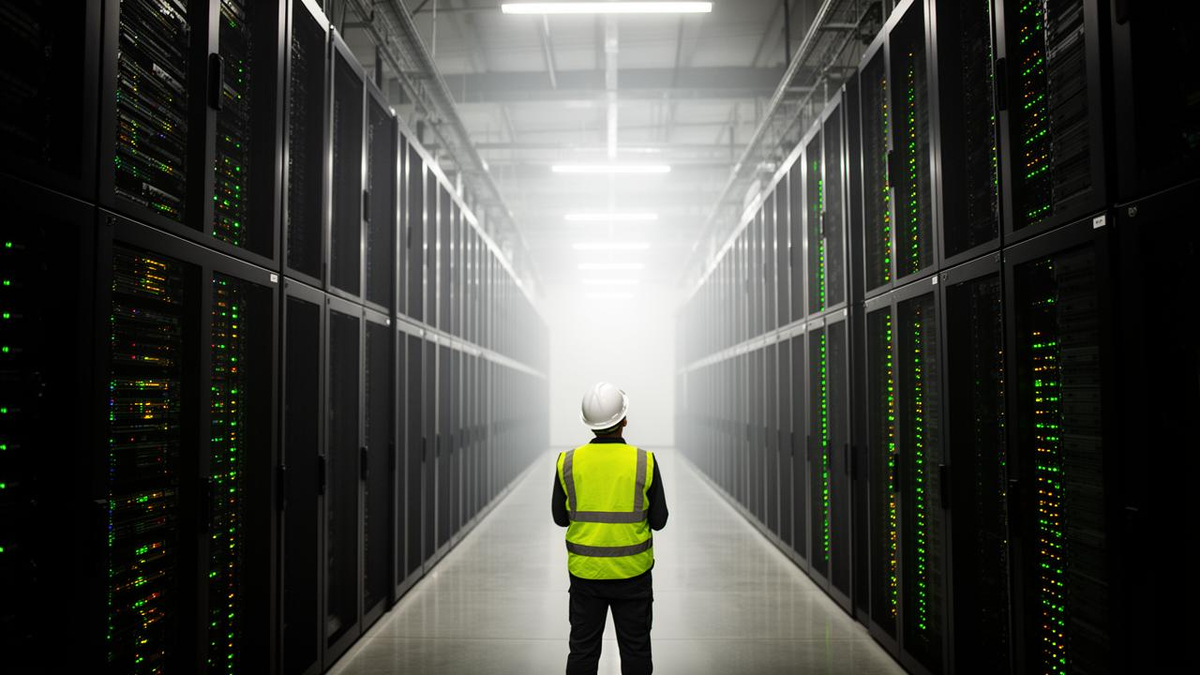
“It’s like walking into a supermarket. If they didn’t have any food but cans of sardines, you would immediately love cans of sardines.”
Contracts that used to run two to three years now run six to nine years, he noted, because every new chip generation sells out instantly and the installed base can’t be replaced when demand outstrips supply. Morgan Stanley’s own thematic strategist, Michelle Weaver, offered a similar warning this month on Bloomberg Television: the market is “dramatically undersupplied,” and power, political and labor bottlenecks will keep compute scarce “for the next several years.” CoreWeave’s latest earnings only amplified the signal — revenue doubled year over year and the stock posted triple-digit gains as the company signaled demand isn’t slowing.
The money is following the scarcity in ways that were unthinkable two years ago:
| Capital channel | Commitment |
|—|—|
| Apollo, BlackRock, Blackstone, Brookfield, Goldman Sachs, KKR | Joint platforms to mobilize **$500B+** of third-party capital for AI compute infrastructure |
| Morgan Stanley | Facilitating a **$1.5 trillion** infrastructure initiative |
| Alphabet | Raised **$25 billion** in the past week |
| Intel | **$15 billion** equity offering, upsized to **$20 billion** ; stock closed above the issue price despite being worth under $100 billion a year ago |
| Google | ~ **$200 billion** capex to compute infrastructure this year |
| China | Exempted data-center bonds from key securitization rules, easing asset-backed security issuance |
“Nobody wants to use their balance sheet anymore,” Visser said. Third-party capital is funding the buildout — and that creates a circularity worth understanding. NVIDIA does much of the lending so frontier labs can buy NVIDIA chips. Data-center operators use third-party money to order more chips. And the labs overpay to secure supply.
Frontier labs are willing to pay four to five times market pricing for large-scale compute because securing it gives them a competitive advantage rivals can’t match, according to tech investor Brad Gerstner’s conversation with NVIDIA CFO Colette Kress, which Visser cited. Buyers are concentrated among those with revenue to deploy.
As for the data-center delays making headlines, Visser is dismissive: they’re already priced into how the industry operates. Memory chips remain the binding constraint, and “the delays are actually good” — they push committed revenue further out and prevent over-deployment before capacity exists.

### Google picks the landlord business
The clearest example of Visser’s thesis is playing out in plain sight at Google. The company’s recent reorganization, he argued, is not a retreat from AI — it’s a capital-allocation shift. The framing came from the All-In podcast’s “AI brain drain” episode and conversations on Moonshots, and Visser endorses it fully:
> “Those who can’t compete on the frontier models go towards compute.”
He credits that line to Alex of Moonshots, an explanation for why Meta, xAI and Google all moved toward compute infrastructure. David Sacks’s blunt take — that frontier AI is now a two-horse race between OpenAI and Anthropic, and “AI infrastructure may be the cleaner business than model development” — sets up the arithmetic. Google will spend roughly $200 billion this year on compute infrastructure that earns a documented 30% return on invested capital, is tax-advantaged through accelerated depreciation, and faces near-certain demand because the entire industry is starving for capacity. Model development, by contrast, burns tens of billions with “high variance and no guaranteed return.”
Under that math, Google’s pivot looks like an engineered endgame: the giant becomes a capital allocator and infrastructure landlord to a swarm of mission-driven startups it partly owns. Visser’s warning to holdouts:
> “Companies that fight this, trying to retain everything internally, will lose the talent and keep the costs.”
The talent question is where it gets uncomfortable. Demis Hassabis, the executive behind Google’s AI research, reportedly wants out and is staying only for now — Visser predicts he’ll be gone within a year. Jeff Dean’s name circulates alongside his. An MIT builder named Kush told Moonshots that for his cohort and younger engineers, “Google is no longer the dream destination” — that honor now belongs to OpenAI, Anthropic, xAI and the other frontier labs. The spiritual center of AI, Visser concluded, has moved elsewhere.
That’s the crux for the stock:
> “If talent’s leaving, multiples compress. Plain and simple.”
And yet the bull case survives, because losing the prestige race doesn’t mean losing the profit race:
> “They may lose the model prestige race and still make a lot of money from AI infrastructure. They may become the Saudi Arabia OPEC of compute.”
The parallel is a fitting one: Google would own the scarce physical layer while others fight over what it powers. The stock’s multiple now hinges on which of those two futures the market decides to believe — infrastructure landlord or faded innovator. It’s the same decision Meta and Elon Musk’s xAI made earlier, when investors grew angry about negative free cash flow and those companies chose to sell some of the compute they couldn’t fully use.
### The gigawatts are going to orbit
SpaceX’s first earnings call delivered what Visser called the “Elon shocked the world again” moment: six to eight gigawatts of incremental data-center capacity in 2027 alone, possibly above ten. Visser’s own analysis puts SpaceX on track for about ten gigawatts by the end of 2027 — “sounds impossible, but we believe it.”
The details matter. Roughly 80% of that buildout’s output is earmarked for space-based data centers. SpaceX has gone exclusive with NVIDIA, putting Vera Rubin GPUs in orbit — Musk’s stated reason: “the Vera Rubin architecture is the best architecture.” The project, which Visser calls Terra, is Star-Trek-scale in both land and power requirements. And Musk has “already proved that he can build data centers faster than anyone.”
For investors, Visser’s read is that SpaceX itself is the durable asset, while Terra is a call option on incremental gigawatts. The deeper point is directional: the largest and fastest builder on the planet is doubling down on compute because he sees the same insatiability curve — which is why Visser’s AI portfolio stays long the “receivers of capital,” the infrastructure owners, rather than just the model labs.
### Agents don’t sleep, so the data lies
The most conceptually aggressive part of Visser’s argument is that AI agents have changed the unit of economic time. “Year-over-year for anything now is a human thing,” he said. Agents don’t take weekends or coffee breaks:
> “Agents don’t sleep. Agents don’t go to the bathroom. Agents don’t go to lunch. Agents don’t go to the pantry to flirt.”
The result is that the economy is effectively doing two years of work per calendar year, heading toward three, four and five. He maps out the sequence: this year the agentic economy opens; enterprise agents become “persistent digital labor” next year; consumer agents — the Jarvis layer that books travel, orders goods and executes purchases while humans sleep — arrive in late 2027. He cited Cloudflare’s forecast, amplified by Musk, that agent traffic will dwarf human internet usage:
> “Humans will be a rounding error on the internet. Bot traffic will exceed human traffic by a factor of 1,000 within five years.”
This time compression explains what Visser calls the central economic paradox of the moment. S&P 500 earnings are growing roughly 30% year over year, with sales up 15% and global earnings per share running near 47% — yet companies aren’t hiring. Historically, that kind of growth triggered a hiring wave. Now it triggers productivity: job losses are showing up first outside healthcare and consumer leisure, the two sectors that, in his words, “can’t be replaced by AI.” His conclusion: this is not a bubble signal. It’s a productivity boom arriving through AI-native businesses and startups forming at record rates.
### A Fed reading a broken dashboard
That compression is why Visser, in his new paper “The Academic Fed: A Secular Regime Shift,” argues the central bank is reading instruments that no longer describe the economy. On labor, his composite of aggregate weekly payrolls — hours, wages and hires combined — is at its weakest six-month rate of change since December 2012, fourteen years ago. The Atlanta Fed’s wage tracker sits at its pre-2020 level. Hourly earnings growth has dropped to 3.2%. Participation keeps falling.
> “If the mandate is labor and inflation, I don’t see why the Fed should be raising rates — especially not three times.”
That last clause was aimed directly at Bank of America’s post-CPI call for three 2026 hikes. On inflation, Visser argues the Fed’s preferred gauge is the outlier. Every alternative measure clusters below it:
| Inflation gauge | Reading |
|—|—|
| Core PCE | The single elevated reading in the set |
| Atlanta Fed sticky core CPI | 2.5% |
| Core CPI | 2.6% |
| Dallas Fed trimmed-mean | 2.2% (2.4% after methodology change) |
| Cleveland Fed | 2.7% |
| Inflation swaps vs core CPI | Lower |
From 1990 to 2020, those alternative measures stayed *above* core PCE. The inversion is recent, and “something has changed in this calculation.” He tied it to a Bill Dudley-sourced report that Fed Chair Kevin Warsh’s task force could jettison PCE as the primary inflation metric as soon as January. His response: “Kevin, if you want me to work on the Fed, give me a call.”
Markets have begun to move. The odds of a September Fed hike fell to 31%, and Bank of Japan pricing sits at 80%, both down from roughly 50/50 before the payrolls report. Two-year Treasury yields broke below their 50-day moving average after one of the longest stretches above it in a decade. But long-term yields won’t rally — “we had inflation surprising to the downside, retail sales missed, the jobs number missed, and long-term yields are just not coming down.”
The dollar-yen intervention week was, in his telling, a “situational awareness” week in which Warsh “basically lost credibility according to people.” Treasury’s Scott Bessent “didn’t create this problem”; the real issue is that “they’re not getting the receipts and they’re spending their way out.”
That’s the setup for what Visser calls the debasement trade: gold, silver and Bitcoin. It hasn’t fully arrived — gold and silver have moved and the dollar sits at new lows, but Bitcoin is “still sitting there… Eventually it will.” The supporting evidence is accumulating: China added 20 tons of gold in July 2026, its largest monthly purchase since October 2023, and the Bank of Korea resumed gold investment after a 13-year pause. The intellectual capstone came from Louis Gave of Gavekal Research, who argued that AI and stablecoins “could reshape rather than simply destroy dollar dominance” — a “compute dollar” potentially replacing the petrodollar. In Visser’s own words, computers are “evolving into an industrial resource, a geopolitical asset and potentially a pillar of the monetary system.”
The core critique is about how different minds approach the same data:
> “Academics ask, ‘When does the evidence tell us this has happened under comparable conditions?’ Markets ask, ‘What’s going to happen before everyone else realizes it?’ Entrepreneurs ask, ‘What becomes possible now that wasn’t possible before?'”
### The next bottleneck is financial rails
Visser’s highest-conviction forward call is that the next constraint is not silicon or electricity — it’s plumbing.
> “Next year is about consumer agents and what they need, which is the financial guardrails, which is where crypto shows in.”
When consumer agents arrive in force in 2027, they’ll need to pay for things. Settlement, stablecoins and tokenization — turning financial assets into digital records on common rails — are the missing layer. The constraint, starting in September when he shifts his research cycle to the 2027 outlook, is “not physical, it’s financial.”
He isn’t waiting for that shift to become obvious. Figure, the fintech he discusses with Anthony Pompliano, reported consumer loan marketplace volume of $4.3 billion, up 132% year over year, with its tokenized on-chain marketplace Figure Connect expected to approach 70% of volume. Its stated mission: “We are building the modern capital marketplace amidst the paradigm shift in the capital markets towards tokenization and standardization” — which Visser reads as confirmation, not aspiration.
Regulators are moving too. A US bank regulator has opened national charters to Bitcoin and crypto firms, and the SEC is “about to cook while Congress is stuck arguing over the Clarity Act.” Stablecoin card spending volume jumped another 16% — “you want to do an ARR on that?” he quipped, referencing the annualized-revenue-run-rate metric startups live by. He has built a crypto ecosystem index spanning ten verticals with four to five names each, roughly 45 names in total, all correlated with and currently outperforming Bitcoin. His framing: “Bitcoin is a representation of the S&P 500 of the future.” For registered investment advisers, the message is that client portfolios will migrate onto these rails whether or not the Clarity Act passes — “mark my words — you guys can reach out in a year when I’m wrong.”

### Staying long without pretending tops don’t exist
The final section of Visser’s argument is a demonstration rather than a claim. Each week he assigns his risk posture a red, yellow or green dot, and he overlays that tactical signal on his AI thematic portfolios to show how to stay structurally long while de-risking when the setup deteriorates. His disclosed 2026 results:
| Portfolio | YTD return (2026) |
|—|—|
| NASDAQ | +20% |
| 100-name AI thematic | +46% |
| 25-name | +74% |
| 10-name | +94% (equal-weight average +103%; median +65%) |
The ten-name portfolio deserves a closer look. The best name is up 249%; the worst — NVIDIA — is up 16.5% and still beats the S&P 500 by roughly 13 points. Eight of ten are up over 40%. And valuation isn’t the constraint: the average forward price-to-earnings-growth ratio is 0.8 (median 0.81), the median 2027 earnings growth forecast is 40%, and seven of ten names have expected growth above 30%.
The discipline behind those numbers is a documented call sequence through this summer’s painful consolidation. On May 17 he said, “I’ve been scaling out of things. I’m effectively out of everything. Definitely out of all Micron.” He flagged the “AI midcycle slowdown” on June 8, published a consolidation playbook and was “combing through the rubble” by late July, then turned net positive only when Micron broke below $90.
> “I don’t try to pick tops and bottoms — nobody can do that, certainly not me. I want to reduce risk [when risk-reward is poor], then add back after enough panic.”
The market has since retraced more than half of its drawdown. To make the framework auditable, he published a prompt that analyzes his own chronological transcripts — measuring how his long-term conviction, short-term outlook and risk appetite shift across episodes — so subscribers can watch the stance drift in real time rather than take his word for it. His site, visserlabs.com, was built with AI in one hour and scored 100 out of 100 on Network Solutions’ checker: “If you use AI and you use it properly… you can build stuff like that.”
The methodological point aimed at the research establishment is that Wall Street’s vertical silo structure “is the structure that makes it slow at a cross-sector regime change. Those are the same property viewed from two directions.” And he reserves his sharpest criticism for the deterministic bears — Michael Burry and Jim Chanos among them — who never change their minds, never admit error and always speak in certainties. As Visser put it: “there’s no ‘it’s a 70% chance.'”
Four threads from the conversation are worth tracking from here. Jackson Hole in late August is the first test: Warsh’s speech and any movement on the PCE task force will show whether the “academic Fed” is serious about changing its dashboard, and the 31% September hike probability against a softening labor market makes it live. Second, the flow of talent into frontier labs is now a leading indicator for hyperscaler multiples — if Hassabis or Jeff Dean actually walks out of Google, Visser’s “multiples compress” line gets tested immediately. Third, the compute financing flywheel deserves scrutiny for circularity risk: NVIDIA vendor lending plus $500 billion of third-party capital chasing the same gigawatts means the CoreWeave-style six-to-nine-year contracts are the collateral, and they’re only as good as the frontier labs’ revenue durability. Fourth, watch Bitcoin’s lag inside the debasement trade — gold and silver have already repriced, the dollar is at new lows, and if Bitcoin catches up, the tokenization thesis becomes the dominant 2027 narrative. The through-line of the entire argument is that the market underprices continuity: compute demand compounds, agents compress time, and the constraint keeps moving — from chips to memory to financial infrastructure — while the analytical frameworks of the sell-side and the Fed keep looking backward.]]>