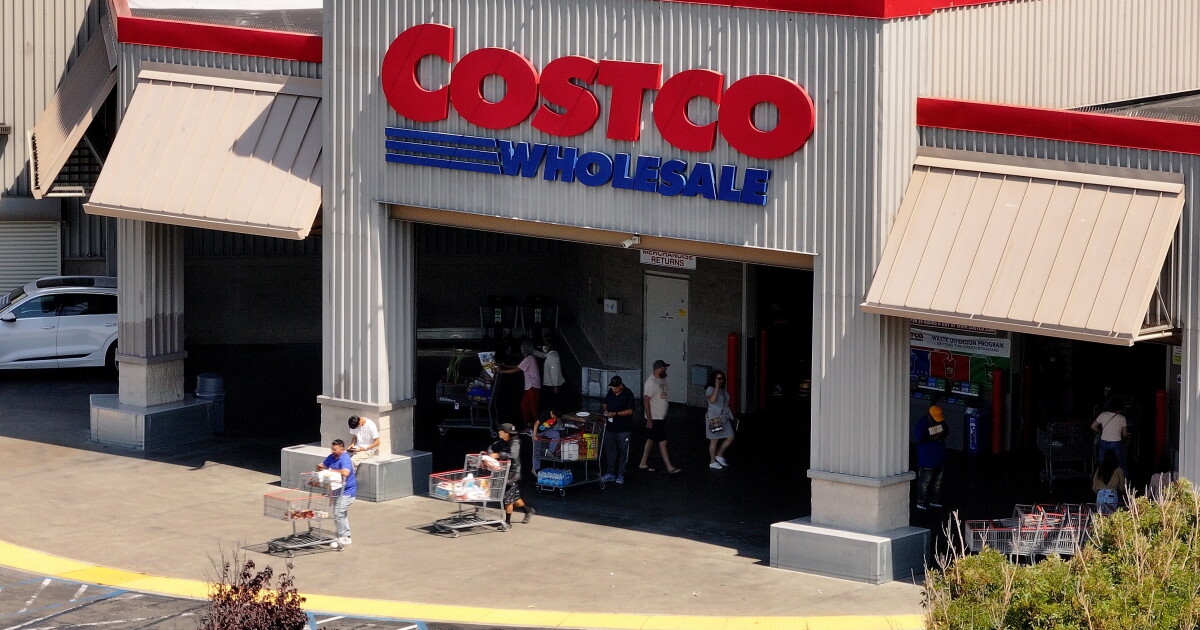
Today’s show: AirTalk host Larry Mantle discusses Costco Medicare plans, ChatGPT for teens, the Diablo Canyon plant and California’s nuclear energy future, the FCC’s history and workplace dress codes.
Have a question or comment about a segment? Want to pitch us a story?
Fill out the form below, and please include an email address so we’re able to follow up if necessary! We’re not able to respond to every inquiry, but all submissions are read and reviewed by our production team.
Costco to sell Medicare Plans — what will that look like?
The topic:
Costco has announced a plan to offer Medicare plans in a limited capacity, starting with Medicare Advantage plans and a Medicare supplement in select areas.
Keep up with LAist.
If you’re enjoying this article, you’ll love our daily newsletter, The LA Report. Each weekday, catch up on the 5 most pressing stories to start your morning in 3 minutes or less.
The latest: Costco is partnering with SCAN, a Long Beach-based nonprofit, for these plans. The exact locations that these first few plans will be offered has not been disclosed, but Southern California is a key market for SCAN, according to the Wall Street Journal.
Background: Prior to its foray into healthcare, the warehouse chain has tangentially been involved in the space via its pharmacies. Costco opened its pharmacy branches back in 1986. Its other health-related ventures include optometry services, GLP-1 medication dispensing and hearing aids.
Guest:
Brandy Lipton, associate professor of health, society and behavior at UC Irvine
This week in AI: OpenAI launches ChatGPT for teens

OpenAI launches ChatGPT for teens, a safer AI version for teenagers.
(
Michael Dwyer
/
Associated Press
)
The topic:
On Tuesday, OpenAI announced its global launch of ChatGPT for Teens, a designated version of the company’s AI chatbot for users under 18. This version will include guardrails such as limits on conversations that involve violence, self-harm, and eating disorders.
Why now? The announcement comes as OpenAI and social media companies including Meta have faced numerous lawsuits alleging that these emerging technologies are harmful to children.
How it works: Users are opted in to ChatGPT for Teens if they self-identify their age between 13 and 17, or if ChatGPT assumes the user is under 18 based on certain signifiers. Parents can set “Quiet Hours” and set up notifications if their teen is engaging with sensitive topics.
Guests:
Allison Mishkin, head of child development at OpenAIThao Ha, developmental psychologist and director of the Healthy Experiences Across Relationships and Transitions Lab, known as the HEART Lab, at Arizona State University
The fate of Diablo Canyon Plant and California’s nuclear power

The Diablo Canyon Power Plant in San Luis Obispo on Feb. 13, the state’s only active nuclear power plant.
The topic:
California’s last nuclear plant, Diablo Canyon, has been at the forefront of the state’s plans for a complete overhaul of its nuclear energy. But after plans to close the plant last year were postponed to a new date in 2030, a growing number of environmental stakeholders are pushing for the plant to remain open as part of California’s renewable energy future.
Background: A decade ago, the plant’s operator, Pacific Gas & Electric, agreed to shut down Diablo’s reactors in 2025. That changed when state officials, including Gov. Gavin Newsom, determined they were not ready to shut down an energy source that consistently provides up to 9% of California’s electricity. They extended its life to 2030.
Environmental concerns: Despite the massive electricity dependent future California faces, opponents of the plant, many of whom live in the area, say that extending the plant’s life means more years of nuclear waste and seismic risk as it gets older and more brittle.
Guests:
David G. Victor, distinguished professor of innovation and public policy at UC San DiegoDiana Gragg, managing director of the Explore Energy Program at Stanford University’s Precourt Institute for Energy; she has a doctorate in civil and environmental engineering
The history of the FCC

FCC Chairman Brendan Carr testifies before the House Appropriations Subcommittee on Financial Services and General Government on May 21 in Washington, DC.
(
John McDonnell
/
Getty Images
)
The topic:
Over the course of the agency’s existence, the Federal Communications Commission has served as a regulatory body for television and radio broadcasts. Although it does seek to uphold some consistent values, its influence on broadcast policy can change over each presidential administration. Today on AirTalk, we’ll dig into how that’s currently on display, and how it fits into the larger picture of FCC history.
Lawsuit: ABC is suing the FCC, saying the agency’s demand for an early review of its broadcast licenses serves as an “existential” threat to the network, as well as violating the broadcaster’s First Amendment rights. This follows FCC Chairman Brendan Carr standing by the agency’s actions against ABC.
FCC deregulates broadcast ownership: Earlier this month, the commission ended a more than 20-year-old limit on TV broadcast, capping a television broadcast owner’s reach at 39%. This theoretically could allow for more mergers and limit competition.
Guests:
Tom Wheeler, visiting fellow in Governance Studies at Brookings and former chairman of the Federal Communications Commission (FCC) from 2013 to 2017 (appointed by Barack Obama)Sanford Williams, lecturer in law at UCLA; he previously worked in the FCC from 1999-2025, including as the Deputy Chief of Staff for FCC Chairwoman Jessica Rosenworcel
What are the unwritten rules of workplace dress codes?

How do you dress in your workplace?
The topic:
Post-pandemic workplaces have led to many workplaces loosening their dress codes — letting folks wear more casual attire or just not enforcing rules. So with that in mind, what’s the current threshold for what’s appropriate work attire? Are hats allowed? Can you wear shorts? Today on AirTalk, we pose the questions to listeners on what their workplaces are doing.
Wall Street Journal asks its readers: Earlier this month, the publication shared a short questionnaire with its readers, asking them what they viewed as acceptable.
Join the conversation: What does your workplace’s dress code look like? Personally, are there any unspoken guidelines you set for yourself with work attire? Share your thoughts by calling (866) 893-5722 or emailing atcomments@laist.com.
Guest:
Payton Seda, AirTalk associate producer