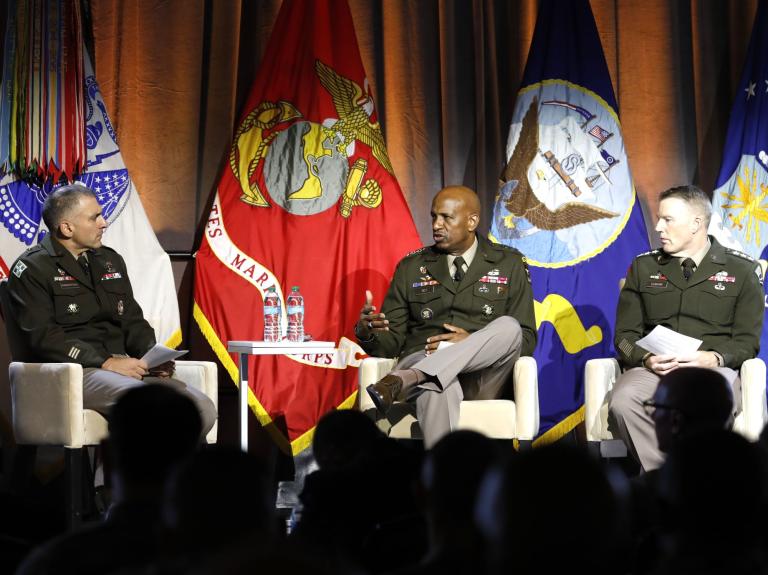
The U.S. Army has four main pillars when it comes to agentic artificial intelligence (AI): speed, scale, innovation and integration. The branch integrates agentic AI “pretty well,” and with the help of industry, leaders innovate with agentic AI every day. However, the branch encounters challenges concerning speed and scale due to the presence of risk, said Lt. Gen. Christopher Eubank, commanding general of the U.S. Army Cyber Command (ARCYBER), during a panel at TechNet Augusta 2026.
To confront the innate battle between speed, scale and risk, ARCYBER leaders announced they have established a new special unit called Task Force Lexington. Eubank described this group as one that focuses on every facet of AI, from simple staff processes to agentics getting after hunting the U.S. Department of War Information Network.
“I have a soon-to-be O-6 who leads a band of about 10 high-speed folks inside of ARCYBER that do all things AI for the command, so that group is charged with developing the agent, developing the harnesses and training the agents,” Eubank said. “Every agent we create is trained in a work role inside of the cyber force, so there’s no rogue things going on here.”
Eubank further explained that Task Force Lexington members have created a plethora of different work roles for agentic AI, such as developing, data engineering, host analyzing and exploitation analyzing. The special unit is also responsible for training the agentic AI to fit its assigned role. The training will have the same standards as the training that humans receive in this space, Eubank ensured.
During the panel, he illustrated what the process looks like. “Agents have a work role, their job qualification record. They get trained,” Eubank said. “They get set on a mission with a human watching. They deliver results. When they make a mistake, they get taught the way to do it, and it goes back in and retrains itself.”