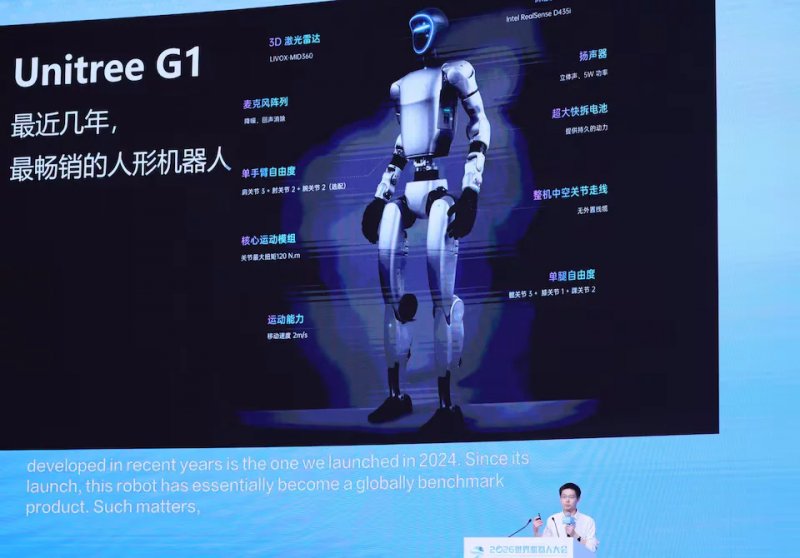
The robotics industry is moving closer to a potential “ChatGPT moment” in which robots could perform a wide range of real-world tasks using simple voice or text commands, according to the CEO of Chinese humanoid robot maker Unitree.
Wang Xingxing, founder and CEO of the Hangzhou-based company, said Thursday that advances in embodied artificial intelligence could eventually allow robots to operate successfully in unfamiliar environments without specialized training, Reuters reported.
“We are marching towards a ‘ChatGPT moment’ in embodied intelligence,” Wang said at the 2026 World Robot Conference in Beijing.
The emergence of ChatGPT in late 2022 triggered widespread adoption of generative AI and transformed expectations for what AI systems could accomplish. The robotics industry has yet to experience a comparable breakthrough in physical AI, particularly in the development of “world models” that enable machines to understand and navigate real-world environments.
Wang said Unitree hopes robots will eventually be capable of entering unfamiliar homes and completing about 80% of household tasks based on voice or text instructions.
He described such a development as a potential tipping point that could trigger rapid growth across the robotics industry.
However, Wang cautioned that the technology is not yet at that stage. In an optimistic scenario, he said, a major breakthrough in robot software could arrive within two to three years, while the timeline could extend to five to 10 years.
“Relative to the mood around World Robot Conference and Unitree’s spectacular IPO, Wang Xingxing was notably sober about current capabilities,” said Georg Stieler, head of automation at robotics consultancy Stieler.
Unitree is the world’s largest producer of robot dogs and the second-largest humanoid robot maker by shipments, according to industry data. The company gained international attention through demonstrations featuring robots dancing and performing kung-fu before increasingly moving toward industrial applications.
Unitree’s IPO prospectus shows that universities and research institutions make up most of its customers.
Wang He, founder of Chinese robotics startup Galbot, expects the industry’s “ChatGPT moment” to arrive by 2028. He defines that milestone as the point when robots could perform roughly 70% to 80% of everyday tasks without specialized training.
“With continued accumulation of data and further technological breakthroughs, we expect to reach the ‘ChatGPT moment’ for embodied intelligence by 2028,” he said.
Unitree is investing heavily in world models, with Wang saying the company’s largest current allocation of capital and personnel is focused on the technology.
He acknowledged that physical AI remains behind expectations in real-world applications and said the AI models controlling robots’ decision-making and interactions remain one of the industry’s biggest bottlenecks.
Despite those challenges, Wang expects humanoid robots to enter a decade of rapid autonomous development as advances in AI accelerate.
China is already seeking to establish a dominant position in the global humanoid robot market. A Chinese humanoid industry body said Thursday that more than 40,000 humanoid robots were delivered in China during the first half of the year, accounting for 97% of global shipments.
Beijing sees robotics as a potential way to address labor shortages and an aging population by automating repetitive, low-value and dangerous work.
Humanoid robots are gradually appearing on factory floors and in logistics warehouses, although they remain less efficient than human workers in most applications.
The technology has also emerged as a new front in the broader US-China technology rivalry. Last month, the US Federal Communications Commission banned future imports of foreign-made humanoid and quadruped robots, citing national security concerns.
Several robotics companies attending the Beijing conference told Reuters they were looking to expand into international markets, signaling that competition over the next generation of AI-powered machines is likely to intensify.