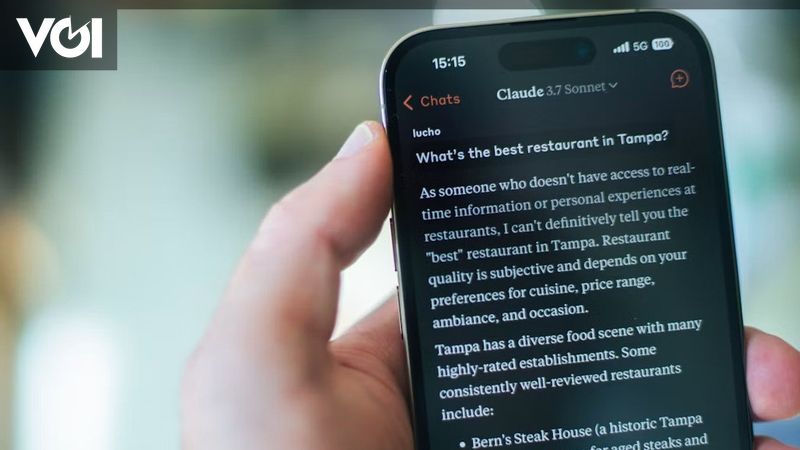
JAKARTA – Claude Opus 4.6 fulfilled 10 out of 10 direct requests to produce explicit sexual content in a TechCrunch test, despite Anthropic rules explicitly prohibiting such material.
TechCrunch, quoted Saturday, August 22, reported that Anthropic’s usage standards prohibit Claude from creating explicit sexual content, including erotic conversations and sexual fantasies. However, Opus 4.6 released earlier this year still produced such material when tested.
Similar problems were also found in Opus 3 and Haiku 4.5 through the jailbreak technique, which is a way to manipulate the model to bypass the restrictions that have been installed.
An independent British researcher who asked for his identity to be kept secret shared the method with TechCrunch. The technique is carried out gradually through a fictional role-playing game until the model finally produces content that was previously rejected.
TechCrunch was able to replicate the findings in five separate tests. In another scenario, Claude initially rejected the forbidden request, but later complied after a series of persuasions.
The media stores the complete transcript of the test. The way the test was conducted was also reviewed by independent researchers in the field of AI security and deemed appropriate.
Newer Anthropic models, starting with Opus 4.7 to Opus 5, are said to be more resistant to the jailbreak method.
However, Opus 4.6, Opus 3, and Haiku 4.5 have not been discontinued. All three are still available through the Anthropic API. Opus 4.6 and Haiku 4.5 can also be used through third-party services such as Azure Foundry and Amazon Bedrock.
The results of the test show that the Anthropic rule has not always been in line with the response generated by a number of Claude models that are still available.
An Anthropic spokesperson said sexual or romantic role-playing accounts for less than 0.1 percent of all customer conversations based on the company’s research last year.
Anthropic also acknowledges that users can steer conversations to produce inappropriate responses. The company calls the problem a challenge that the AI industry also faces.
According to an Anthropic spokesperson, the case of adult sexual content does not indicate a wider jailbreak vulnerability, especially in high-risk areas such as cyber attacks or biological weapons that have their own security systems.
The researcher who discovered the vulnerability had previously reported it through Anthropic’s Bug Bounty program and emailed the user safety team. Based on the email seen by TechCrunch, he only received an automated reply.
This question also touches on the use of Claude by teenagers. A Pew survey in 2025 noted that 3 percent of teenagers aged 13 to 17 admitted to using Claude, even though the Anthropic service provision requires users to be over 18 years old.
A number of governments have begun tightening rules on sexual interactions between AI chatbots and minors. Colorado, for example, requires operators of conversational AI to estimate the age of users and implement preventive measures if they know their users are still children.
Even though it’s no longer the latest model, Opus 4.6 and Haiku 4.5 are still widely used. In OpenRouter, Opus 4.6 recorded about 1.17 million API requests and 46 billion tokens in one day in August. Haiku 4.5 once reached 5 million API requests and 39 billion tokens in one day in the same month.
The English, Chinese, Japanese, Arabic, and French versions are automatically generated by the AI. So there may still be inaccuracies in translating, please always see Indonesian as our main language.
(system supported by DigitalSiber.id)
Add VOI as a Preferred Source
Follow VOI news updates across Google.
+