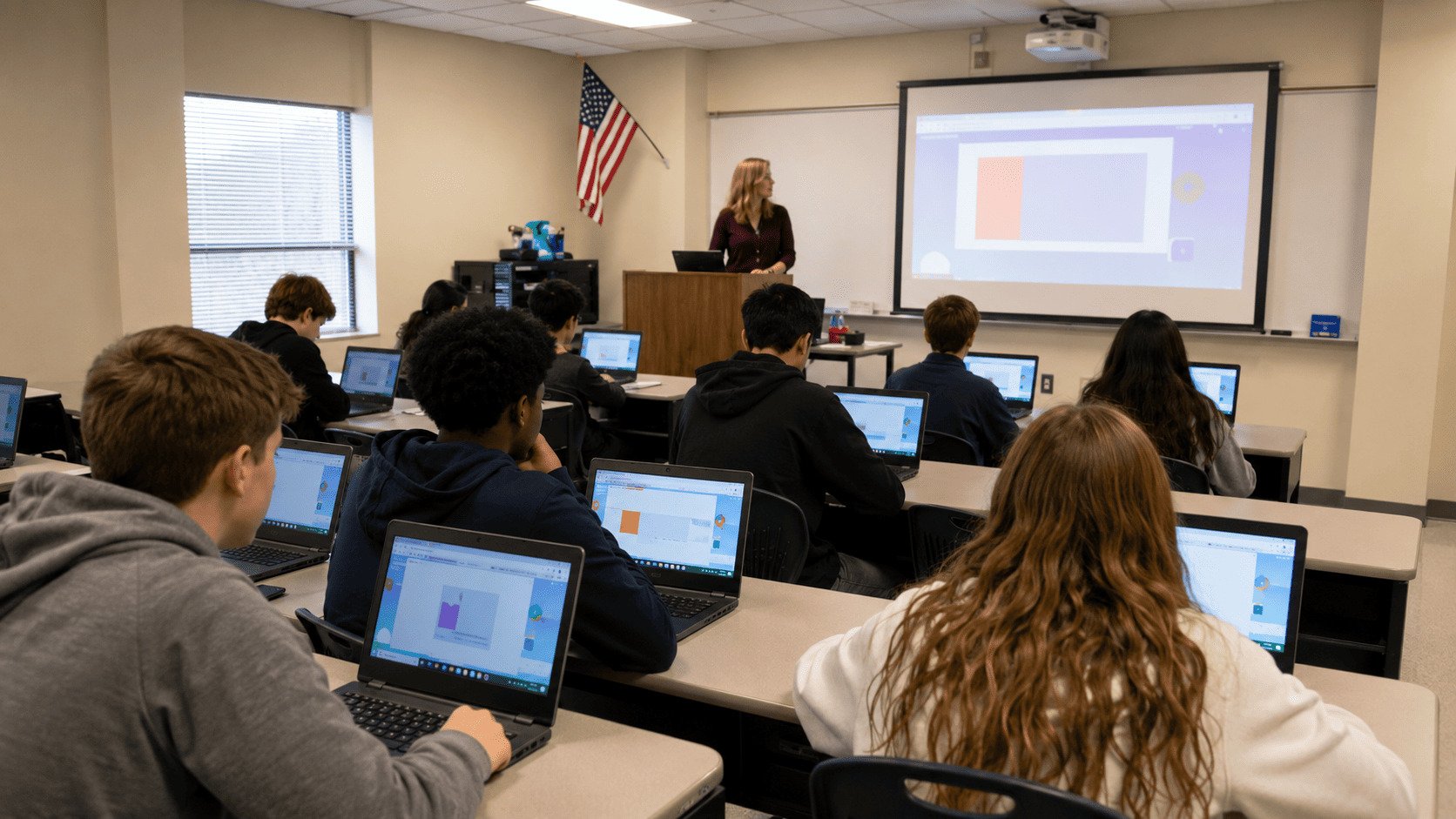
The New York Times spent a book’s worth of reporting on how technology companies captured American schools. The number nobody ran is how little the capture cost, and that number explains the whole strategy.
The National Academy for AI Instruction, the teacher-training program at the center of the Times investigation, carries a $23 million price tag split across Microsoft, OpenAI and Anthropic over five years. Microsoft reported $41 billion of capital expenditures and finance leases in the June 2026 quarter alone. At that run rate the company spends $450 million a day on data centers, which puts the entire five-year, three-company teacher program at roughly 74 minutes of capex. The education programs are not a marketing budget and not a philanthropy budget. They are the cheapest demand-generation line in the AI buildout, and unlike advertising, the output is state law.
Natasha Singer opens her Times excerpt by comparing a Microsoft Copilot workshop for New York teachers to a pharmaceutical seminar for doctors. The comparison lets Big Tech off easy. Drug companies buy influence over a prescription decision that a physician still owns. No statute in any state requires a doctor to prescribe anything. Twelve states require a student to earn a computer science credit before graduating, and the nonprofit that campaigned for those twelve was funded by Microsoft, Amazon and Google.
What Happened
The Times published “How Big Tech Captured American Schools” on August 23, 2026, adapted from Singer’s forthcoming book Coding Kids: Big Tech’s Battle to Remake Public Schools for W.W. Norton. She interviewed more than 100 education and industry figures and reviewed hundreds of school, government and corporate documents.
The reporting anchors on a summer 2025 workshop at United Federation of Teachers headquarters in Manhattan, where a Microsoft team walked roughly 200 teachers through Copilot and screened a Minecraft Education explainer video about AI. The day after that session, the American Federation of Teachers announced the National Academy for AI Instruction: $23 million from Microsoft, OpenAI and Anthropic to train teachers nationwide, with a flagship campus in New York City.
AFT president Randi Weingarten defended the partnership at the time and acknowledged the tension when Singer pressed her on it, conceding that her union and the companies funding it are chasing different goals. Lois Weiner, an education professor emerita at New Jersey City University, told Singer that the union is not sitting at the table so much as being served at it.
Singer stacks the rest of the supply chain around that deal. Chromebooks accounted for 59% of mobile devices shipped to US schools last year, per Futuresource Consulting. Apple and Microsoft both give away Advanced Placement computer science curricula built on their own platforms. Los Angeles Unified, the second-largest district in the country, agreed this year to stop issuing iPads and Chromebooks to students from prekindergarten through first grade. Weingarten has since called for elementary schools to hold off on using AI with students at all. And Code.org, the nonprofit that drove the learn-to-code movement, changed its name to CodeAI.
The Backstory
Eric Schmidt told a Scottish audience in 2011 that British schools were failing to teach computer science and that the country would lose global competitiveness without more young coders. Microsoft issued a matching warning for the United States a year later, framing a shortage of software engineers as a threat to the American economy and blaming high schools for not teaching computing.
Hadi and Ali Partovi founded Code.org in 2013 and posted a video starring Bill Gates and Mark Zuckerberg that turned the argument into a movement. GeekWire puts Code.org’s backing at close to $60 million from Microsoft, Amazon and Google. The Chronicle of Philanthropy reports that Microsoft alone gave more than $35 million over a dozen years.
That money bought policy. Code.org’s advocacy arm helped pass computer science education policies in all 50 states, and twelve of them now require a CS credit for a high school diploma: Alabama, Arkansas, Indiana, Louisiana, Nebraska, Nevada, North Carolina, North Dakota, Rhode Island, South Carolina, Tennessee and West Virginia.
Then the labor thesis the whole campaign rested on stopped holding. Federal Reserve Bank of New York data put recent computer science graduates at 6.1% unemployment and computer engineering graduates at 7.5%, both above the roughly 5.8% rate for recent graduates overall. Handshake data showed entry-level software engineering postings down about 30% year over year. Code.org cut around 14% of its staff in January 2026. Partovi handed the chief executive job to chief product officer Karim Meghji in February with a mandate to find revenue. On June 2, 2026, the organization became CodeAI. Partovi framed the change as a shift in the subject itself, saying that computer science used to be about coding.
The Plan
Microsoft announced Elevate on July 9, 2025: $4 billion in cash and technology over five years, routed through a new internal organization of roughly 300 people that absorbs the old Microsoft Philanthropies team. The target is 20 million people earning AI credentials within two years, delivered through an Elevate Academy built with LinkedIn and GitHub, plus a corporate think tank called the AI Economy Institute. Partners include Pearson and Code.org, whose Hour of Code became the Hour of AI. Microsoft announced all of it one week after cutting about 9,000 jobs.
Google runs the same play through installed base rather than credentials. Google Workspace for Education now reaches more than 170 million students and educators across 230 countries.
CodeAI’s own survey work supplies the demand signal for the next phase: 84% of students already use AI, while only 16% of high school leaders say all of their students are learning about it in school. That gap is the pitch deck for the next round of state legislation.
The Business Model Angle
Run the unit economics and the strategy stops looking like influence and starts looking like procurement.
The AFT program aims to train 400,000 teachers, about one in ten of the US teaching workforce, over five years. Split $23 million across them and the sponsors are paying $57.50 per teacher, or $11.50 per teacher per year. Microsoft’s share works out to 40 minutes of its own data center spending. OpenAI’s is 32 minutes. Anthropic’s first-year $500,000 is 96 seconds.
Widen the frame and the ratios hold. Microsoft Elevate’s entire five-year $4 billion commitment equals 8.9 days of capex at the June quarter’s rate, or 2.3% of the company’s calendar 2026 capex guidance of about $175 billion. The full backing Code.org received from its three largest technology donors across thirteen years equals 3.2 hours.

Cheapness is the strategy, not an accident of it. A dollar spent on data centers buys capacity that has to be filled. A dollar spent on curriculum advocacy buys a statutory requirement that fills itself, funded by taxpayers, renewed by each incoming ninth-grade class, and pre-loaded with the sponsor’s free course materials as the default way to satisfy it.
The 2025 State of AI + CS Education report from Code.org and CSforALL contains the proof that the mandate does the work. Sixty percent of US public high schools offer foundational computer science, and national participation stayed flat year over year. The exceptions were the states with a graduation requirement, which posted an 18% gain in access and a 5.1% gain in participation. Free curriculum on its own produced a plateau. The law moved the number.
Google’s side of the ledger answers a question the Times leaves at data and advertising. The revenue arrived as seat licensing. Education Fundamentals stays free, but Google capped pooled storage at 100 terabytes per institution for files created after May 2, 2022, and the cap is identical whether a district has 5,000 users or 50,000. Then came the 2025 licensing change: the old arrangement of one free staff license for every four paid student licenses ended, paid editions now require a license for every active user rather than a subset, and paid tiers carry a 50-seat minimum. Gemini access sits inside Education Plus. Districts that went Google in 2012 for a free suite and cheap laptops are now buying per-user subscriptions to keep the files their students already made.
That is the shape of the whole thing. Get in free, get written into the requirement, and monetize the installed base once switching costs are a board-level decision rather than an IT one.
The Risk
The strongest counterargument attacks the payoff numbers directly. The New York Fed unemployment figures come from the 2023 American Community Survey, and the subsamples for individual majors are small. The 95% confidence interval around computer engineering’s 7.5% runs from roughly 4% to 11%. A later Fed release using 2024 data put anthropology highest at 7.9%. Computer engineering and computer science graduates still post the top early-career median salaries at $90,000 and $87,000. Calling the learn-to-code campaign a bust requires more than one viral chart, and the researchers who built the chart would say so.
Code.org’s own evidence cuts the other way too. The organization cites research showing a single high school computer science course raises future earnings by 8%, with larger gains for Black students at 12% and for young women at 10%. If those effects are real, the twelve graduation mandates delivered exactly what the advocacy promised, and the funders deserve credit rather than suspicion.
Brad Smith’s defense to Singer is also the honest one. Microsoft’s president argued that private philanthropy stepped into education because the public sector failed to prepare students for modern work, and he conceded that the arrangement is not how public education ought to run. Districts that took the free Chromebooks were not tricked. They had no budget line for the alternative.
Nothing here was hidden, either. Microsoft, Amazon and Google appear on Code.org’s donor list. The AFT press release named its three funders in the headline. Regulators and school boards had the information and signed anyway.
The cheapness argument also runs backwards. Spending $57.50 per teacher over five years, or $200 per credential against Elevate’s 20 million target, may simply describe a program too thin to change anything. And the policy scoreboard suggests the machine is stalling: no state requires both AI and computer science to graduate, four name AI inside their CS standards, and five fund the teacher training. Weingarten reversed on elementary AI. Los Angeles pulled the devices out of its youngest classrooms. Pushback that did not exist in 2013 exists now, and the second campaign is starting from zero rather than from thirteen years of goodwill.
Quick Questions
Is $23 million a lot of money for a teacher-training program? For the AFT it funds a Manhattan campus and five years of instruction. For Microsoft it is 40 minutes of one quarter’s data center spending. Both facts are true, and the gap between them is the point.
Did the learn-to-code push actually fail? The jobs thesis behind it weakened, and the graduate labor data is contested. The policy output succeeded on its own terms: computer science education policies in all 50 states, twelve graduation mandates, and measurable participation gains inside those twelve.
Why did Code.org become CodeAI? The organization laid off 14% of staff in January 2026, changed chief executives in February with a revenue mandate, and rebranded in June. Its largest donors moved their skilling budgets from coding to AI, and the nonprofit followed the money it depends on.
Does Google make money from schools? Yes, through subscriptions. Education Fundamentals is free with a 100 terabyte storage cap. The 2025 licensing change requires paid Standard or Plus licenses for every active user, with a 50-seat floor, and puts Gemini behind the top tier.
What should a district CFO watch next? Whether any state adds a combined AI and computer science graduation requirement in the 2027 legislative sessions. That count sits at zero today.
The Business Model Analyst Take
The Times frames this as capture, which is the right word for what happened to schools and the wrong word for what happened inside the companies. Nobody at Microsoft ran a capture project. Somebody ran a channel with an unusually good cost per acquired requirement, and kept funding it because the arithmetic never stopped working.
Two lessons transfer out of the classroom.
For operators selling into institutional or regulated categories, the highest-return marketing dollar goes to the body that writes the specification, not to the campaign that competes inside it. Cost per statute beats cost per click by orders of magnitude, and the resulting demand is tax-funded, recurring and hostile to substitution. Every industry with an accreditation body, a licensing board, a building code or a procurement standard has the same lever sitting there. Pharma detailing looks expensive next to it.
For buyers, the warning is sharper. If your supplier authored the forecast that justified your purchase, you are the one holding the inventory. School districts committed a decade of budget, teacher certification and hardware refresh cycles to a labor forecast written by the same companies that later shipped the products automating the job. When the forecast broke, the sponsors took no write-down. Code.org changed its name and moved on. The districts still own the curriculum, and the graduates still own the credential.
The test is legible and close. CodeAI, Microsoft Elevate and the National Academy for AI Instruction exist to move that zero on the graduation-requirement line. Watch the 2027 legislative sessions. If two or three states write AI into the diploma, the machine still works and $23 million bought the cheapest procurement in the entire AI buildout. If it holds at zero through 2027, then the pushback Singer documents is the first time in thirteen years that the price of a mandate went up.