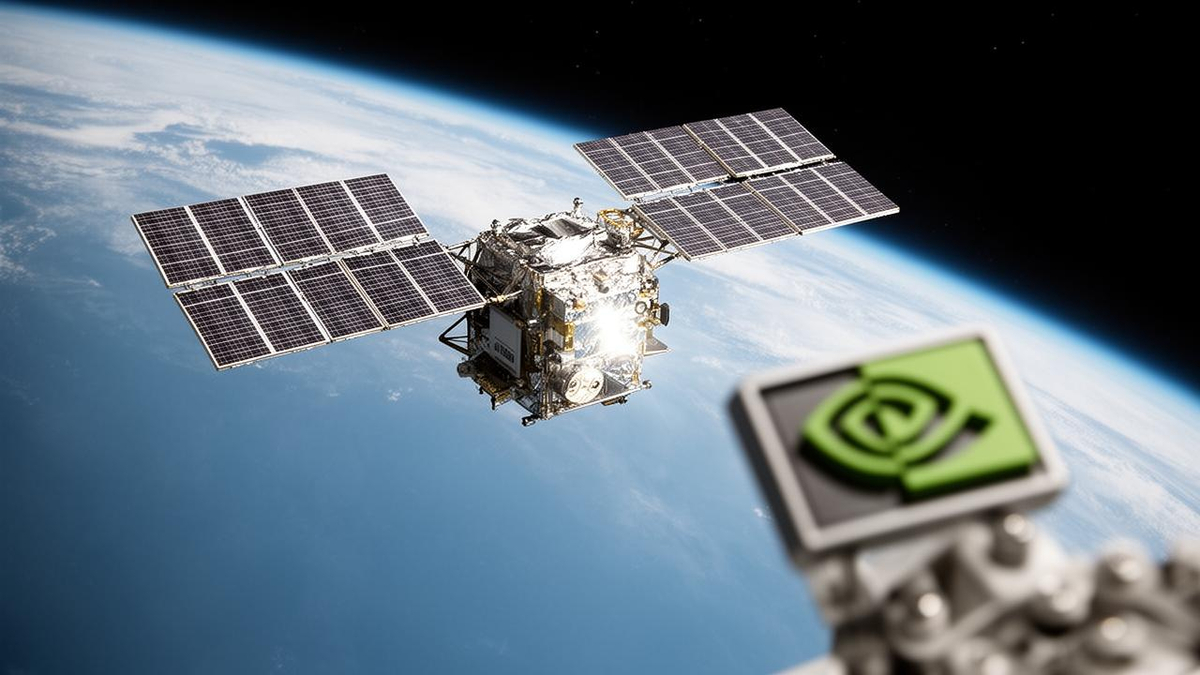
Nvidia Corp. (NVDA) has struck a deal with SpaceXAI to supply its next-generation Vera CPUs and Vera Rubin systems for the AI company’s expanding infrastructure, including a planned satellite that would bring accelerated computing into orbit for the first time.
This is not the companies’ first disclosure on the effort. On August 4, SpaceX first revealed on X that it was partnering with Nvidia to design the Starmind AI1 satellite compute payload. Musk explained the choice came down to Nvidia GPUs being, in his words, simply the best available. Monday’s announcement builds on that initial reveal with specifics on how the hardware will be deployed across SpaceXAI’s terrestrial and orbital infrastructure alike.
SpaceXAI, the former xAI business now operating within SpaceX (SPCX), will deploy Vera CPUs to handle the orchestration-heavy workloads that define agentic AI applications. The partnership also covers the expansion of infrastructure supporting Grok, SpaceXAI’s chatbot, with plans to scale toward gigawatt-level computing capacity.
The announcement, made Monday, underscores how Nvidia is positioning itself beyond conventional data centers as customers begin exploring space-based computing. SpaceXAI said it will use an optimized version of the Vera Rubin NVL72 rack-scale system in its first-generation Starmind satellite, adapting the architecture for the unique constraints of orbital operations.
Vera Targets Agentic Workloads
Agentic AI systems differ from traditional models in that they must coordinate multiple software tools, execute code, analyze information, and run simulations between model calls. These tasks place heavy demands on CPUs, which manage the orchestration while GPUs remain focused on model training and inference.
Nvidia designed the Vera CPU specifically for this role. The processor features 88 Olympus cores and high-bandwidth LPDDR5X memory, delivering up to 1.2 terabytes per second of memory bandwidth. The chip also packs 176 processing threads via Nvidia’s Spatial Multithreading design, a 164MB unified L3 cache, and an 1.8 terabyte-per-second NVLink-C2C link to the GPU. According to the company, Vera can complete certain AI, reinforcement learning, and data-processing tasks up to 1.8 times faster than x86 processors.
Mike Nicolls, president of SpaceXAI, said the technology should improve AI agent performance while allowing the company to extract more work from each watt of computing power.
The efficiency gains matter as SpaceXAI scales its infrastructure. The company expects its computing footprint to grow toward gigawatt-scale capacity, a level that would make it one of the largest AI compute deployments in the world.
One Architecture, Two Frontiers
The Vera Rubin platform combines computing, networking, data processing, and software into a single architecture. Each Vera Rubin NVL72 rack pairs 72 Rubin GPUs with 36 Vera CPUs, delivering roughly 3.6 exaflops of NVFP4 inference compute alongside 20.7 terabytes of HBM4 memory at 1.6 petabytes per second of bandwidth, according to Nvidia’s published rack specifications. The platform includes NVLink interconnect technology, Spectrum-X Ethernet networking, and BlueField data processing capabilities, all designed to support faster data movement across large clusters.
For SpaceXAI, the appeal lies in consistency. The company gains a common computing architecture that spans terrestrial data centers and future orbital systems, simplifying software deployment, system management, and workload scaling across environments with radically different physical constraints.
That consistency becomes critical when extending into space. Orbital computing faces strict limits on power, thermal management, bandwidth, and reliability that do not exist in ground-based facilities. Nvidia and SpaceXAI will adapt the Vera Rubin NVL72 system to meet those demands while preserving a common software foundation.
The Starmind satellite represents the most ambitious element of the partnership. If successful, it would mark the first deployment of Nvidia’s accelerated computing architecture beyond Earth, opening a potential new market for the chipmaker.
SpaceX has sketched an even larger vision for the Starmind network: an eventual constellation of up to 1 million orbital compute satellites operating between 500 and 2,000 kilometers in altitude, linked by a petabit-scale optical laser network — a scale that would dwarf the roughly 15,000 active satellites currently in orbit today, per details SpaceX shared alongside its initial August 4 disclosure of the partnership.
Market Reaction
Despite the announcement, Nvidia shares fell 2.13% to $210.15 on Monday, suggesting investors were not immediately swayed by the orbital computing narrative. The decline came amid broader market pressure, and the deal’s long-term implications may take time to materialize.
The partnership nevertheless reinforces Nvidia’s dominant position in AI infrastructure. The company has spent years pitching investors on the idea that AI computing would permeate the world’s data centers. SpaceXAI’s plans offer a glimpse of what the next frontier might look like.
ComponentKey SpecificationsVera CPU88 Olympus cores, 176 threads, 1.2 TB/s memory bandwidth, 164MB L3 cacheVera Rubin NVL72 rack72 Rubin GPUs + 36 Vera CPUs, 3.6 EFLOPS NVFP4 inference, 20.7TB HBM4Vera Rubin platformNVLink, Spectrum-X Ethernet, BlueField DPUsStarmind satelliteOptimized Vera Rubin NVL72 rack-scale systemPerformance claimUp to 1.8x faster than x86 on select workloadsStarmind manufacturing timelinePrototype testing early 2027; mass production later 2027 (per SpaceX, pending schedule)
Note: Specifications as disclosed by Nvidia and SpaceX across the August 4 and August 24, 2026 partnership announcements.
For Nvidia, the deal represents another large deployment for its next-generation data center hardware. For SpaceXAI, it provides a unified computing strategy that extends from massive terrestrial facilities to the edge of space. The companies did not disclose financial terms, and neither has given a firm date for Starmind’s first satellite launch — though SpaceX has said prototype testing is planned for early 2027, with mass production targeted for later that year if development stays on schedule.