
Aug 25, 2026 23:42:00
Windows’ drawing app ‘Paint’ and image management app ‘Microsoft Photos’ are equipped with AI-powered image generation and editing functions. It has been discovered that using these AI functions generates
a GUID (Globally Unique Identifier) from the server, which is then embedded in the image as an invisible digital watermark.
Microsoft Paint and Photos Embed Server-Issued GUIDs as Invisible Watermarks in Locally-Generated Images :: Xusheng Li
https://xusheng.dev/posts/reversing/mspaint_invisible_watermark/main/
Xu Shen Li, a software developer and security researcher, became interested in exactly how AI image generation in Microsoft Paint works and conducted an investigation.
Before conducting the investigation, Lee had anticipated that image generation might be performed via a remote API, but in reality, because Microsoft includes a local model in Windows as a feature of Copilot+ PC, image generation was possible both locally and remotely.
Further investigation revealed that both Microsoft Paint, which uses AI to generate images, and Microsoft Photos, which uses AI to edit images, send prompts to a remote server for moderation, and the server sends a GUID along with the moderated prompt.
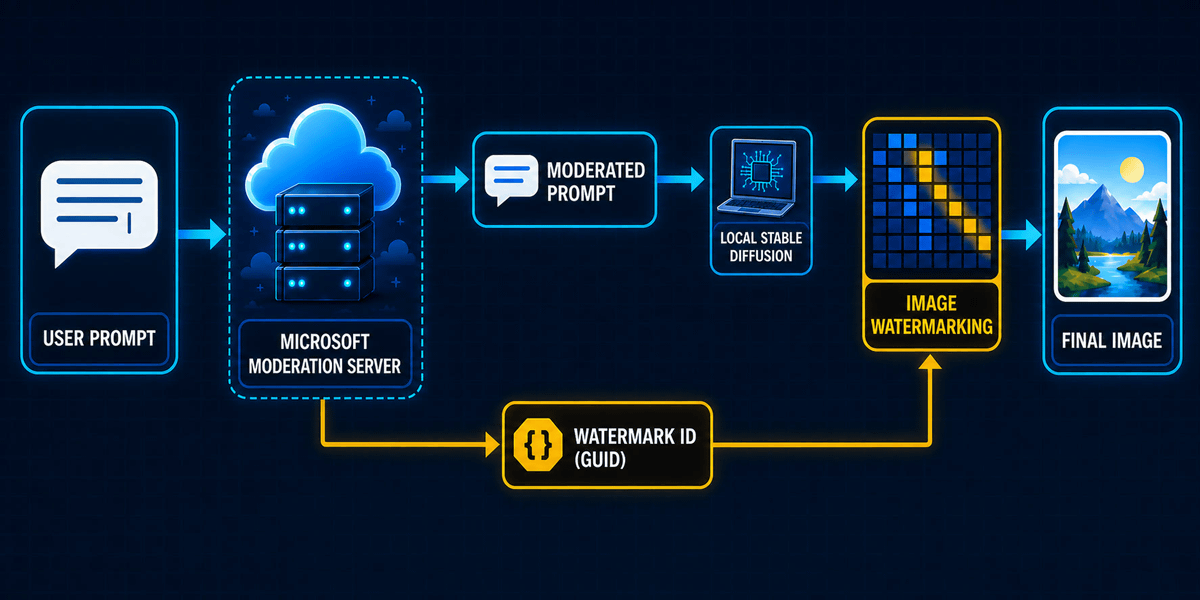
Even with Copilot+ PC, which allows for completely local image generation and editing, prompt moderation was performed remotely.
Microsoft Paint originally had a setting to display a watermark indicating that an image was AI-generated, and when this was enabled, the Copilot logo would appear in the lower right corner of the image. However, this GUID was embedded as an invisible watermark, meaning it was not visible to the naked eye.
Microsoft explains that the C2PA manifest is incorporated so that it can recognize that an image is AI-generated when it is generated, but Lee points out that it does not explain that the C2PA manifest includes a GUID to identify invisible watermarks, or that even locally generated images receive the watermark GUID from a remote server.