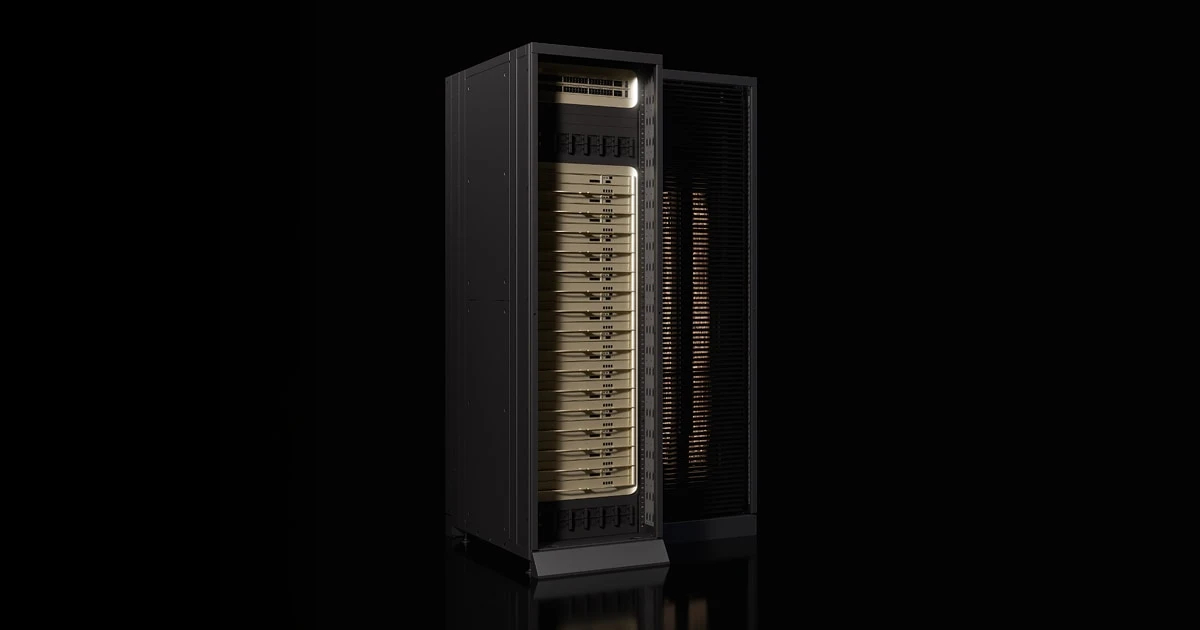
Nvidia has officially announced volume production of its next-generation AI inference accelerator “Grok 3 LPX,” raising expectations for a turnaround at South Korea’s Samsung Electronics foundry division, which has been tapped to produce the chip’s core components. Under the current arrangement, Samsung Electronics manufactures the entire supply of language processing units (LPUs) — the key component of the Grok 3 LPX — on its 4-nanometer process. With the supply scope expanding from HBM to logic semiconductors, industry observers say the two companies’ partnership has evolved into a “full-spectrum alliance.”
Nvidia announced the start of Grok 3 LPX volume production on the 24th (local time) at Hot Chips 2026, a semiconductor conference held in California. The product is a system that packages 256 LPUs into a single rack, using high-speed SRAM instead of standard DRAM to reduce data access times and boost inference performance. Nvidia said the platform can deliver response speeds up to four times faster than competing platforms for agentic AI workloads such as coding.
Jensen Huang, Nvidia’s CEO, said at GTC 2026 in March that “Samsung is building Grok 3.” This production announcement is a continuation of that commitment. The first customer is AI cloud provider Nebius, which plans to deploy Grok 3 LPX in its “Nebius Token Factory” inference platform starting at the end of this year.
The significant improvement in Samsung foundry’s 4nm process stability is also cited as a key factor behind the production ramp. According to industry sources, Grok 3 production yields have improved two to three times since April, reaching above 80% — a level considered sufficient for stable volume production. Analysts note that the process expertise Samsung Electronics accumulated while mass-producing HBM4 base dies on the same 4nm-class process has translated into production stability for large AI customer chips.
With yield improvements coinciding with rising AI semiconductor orders, the 4nm line at Samsung’s Pyeongtaek campus in Gyeonggi Province is reportedly running at close to 100% utilization. Pricing power is also recovering. Samsung Electronics recently raised prices on new orders for select 4nm, 5nm, and 8nm processes by up to 10–15%. This underpins growing expectations for improved profitability at the foundry business, which has posted losses for an extended period.
The scope of collaboration between Samsung Electronics and Nvidia is also expanding on the memory side. Samsung Electronics is supplying sixth-generation high-bandwidth memory HBM4 for Nvidia’s next-generation “Rubin” GPU. Global investment bank KeyBanc recently raised its annual shipment forecast for Rubin GPUs by 9%, from 1.75 million units to approximately 1.9 million units. If Rubin production ramps faster than expected, Samsung Electronics — with its large-scale HBM production capacity — is likely to see its supply volumes expand in tandem.
When low-power DRAM modules “SOCAMM2” for the Vera CPU and data-center SSDs are factored in, Samsung Electronics is positioned to supply Nvidia with virtually all major semiconductors that go into AI servers. The company is now viewed as a core partner providing both memory and logic semiconductors, rather than merely an HBM supplier.
The expansion of the AI inference chip market beyond Nvidia also presents additional opportunities for Samsung Electronics. OpenAI recently announced that its in-house inference AI chip “Habanero” outperformed Nvidia’s current flagship GB300 in performance-per-watt and response speed. The chip, co-developed with Broadcom, is slated to be deployed for running OpenAI’s AI models within the year. Tech-focused publication SemiAnalysis reported that Habanero is equipped with HBM4 delivering 15.4TB/s of bandwidth per package and identified Samsung Electronics as the supplier. If actual supply is confirmed, Samsung Electronics would expand its HBM customer base beyond Nvidia to include AI companies developing their own chips.
The shift in the AI semiconductor market’s center of gravity from training GPUs to inference-specific chips is also expected to work in Samsung Electronics’ favor. As inference demand — the actual running of AI services — surges alongside the training phase of building large-scale AI models, custom semiconductors like Nvidia’s Grok 3 and OpenAI’s Habanero are emerging in rapid succession. The logic is straightforward: the more diverse the chip landscape becomes, the greater the demand for advanced foundries to produce them and for HBM to process massive volumes of data at high speed.
Samsung Electronics is leveraging this demand expansion as a springboard for a foundry turnaround. After securing major customers on its 2nm process last year, including Tesla’s next-generation AI chip “AI6,” the company has now entered full-scale production of Nvidia volumes on 4nm. With advanced-node utilization rising and new orders increasing, some analysts project the company could significantly narrow its losses or even return to profitability as early as this year.
Kim Dong-won, head of research at KB Securities, said: “Samsung Electronics’ foundry business is expected to enter a meaningful inflection point in the third quarter. With the recent 15% price increase and the full ramp of 4nm LPU production taking effect, we expect the business to return to profit for the first time in four years since 2022, excluding costs such as performance bonus provisions.” However, some in the industry urge caution, noting that the foundry business has a time lag from order intake to volume production and carries significant fixed-cost burdens from large-scale capital expenditures, requiring a long-term perspective.