Google DeepMind, after enduring a brutal wave of talent departures and a leadership overhaul, has landed a heavyweight returnee. Barret Zoph announced on X that he is joining Google DeepMind, focusing on reinforcement learning and post-training. According to Reuters, his title will be VP of Research.
Zoph’s AI career began with Google Brain’s Residency program. He spent six years at Google Brain, producing two highly cited papers as first author: “Neural Architecture Search with Reinforcement Learning” and “Learning Transferable Architectures for Scalable Image Recognition.” Using reinforcement learning to automatically search network architectures marked one of the starting points of the neural architecture search subfield.
In his post, he wrote that Google has all the ingredients needed for sustained success in AI, and he is excited to be part of that mission. The comments section quickly filled with congratulations from industry heavyweights, including Jason Wei, known for chain-of-thought prompting; Thang Luong, head of DeepMind’s superhuman reasoning team; Logan Kilpatrick, Google’s chief AI evangelist; and Thomas Kipf, creator of graph convolutional networks.
Behind this announcement lies a remarkably winding career trajectory. In September 2022, Zoph left Google for OpenAI, eventually rising to VP of Research for post-training, where his team handled alignment, tool use, evaluation, ChatGPT, search, and multimodality. ChatGPT’s post-training system was built by him and John Schulman, among others.
On September 25, 2024, he announced his departure on the same day as Chief Research Officer Bob McGrew—just hours after CTO Mira Murati had announced her own exit. The near-simultaneous departure of all three was the most striking moment in that round of upheaval at OpenAI.
In February 2025, Thinking Machines Lab was officially founded, with Murati as CEO and Zoph as co-founder and CTO. That July, the company—which had no product yet—closed a seed round of approximately $2 billion at a post-money valuation of $12 billion, with investors including a16z, Nvidia, AMD, Cisco, Accel, ServiceNow, and Jane Street. It was one of the largest seed rounds in Silicon Valley history.
But the venture lasted less than a year. On January 14, 2026, Murati announced she was parting ways with Zoph, and that Soumith Chintala, creator of PyTorch, would take over as CTO. Fifty-eight minutes later, Fidji Simo, CEO of OpenAI’s applications business, announced on X that Zoph, fellow co-founder Luke Metz, and founding team member Sam Schoenholz were all returning to OpenAI.
Back at OpenAI, Zoph was assigned to lead the enterprise business, with the title of VP and GM of Enterprise. But five months later, he left again. According to The Verge’s June 19 report, OpenAI confirmed Zoph’s departure; he posted a farewell message in the company Slack, with the reason for leaving unclear.
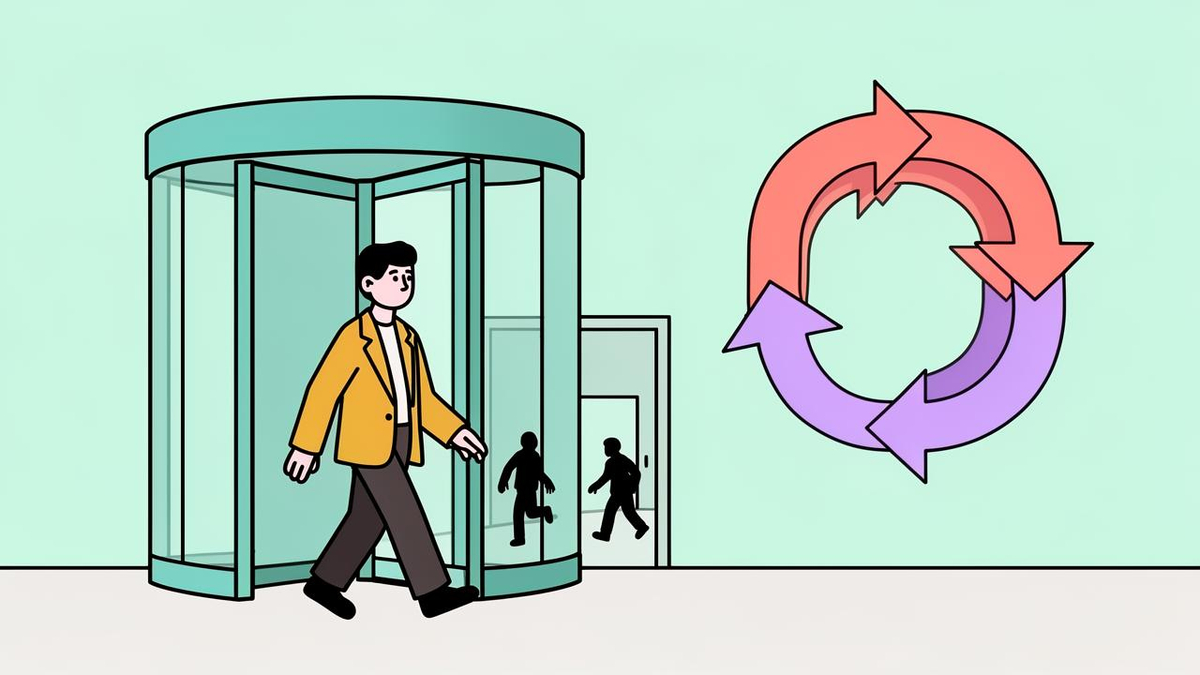
From the founding of Thinking Machines Lab to today: eighteen months, three employers, two of which were places he had already left before.
The reason for his departure from Thinking Machines Lab remains unresolved, with no version accepted by all parties. At least four narratives exist that are not fully compatible with one another. Tech journalist Kylie Robison, citing two sources familiar with the matter, reported that TML terminated Zoph’s employment for “unethical behavior.” According to Wired, a source close to TML claimed Zoph was accused of sharing confidential company information with a competitor, though the outlet explicitly noted it was unable to verify this with Zoph himself.
According to The Wall Street Journal, Zoph had admitted to Murati that he was in a romantic relationship with a more junior colleague, one that began when both were still at OpenAI. Murati had suspected as early as last summer; Zoph initially denied it, and weeks later the two acknowledged the relationship to Murati. The paper also noted that while the woman was junior to Zoph, she did not report to him. She subsequently left TML and returned to OpenAI.
Zoph himself told the Journal that TML terminated his employment only after learning he was going to leave—”that’s it.” He added that TML never cited any performance reasons or unethical behavior as grounds for dismissal, and that any suggestion to the contrary is false and defamatory. TML has not publicly commented to date.
Google DeepMind’s talent ledger
Zoph’s return comes after the most severe summer of talent loss in DeepMind’s history.
Starting in mid-June, DeepMind bled talent continuously. On June 18, Noam Shazeer—co-lead of the Gemini model and one of the authors of the Transformer paper “Attention Is All You Need”—announced he was joining OpenAI. Google had brought him back just two years earlier through a roughly $2.7 billion Character.AI licensing deal. Two days later, John Jumper, who shared the 2024 Nobel Prize in Chemistry with Demis Hassabis for AlphaFold, announced he was joining Anthropic, accompanied by AlphaFold paper collaborators Jonas Adler and Alexander Pritzel.
Additionally, Denny Zhou had earlier quietly moved to Meta, and David Silver—an early DeepMind employee and a leading figure in reinforcement learning—left to start his own company called Ineffable Intelligence. On June 22, Alphabet’s stock fell roughly 5%–6%, with market reports widely linking the decline to concerns over AI spending and Google’s ability to retain top talent.
By August, Google underwent a major organizational restructuring. On August 5, Sundar Pichai announced that Hassabis would step down as CEO of Google DeepMind, transitioning to Chairman of GDM and Alphabet Chief Scientist, while continuing to lead Isomorphic Labs. Koray Kavukcuoglu, previously CTO and Google’s chief AI architect, took over day-to-day operations as Senior Vice President, reporting directly to Pichai. Jeff Dean, Google’s Chief Scientist who had been with the company for 27 years, announced he was leaving with several colleagues to found a public-benefit company called Discovery Loop, with Google as one of the investors.
Analysis from UK-based data intelligence firm Zeki Data, provided exclusively to Fortune, shows that DeepMind’s share of research and senior engineering hires in Europe, the Middle East, and Africa has plummeted from 49% in 2022–23 to 18.6% in 2025–26—the steepest regional market-share decline of any major AI lab the firm tracks.
Globally, DeepMind is still net-adding research and senior engineering staff, but its join-to-leave ratio has fallen sharply from roughly 12-to-1 in Q2 2023 to about 2-to-1 in Q3 2026. By comparison, Meta’s ratio in 2025 was 3-to-1, OpenAI’s was 5.7-to-1, and Anthropic’s was a staggering 22-to-1.
Among those leaving DeepMind, Anthropic has become the top destination. Of the researchers and senior engineers who departed in the past 12 months, 25% went to Anthropic, 21% to Meta, and 14% to OpenAI.
A critical reinforcement during rebuilding
Kavukcuoglu’s words upon taking office read like a mission statement: the top priority is ensuring there is as clear a path as possible to deliver on the Gemini roadmap. An internal memo to employees also referenced Gemini 4.
The timing of Zoph’s arrival makes the picture clearer: this is the rebuilding phase under Koray, and DeepMind needs someone who can lead post-training and RL teams. That is why DeepMind is willing at this juncture to take on an executive whose resume carries controversy. On the talent ledger of the past three months, this is one of Google’s rare additions.
According to Fortune, multiple current and former employees say DeepMind’s shifting identity has eroded some of its historical appeal. As Google pushes to close the gap with OpenAI and Anthropic, the lab has been organized more tightly around improving and commercializing Gemini—a shift some researchers believe has displaced the open-ended, long-horizon scientific research that once made DeepMind an ideal destination for academics.
A former DeepMind engineer told Fortune: “Most of the old-timers who joined DeepMind before the ChatGPT moment joined to be part of an AI research lab. Anyone who joined before 2023 thought they were joining an AI research lab, and then suddenly they were being asked to build products for Google.”
Zeki Data founder Tom Hurd noted: “They had the crown in Europe, and then it started eroding from a very high base. Microsoft AI Superintelligence and Meta Superintelligence are eating into their market share, alongside OpenAI and Anthropic.”
From another angle, the entire arc—from Murati leaving OpenAI to found Thinking Machines Lab, to three co-founders flowing back to OpenAI, to Zoph moving from OpenAI to DeepMind—shows that talent movement has almost completely detached from the “company” as a unit. Today’s AI labs, even those bearing founder or founding-team-member titles, see people come and go like ordinary employees.
If a co-founder’s departure can be picked up by another company within 58 minutes, what exactly does the “co-founder” title still anchor in today’s AI industry? Equity and non-compete clauses clearly cannot lock these people down, and neither can company vision. What is truly in motion are the few dozen brains who know how to organize a billion-dollar-scale experiment—and every lab is bidding for the same people.
The most sought-after researchers bring more than technical knowledge embedded in papers and code. They bring judgment about which ideas are worth pursuing, experience running hyperscale experiments, and the ability to recruit other in-demand scientists.