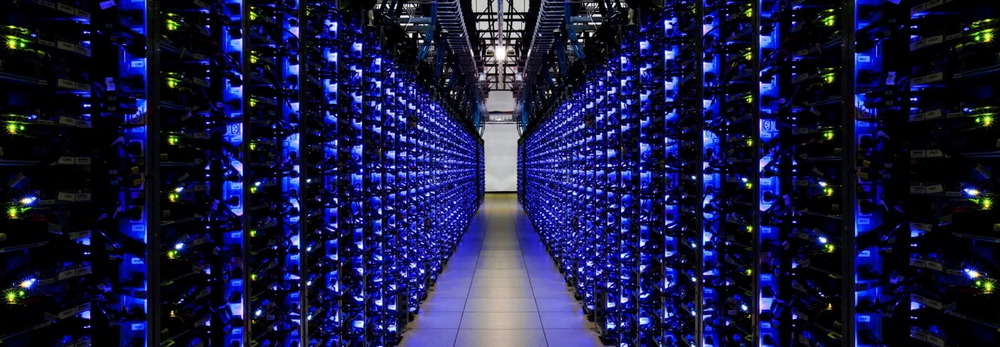
 사진 확대 Google data center packed with servers. Big Tech founders and AI researchers say AI model performance has improved through the ‘scaling law,’ which increases data input and computing power. Google
The launch of ChatGPT, which sparked the generative AI revolution in 2022, was not, strictly speaking, sudden. Earlier achievements in chess and Go offered clues. AI systems that repeatedly defeated the world’s strongest players did not inherit human know-how or knowledge. Instead, they found answers through data-driven exploration and learning. The AI industry proposed a hypothesis known as the ‘scaling law.’ It held that making models larger and increasing data input and computing power through massive infrastructure could improve AI performance faster than human-designed algorithms. ChatGPT’s arrival provided some support for that idea.
Still, it was not perfect. For it to qualify as a law, it had to answer a fundamental question: Would the scaling law continue to work and eventually produce artificial general intelligence (AGI), a system with human-level intelligence?
‘The Scaling Era,’ written by AI podcaster Dwarakesh Patel, is a book that brings together the many voices in the AI industry surrounding that question. Through the perspectives of 22 people on the front lines of the field, including founders, researchers and critics, it examines the future of scaling and its sustainability, as well as the risks that could emerge if AGI arrives.
 사진 확대 The Scaling Era By Dwarakesh Patel, translated by Noh Seung-young Published by Insight, 25,000 won
According to the book, AI experts generally agree that the scaling law has driven AI progress. But none offered a precise causal explanation. Most argued probabilistically that scaling up increases the chances of learning more rules and context. One even cited humanity’s evolutionary history, which favored the development of larger brains, as evidence. They also stopped short of saying whether scaling would lead to AGI. Still, the dominant view was that large language models alone have limits. A representative example is Google DeepMind co-founder and 2024 Nobel Prize in Chemistry laureate Demis Hassabis, who argued that improvements in AI architecture, algorithms and multimodal systems are needed.
The book also raises practical problems surrounding scaling. The question is whether the infrastructure needed to support enormous computing power can actually be secured. Data centers and power consumption for AI computing require massive power grids. The words of Germany-born AI researcher and hedge fund founder Leopold Aschenbrenner of Situational Awareness are symbolic.
“By 2030, trillion-dollar clusters using 100 GW will consume more than 20% of U.S. power generation. …(omitted)… U.S. power generation has been flat for decades.”
Even if AGI emerges, serious problems would remain. That is because it is unclear whether AI can be aligned to benefit humanity. If AGI appears faster than expected, alignment could fail before we are able to respond. Before we even understand what happened inside the model, highly intelligent systems driven by harmful motives could inflict damage on humanity.
“Our alignment efforts must happen in a very short time frame. If the capabilities needed to automate AI safety are only secured once AI is nearing human-level intelligence, then the intelligence explosion may already be well underway.” (Carl Shulman, former researcher at the University of Oxford’s Future of Humanity Institute)
The book also covers debates and forecasts on other issues, including the U.S.-China power struggle that AI could trigger, its impact on the global labor market, and the timing of AGI’s arrival. There is no single prediction or model answer. But as you follow the many thought experiments and questions raised by people on the front lines of the AI industry, the layered picture of the AI ‘scaling’ race, which extends beyond global Big Tech companies into competition between nations, comes into focus. The author says, “The purpose of this book is to capture what it feels like to be in the middle of the scaling era.”
[Choi Hyun-jae, reporter]
This article has been translated by GripLabs Mingo AI.