Technology is increasingly bringing Americans together. Just not the way we once envisioned.
About a quarter century ago, 8 in 10 Americans said they anticipated that the new millennium would usher in “the triumph of science and technology.” At the time, most adults said they had a positive view of computers and the internet.
Now Americans are increasingly united against rapidly advancing technologies and the companies behind them. Neighbors have rallied against data centers. Crowds at commencements booed artificial intelligence. And a lawsuit brought by 48 states against Meta over claims that its Facebook and Instagram platforms endangered children led to a landmark $18 billion settlement.
Public opinion of the nation’s largest technology companies and their sophisticated products dropped to multiyear lows in 2026, polls show. And Americans say they are more concerned than excited about a future dominated by AI.

Protesters march across San Francisco from OpenAI’s headquarters to xAI on March 21, 2026, calling for a pause in the development of artificial intelligence,
“Americans are coming together to agree on something, but for totally different reasons,” said Thomas Kahn, director of the Center for Congressional and Presidential Studies at American University. “The motivations are different, but the concern is the same – and nationally we’re seeing politicians respond to it.”
The backlash has been strikingly bipartisan. From rural communities to large cities, pushback against the initiatives of Silicon Valley is forming a unique coalition of liberals and conservatives. This is mirrored by the elected officials speaking out against data centers and high-tech surveillance, including Vermont Sen. Bernie Sanders, Florida Gov. Ron DeSantis, New York Rep. Alexandria Ocasio-Cortez and Texas Gov. Greg Abbott.
The vitriol at times has led to threats and violence. In April, a man threw a Molotov cocktail at the home of OpenAI CEO Sam Altman. Local officials who have voted in favor of data centers have received death threats. And in August, a county commissioner in Tennessee said the CEO of Flock Safety, which maintains a vast network of AI-powered surveillance cameras, should be hanged for treason.

A Flock Safety camera is shown mounted to a light pole on August 03, 2026, in Beverly Hills, California.
Tech titans have defended their products and largely brushed off concerns as overblown or misguided. Some executives and government officials say allowing foreign adversaries to outpace the United States in AI development could jeopardize national security. Others argue restrictions could rob the world of a utopian future.
“Maybe with 10 gigawatts of compute, AI can figure out how to cure cancer. Or with 10 gigawatts of compute, AI can figure out how to provide customized tutoring to every student on earth,” Altman wrote on his blog last year. “If we are limited by compute, we’ll have to choose which one to prioritize; no one wants to make that choice, so let’s go build.”
Data center backlash goes mainstream
Over the past year, data centers went from a little-discussed topic to a political lightning rod capable of reshaping elections.
What it looks like to live next to a sprawling data center
1 of 17
A drone view shows The Markley Group data center in a residential neighborhood in Lowell, Mass., July 28, 2026.
Data centers are emerging as a flashpoint in communities nationwide. Critics pushing back say the centers strain water and electricity resources and disrupt neighborhoods.
(Brian Snyder, REUTERS)
These gargantuan facilities, which house thousands of powerful computers as well as data storage systems and networking equipment, are being built at a historic rate to meet the demand for AI and cloud computing. The problem: Americans don’t want them.
A Gallup survey released this year found roughly 71% of U.S. adults oppose building data centers in their area, including 48% who said they strongly oppose them.
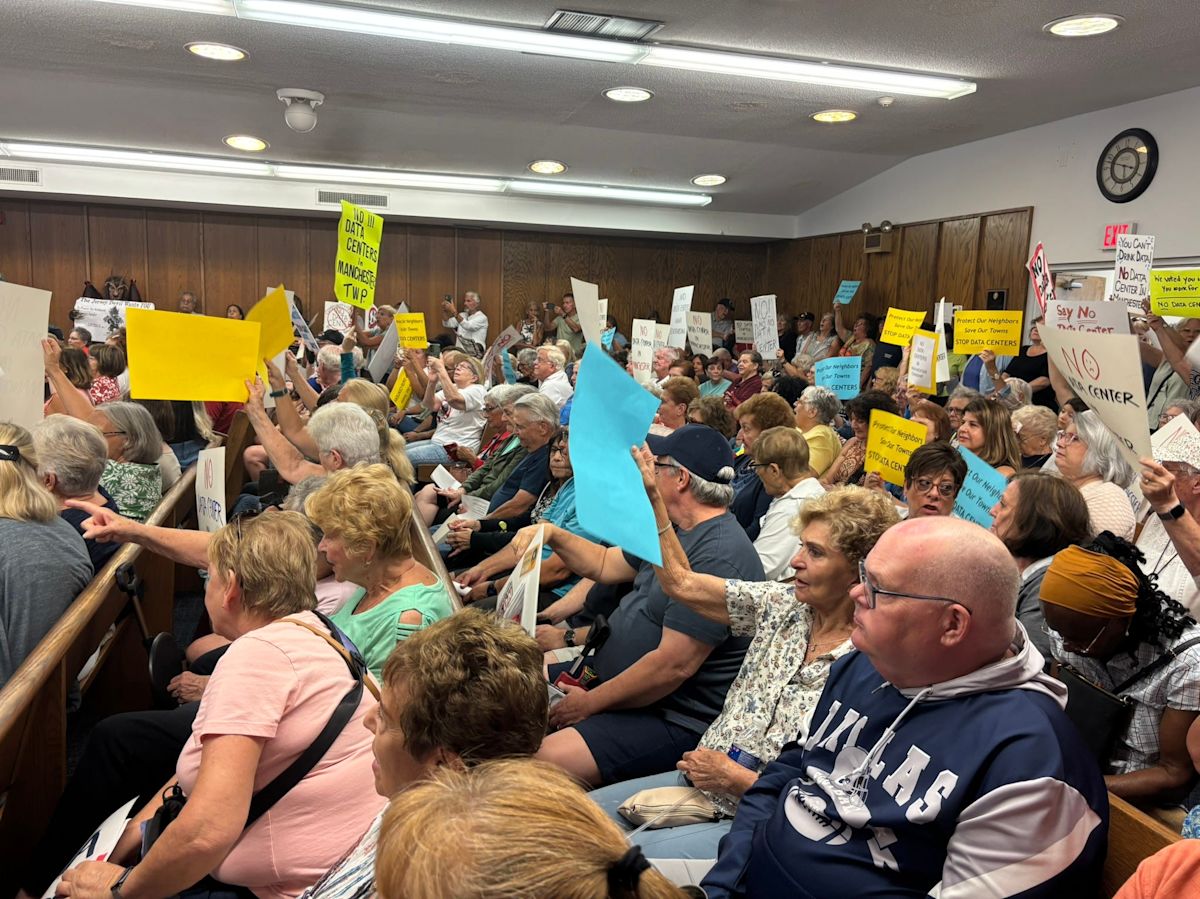
Industry advocates, including President Donald Trump, say data centers are essential infrastructure for the AI era, supporting technological innovation, creating high-paying jobs and generating tax revenue for local communities. But across the country, opponents have packed city council meetings to express fury about the strain on water and electricity resources, as well as the disruption to communities with noise and pollution.

Protesters hold up ‘Stop data centers’ signs, on the day of U.S. President Donald Trump’s speech at the General Motors Proving Ground, in Milford, Michigan, U.S. July 27, 2026.
Many politicians have either seized on the outrage or scrambled to shield themselves from the growing anger.
“People really effing hate data centers,” Abdul El-Sayed, the progressive Democratic nominee for Senate in Michigan, said at a campaign event in July. Days later, the governors of Texas and Pennsylvania – both of whom celebrated data center projects last year – announced new restrictions on the computing hubs.
In the first three months of 2026, local opposition has blocked or delayed at least 75 data center projects worth roughly $130 billion, according to Data Center Watch, a research firm that studies data centers. Still, more than 1,500 data centers are under development.
Residents in areas with functioning or proposed data centers told the USA TODAY Network they had a range of concerns, from plummeting property values to rising electricity bills to a lack of public notice.

The Memphis City Council approved the Data Center Moratorium for the 1st reading during a City Hall meeting on August 18, 2026 at 125 North Main Street in Memphis,Tenn.
Raneem Imam of Memphis recently attended a City Council meeting to support a moratorium on new data centers. She told The Commercial Appeal, part of the USA TODAY Network, she was “feeling very voiceless” and had a lingering sense of being “walked all over” by large tech companies. (Elon Musk’s SpaceXAI operates three data centers in Memphis and recently announced plans for a fourth.)
In the small town of Manchester, New Jersey, Anne Cahalane was among a group of local residents demanding a similar ban on large computing hubs.
“That’s the last thing we need here,” she told the Asbury Park Press, part of the USA TODAY Network. She called a recent data center proposal “reckless and dangerous.”
Movement aims to ‘stop Flock’
The latest front in Americans’ war on tech has taken the form of automated license plate readers.
Though several companies produce the surveillance technology, the largest is Flock Safety, which maintains a network of 120,000 AI-powered cameras across 49 states.
Unlike older surveillance cameras, Flock transfers information captured by its devices into a searchable database that authorities can access without a warrant. The company says its cameras scan 20 billion vehicles every month.

A Flock camera trains its lens on vehicles traveling down County Street in New Bedford, MA on August 20, 2026.
Flock CEO Garrett Langley and many police officials say the cameras provide law enforcement with an essential crime-fighting tool that has helped find missing people, recover stolen vehicles and track down suspects, including in high-profile crimes such as the 2025 mass shooting at Brown University. Flock says its cameras help solve 700,000 crimes each year.
But outrage over the technology has erupted in recent months amid concerns about privacy, mass surveillance and police misconduct. The backlash intensified after reports of immigration authorities accessing Flock data, officers abusing the network to stalk women, and misreads that led to innocent people held at gunpoint.
Activists and residents have rallied against the technology, chanting and holding signs reading “Safety is not surveillance” and “Get The Flock Out.” The backlash also prompted lawsuits and a string of vigilantism that has seen people cut down, run over or shoot dozens of Flock cameras nationwide. The uproar has even drawn the attention of the president, who said his stance on the matter is “under review.”

Anti-Flock surveillance protesters, including Kristopher Weiss, front, gather outside Columbus City Hall before Councilmember Emmanuel Remy holds a council hearing on the city’s Flock Safety license plate reading cameras on Aug. 10, 2026.
This year, about 100 jurisdictions nationwide have paused or canceled their contracts with Flock, according to data collected by the group DeFlock. The company has said the number of jurisdictions partnering with Flock far outpaces the number canceling their agreements.
Still, the pushback led Langley to announce a slew of measures aimed at curbing police misuse. In an interview with USA TODAY, Langley said Flock will require all law enforcement agencies to adopt an audit system that flags abnormal search behavior. He also said data unrelated to an ongoing case will be retained for seven days instead of 30.
But as with data centers, elected officials of both parties have come out against the technology, seizing on Americans’ fury.
Republican Rep. Keith Self, who is running for reelection in Texas, posted on X, “Big Brother has NO place in the Lone Star State.” Republican Sen. Josh Hawley of Missouri announced a congressional investigation into the company. And Sanders, D-Vermont, pledged to introduce legislation to rein in the technology.
“If you are dropping your kids off at school, Flock knows. If you are going to a doctor, Flock knows,” Sanders posted on X. “We must come together to stop Flock and AI mass surveillance.”

Stone Bruner of Greenville stops to look at a black plastic bag covering a flock camera in downtown Greer, S.C. Tuesday, August 25, 2026.
Ominous warnings about an AI-powered future
Anger at data centers and Flock cameras comes as Americans sour on AI and the powerful companies behind it.
A survey from Pew Research found that 52% of Americans say they’re more concerned than excited about increased use of AI in daily life, up from 37% in 2021. For Gen-Z, which has adopted the technology more than any other age group, only 1 in 10 say they’re more excited than concerned.
Anxiety about AI largely centers on the potential for mass job loss, a scenario tech executives themselves have warned about.
Altman forecasts a “difficult economic transition,” and Anthropic CEO Dario Amodei said AI could wipe outhalf of all entry-level white-collar jobs within five years. More recently, Microsoft founder Bill Gates warned that “many jobs will disappear forever” and that AI could become the “worst source of injustice.” And Meta walked back sweeping plans to reduce its workforce through AI, Reuters reported.

Activist Brandy Price holds a sign in opposition to data centers and xAI as City Council meets to discuss a data center moratorium during a City Hall meeting on August 18, 2026 at 125 North Main Street in Memphis,Tenn.
Americans, meanwhile, are growing tired of what many call “AI slop,” a term describing low-quality content generated by artificial intelligence. The pushback prompted several companies, including LinkedIn and Spotify, to purge their platforms of the digital waste.
As Americans’ views on AI turn negative, so have their view of Big Tech.
A YouGov Poll in July found that 7 in 10 adults believe technology companies have too much power. And while most respondents said they had recently used AI, fewer than 1 in 5 said they trust tech companies to manage the development and deployment of the technology.

CEO of Meta and Facebook Mark Zuckerberg, Lauren Sanchez, Amazon founder Jeff Bezos, Google CEO Sundar Pichai and Tesla and SpaceX CEO Elon Musk attend the inauguration ceremony before Donald Trump is sworn in as the 47th US President in the US Capitol Rotunda in Washington, DC, on Jan. 20, 2025.
Bernard Koch, an assistant sociology professor at the University of Chicago who researches artificial intelligence, said worries about AI’s impact on people’s lives are probably fueling the uproar over data centers and Flock cameras.
“This stuff is a proxy for people’s distaste for Big Tech, surveillance capitalism, AI automation of jobs,” he said. “They’re potent symbols.”
David Karol, an associate professor at the University of Maryland who studies American political development, agreed that some of the vitriol could be related to hostility toward tech companies but said the issues remain largely a local concern.
“They are related, but I wouldn’t say most of the concern is about abstract attitudes about AI,” Karol said. “I think that’s part of the story, but I think there’s also specific concerns.”
A unifying dispute
Across the country, pushback against ever-advancing technologies is bringing together a unique and unlikely coalition.
In Hendersonville, North Carolina, lifelong conservative Austin Rhodes teamed up with his progressive neighbor Tiernan Turner to speak out against Flock cameras.
“The beautiful thing about it … is that it’s not a left or right issue,” Rhodes, a berry and cattle farmer, told the Hendersonville Times-News, part of the USA TODAY Network. “If you’ve struck a chord that resonates with the left and the right, in a divisive culture, you’ve obviously (really) struck a chord.”

Austin Rhodes, a leader of a grassroots effort opposing the use of Flock cameras in Henderson County and Hendersonville, near a Flock camera on Ridge Road in Dana on Aug. 12, 2026. Rhodes is among those calling for the cameras to be defunded and removed.
Their efforts have since been backed by the progressive activist group PERSIST of Henderson County, which is best known for its role in organizing “No Kings” protests against the Trump administration.
“It’s been amazing to me how nonpartisan this is,” Holly Newton, a local progressive activist, told the Times-News. She said Flock cameras have brought her together with people she would “typically disagree with on pretty much everything.”
Opposition to data centers is similarly bipartisan.
Tracee Laing is among a group of organizers who have collected signatures from residents in an effort to ban hyperscale data centers in Licking County, Ohio, just east of Columbus.

Like similar buildings in other parts of the data center development zone, ribbed aluminum framing supports puncture and water-proof fabric that covers five Meta data centers on a 414-acre site between Miller (right), Clover Valley and Green Chapel roads. Sidecat LLC is listed as the owner of this $30,098,600 parcel on the Licking County Auditor’s website. The sprawling Intel site is visible at the top of the image. Ohio is home to at least 195 data centers, with 134 in the Columbus region, according to the tracking website DataCenterMap.com. New Albany alone is home to 46 data centers and counting.
“I’ve circulated a lot of petitions, and this is the one that really has bipartisan support,” Laing told The Newark Advocate, part of the USA TODAY Network. “It doesn’t matter what party you are a member of. People see and are experiencing all the downsides of the data centers, and they are willing to sign.”
As more communities oppose these technologies, experts anticipate a flurry of regulations will follow.
“It’s still early in the game,” said Kahn, the American University lecturer. “But we are already seeing a reaction, and I think the reaction is only going to get more intense.”
Christopher Cann is a national reporter for USA TODAY. Contact him at ccann@usatoday.com.
This article originally appeared on USA TODAY: In a rare moment of unity, Americans are fighting Big Tech together