TimesFM-3 is built on a Transformer, the same base architecture as its predecessors, but it groups 32 consecutive data points into a single patch and normalizes each series to a common scale so measurements of very different magnitudes can be compared directly.
The model processes data in two alternating directions. Along the time axis, it looks for patterns within a single series, only drawing on past values to avoid leaking future information. Across series, it compares all variables at a given point in time and learns how they relate, which lets it pick up on things like how a discount on one product affects sales of another.
 Blue marks the target series, purple a variable known only historically, and green a known future event whose tokens already include upcoming patches. | Image: Google
The model has 330 million parameters and was trained on real and synthetic time series totaling more than one trillion data points, according to Google. Like its predecessors, it works zero-shot and needs no extra training for new tasks.
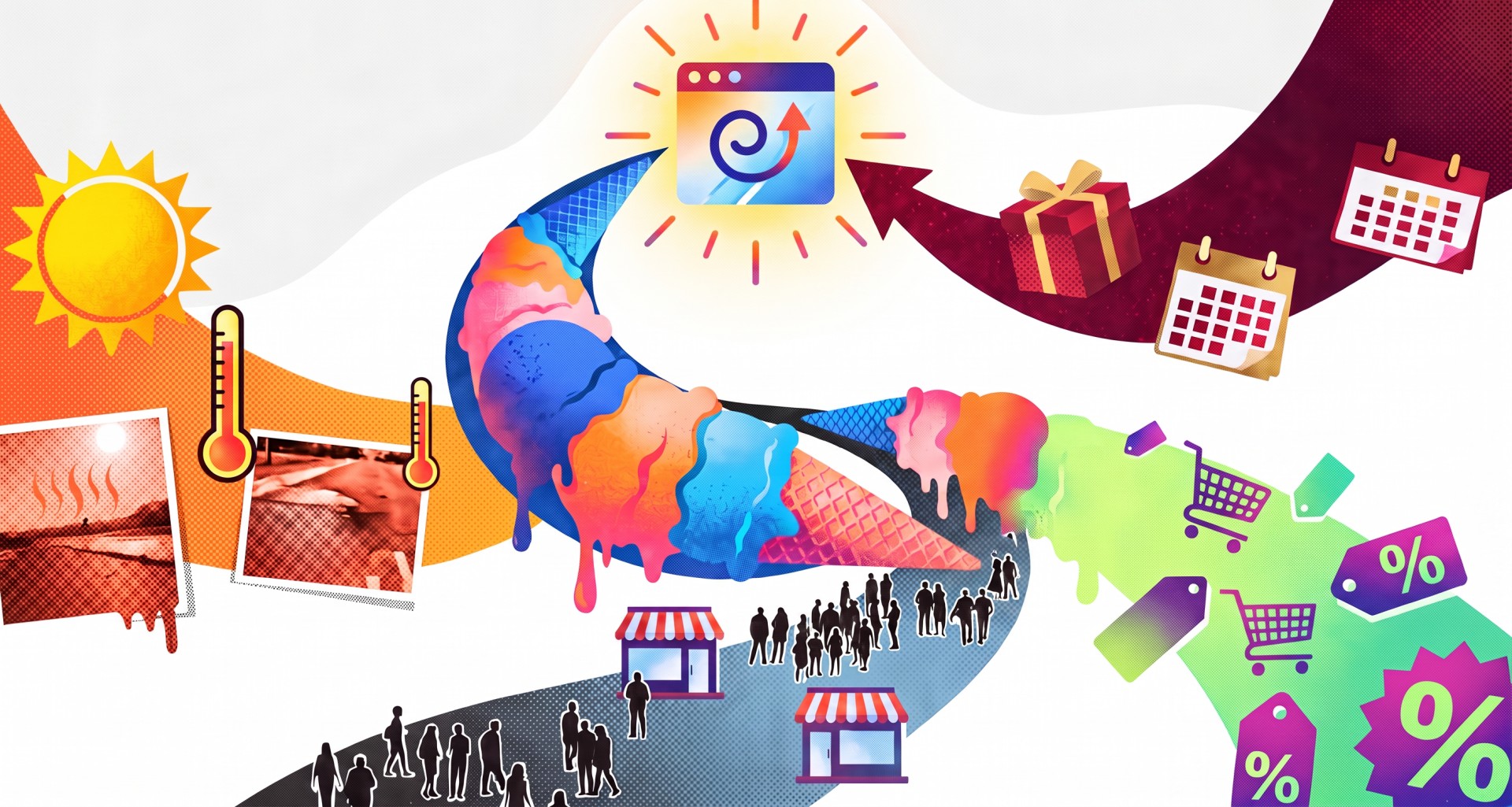
TimesFM-3 handles three types of supplementary data. It predicts multiple related variables at once, like different ice cream flavors, and it incorporates factors known only for the past, such as historical foot traffic. It also uses known future events like planned discounts or weather forecasts. Instead of a single point estimate, TimesFM-3 outputs nine values per time step to capture the range and uncertainty of each prediction.
One-shot forecasting replaces error-prone step-by-step approach
Earlier versions predicted the future one block at a time, which Google says was slow, compute-heavy, and let errors compound as each prediction built on the last. TimesFM-3 takes a different approach by marking all future time steps as blanks and filling them in a single pass.
Google shows the payoff with its ice cream example. A model that only knows past sales just continues the usual weekly pattern, blind to planned promotions. When TimesFM-3 gets the discount schedule, it learns from history how much promotions boost demand and expects roughly 20 percent more units on each promotion day.
 The blue forecast knows the discount schedule and expects about 20 percent higher sales on the orange-marked promotion days, while the red forecast just continues the usual weekly pattern. | Image: Google
TimesFM-3 leads across three benchmarks
On Gift-Eval, FEV-Bench, and Time, TimesFM-3 ranks first among all pretrained forecasting models in both point accuracy and uncertainty calibration, according to Google. Competitors include Amazon’s Chronos-2, the Toto-2.0 family, and Google’s own TimesFM-2.5. Even limited to a single variable, TimesFM-3 matches or beats the field, and adding more data widens the gap.
 Lower left is better. TimesFM-3 leads Gift-Eval by a wide margin, even when limited to a single variable. | Image: Google
 TimesFM-3 takes the top spot on FEV-Bench as well. Amazon’s Chronos-2 comes close to TimesFM-3’s univariate mode but falls well behind the full version. | Image: Google
 On the Time benchmark, TimesFM-3 leads again, followed by the Toto-2.0 family. Its predecessor TimesFM-2.5 lands well behind the pack. | Image: Google
TimesFM-3 is available on GitHub and Hugging Face, and Google plans to add it to BigQuery in the coming weeks. TimesFM-2.5 currently handles single-variable forecasting there via the AI.FORECAST command.
Since the family launched in 2024, Google says it has been deployed in retail, finance, manufacturing, healthcare, and the sciences. All versions through TimesFM-2.5, released in September 2025, could only process one data series at a time, making TimesFM-3’s multivariate support a major step forward.
Google is also building forecasting models beyond time series. In early August, Google DeepMind released WeatherNext Cyclones, an open-source AI system for tropical cyclones that predicts storm tracks and intensity about a day further out than leading operational models.