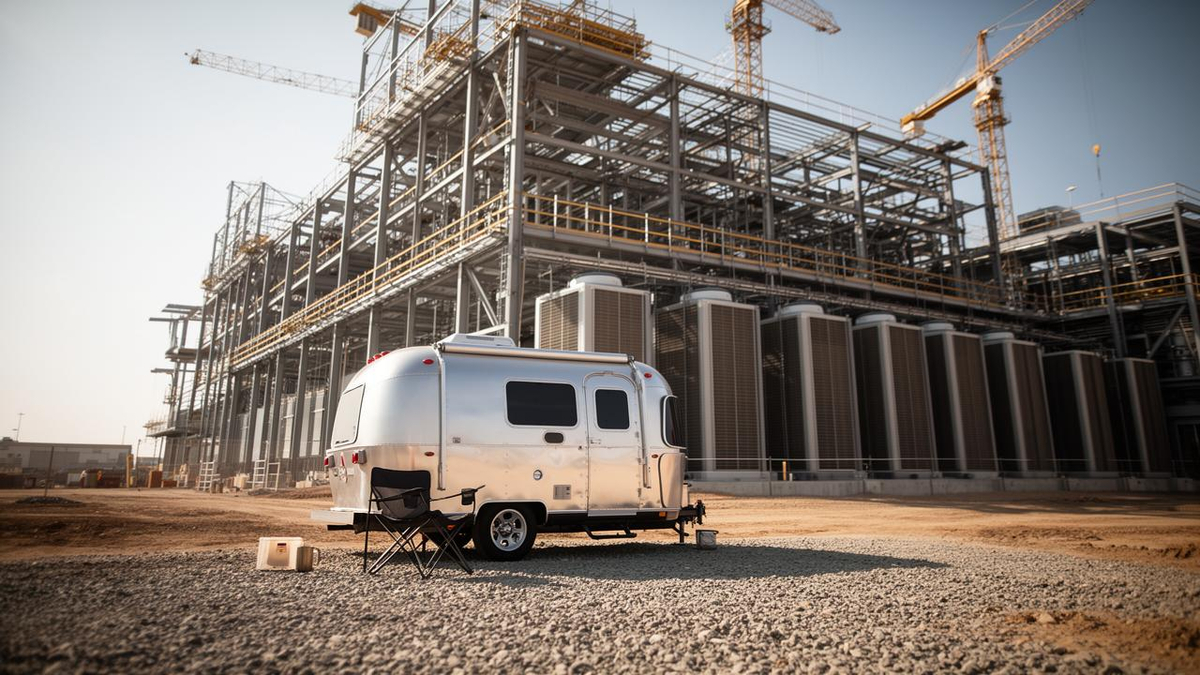
Elon Musk, whose fortune now approaches $1 trillion, has traded the factory floor for an aluminum-shelled Airstream trailer parked steps from the servers he is racing to bring online in Memphis, Tennessee.
The billionaire said Monday he was speaking from his new “palace” during a taping of the All-In podcast, where he appeared alongside SpaceX President and Chief Operating Officer Gwynne Shotwell. The trailer sits adjacent to xAI’s most aggressive infrastructure project to date, a supercomputer expansion that has positioned the company as a surprise player in the cloud computing market.
Shotwell framed the living arrangement as characteristic of Musk’s hands-on management style. “This is Elon, by the way, doing what people don’t believe he does. He sleeps on the factory floor. He’s in Memphis, helping build buildings,” she said during the interview.
The world’s richest person has a net worth of $917 billion, according to the Bloomberg Billionaire Index, and briefly became the first person ever to cross the trillion-dollar threshold for 12 days in June. Yet his current accommodations reflect a pattern that stretches back to his earliest ventures: sleeping where the work is.
The Colossus Expansion
Musk’s presence in Memphis is tied directly to xAI’s push to scale Colossus, the supercomputer center the company began constructing in 2024 to power Grok, its large language model. The initial build reportedly took just 122 days, and the facility has since generated so much computing capacity that xAI has struck deals to sell excess power to Google (GOOGL) and Anthropic for billions of dollars.
In late July, xAI announced plans for a fourth data center in the area, dubbed Minihard, adding to its existing footprint and cementing Memphis as the hub of the company’s terrestrial infrastructure buildout.
SpaceX absorbed xAI in February of this year, and the combined entity completed its initial public offering in June, setting a record for the largest IPO in history. That corporate restructuring has only intensified scrutiny of Musk’s broader ambitions across his business empire.
Renewed Merger Speculation
During the same All-In appearance, Musk was asked directly why Tesla (TSLA) and SpaceX remain separate companies. His response did nothing to dampen speculation that the two could eventually combine.
“The two companies already collaborate so deeply in so many areas that it’s hard to predict what might happen next,” Musk said, responding to a question from podcast co-host David Friedberg.
The exchange followed an earlier moment in the event when Friedberg jokingly asked Shotwell whether she liked electric vehicles, after co-host Jason Calacanis had questioned her about which companies SpaceX might acquire next. The banter came on the heels of SpaceX’s acquisition of the AI coding startup Cursor.
Market chatter about a Tesla-SpaceX merger has grown louder throughout 2026. Musk himself has repeatedly discussed the “convergence and integration” of his various companies, and SpaceX and Tesla are already collaborating on a joint project called Terafab, which aims to produce semiconductors in the United States, starting in Texas.
Neither Tesla nor SpaceX has issued a formal comment on the possibility of a merger.
A Pattern of Sleeping on Site
Musk’s trailer arrangement is the latest chapter in a well-documented history of living close to his projects. When he and his brother Kimbal were building Zip2 in the 1990s, they slept in a small Palo Alto office for six months, showering at the local YMCA, according to Walter Isaacson’s biography of the entrepreneur.
After selling Zip2 to Compaq for $22 million, Musk still slept under his desk most nights while preparing to launch X.com, the online bank that eventually became PayPal. Even after eBay’s acquisition of PayPal netted him roughly $175 million, he frequently stayed at colleagues’ homes while traveling in Silicon Valley.
The pattern intensified during Tesla’s “production hell” period in 2017 and 2018, when the company was pushing to manufacture 5,000 Model 3 sedans per week. “It was a frenzy of insanity,” Musk told Isaacson of that time. “We were getting four or five hours’ sleep, often on the floor. I remember thinking, ‘I’m like on the ragged edge of sanity.'”
After acquiring Twitter in 2022, Musk claimed a couch in the company’s seventh-floor library at its San Francisco headquarters, describing the situation as a “code-red” emergency that required his constant presence.
His housing choices have not always been modest. In 2012, he purchased a seven-bedroom, 11-bathroom mansion in Bel Air for $17 million, and he owned a $32 million Mediterranean-style estate in Silicon Valley. But in 2020, he sold many of his properties and moved to Texas, renting a roughly $50,000 house near SpaceX’s Starbase facility in Boca Chica.
The Airstream Connection
Musk did not specify which Airstream model he is currently occupying, though some of the company’s aluminum-shelled campers pack a sleeping area, kitchen, and bathroom into a 16-foot space. The brand, founded in 1931, is known for its riveted-aluminum “silver bullet” design that has remained largely unchanged since 1936.
A 1960 Airstream Bambi holds a place in the permanent collection at the Museum of Modern Art, and NASA famously used a modified Airstream to quarantine the Apollo 11 astronauts after their return from the moon — a fitting connection for the founder of SpaceX.
The decision to live in a trailer rather than secure permanent housing in Memphis underscores the intensity of the current AI infrastructure race. With xAI’s expansion accelerating and merger speculation swirling, Musk appears determined to remain within walking distance of the servers that represent his company’s most ambitious bet yet.
As Shotwell put it during the podcast, the arrangement is simply the latest example of a leader who commits fully when a project demands his attention — even when that commitment means calling a 16-foot trailer home.