Sep 18, 2026 13:30:00
Anthropic, the developer of the AI chatbot ‘Claude,’ has released metrics showing the extent of its AI utilization within the company. As of August 2026, Claude is ‘leading’ 26% of the company’s AI research and development activities, and approximately 30,000 AI agents are running simultaneously on its main internal platforms.
Measurements for understanding the pace of AI development inside frontier labs \ Anthropic
https://www.anthropic.com/institute/measuring-pace-of-ai-development
Companies developing high-performance AI models are increasingly using AI itself to develop next-generation AI. Anthropic reported on AI utilization based on three metrics: ‘to what extent is AI responsible for research and development?’, ‘to what extent can AI agents be monitored?’, and ‘for what purposes are computing resources being allocated?’.
To demonstrate the first point, ‘to what extent AI is responsible for research and development,’ Anthropic has created a prototype index called the ‘Anthropic R&D Automation Index.’ Based on evaluation criteria proposed by the AI research institute Epoch AI, this index classifies AI’s involvement in research and development into the following six stages.
Level 0: Tasks performed by humans only.
Level 1: AI involvement is very limited, and humans perform the majority of the work.
Level 2: AI assists with some tasks, but humans are primarily responsible for completing the tasks.
Level 3: AI handles the majority of the work under detailed instructions and supervision from humans.
Level 4: The AI receives general instructions from a human and performs most of the work independently.
Level 5: The ‘fully autonomous’ stage where the AI autonomously handles everything from task discovery to execution.
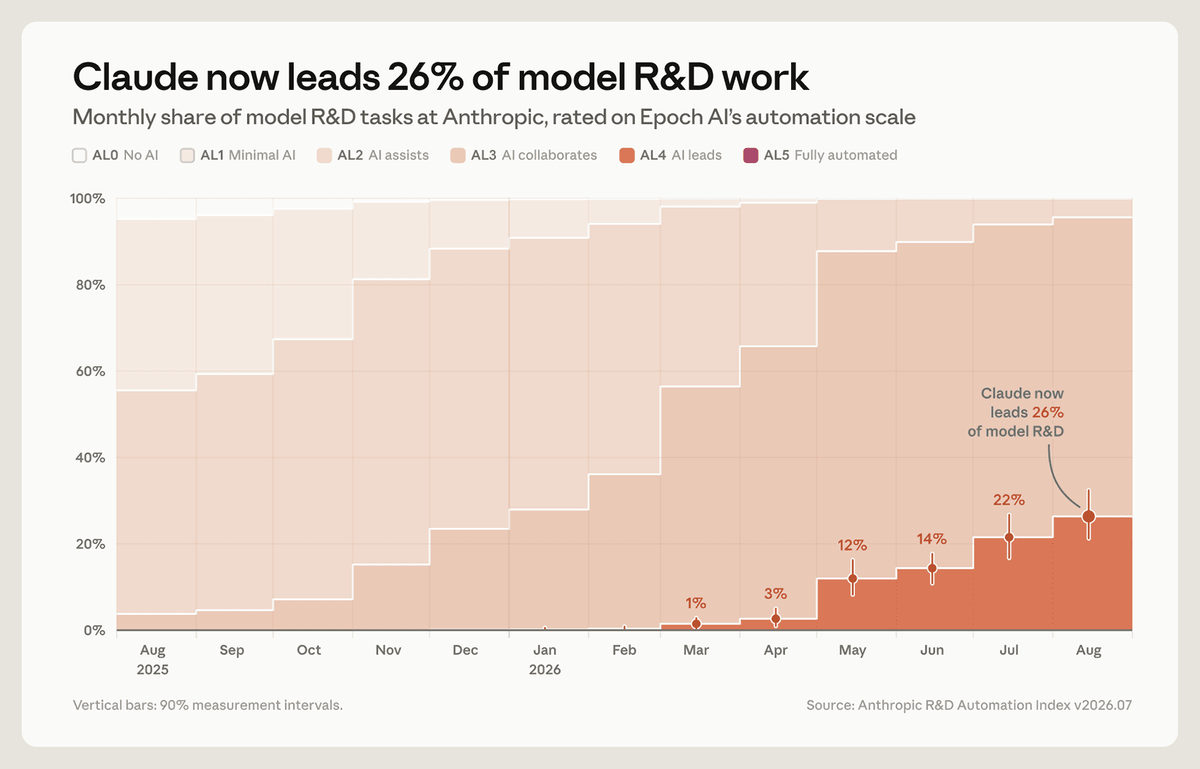
As of August 2026, 26% of Anthropic’s research and development work had reached Level 4. Including Level 3 and above, where AI and humans work together, the figure exceeds 90%. On the other hand, none of the AI research and development work measured had reached Level 5, ‘fully autonomous.’
The image below shows Anthropic’s research and development activities categorized by the Anthropic R&D Automation Index and summarized chronologically. The percentage of AI-driven research at Level 4 (AL4) was almost 0% at the beginning of 2026, but increased to 26% by August 2026.
As of August 2026, Anthropic’s main internal agent platform had approximately 30,000 AI agents simultaneously running, handling research and engineering. Regarding ‘how well they can monitor their AI agents,’ Anthropic states that they combine monitoring that checks agent actions before execution with monitoring that analyzes activity records after execution. In August 2026, they monitored over one billion decisions, with approximately 50 of the highest priority decisions being reviewed weekly by human staff.
Regarding ‘how computing resources are allocated,’ a study conducted over the week of July 13-20, 2026, revealed that approximately 6% of computing resources intended for AI research and development were used for safety-related research. Furthermore, when considering only AI used for AI research and development, safety-related research accounted for approximately 12%.
Anthropic states that it will continue to publish its metrics and will accept independent third-party evaluators from multiple external organizations to verify its internal data and evaluation processes.