
Key Takeaways:
Multi-agentic systems have evolved into a dynamic, task-based organization of skills with a flatter hierarchy than a traditional military force, and some are headless.
Agentic capabilities will also come from physical, deterministic engines, and those agents will talk to other agents in different formats to help ensure 100% accuracy, which AI models alone cannot achieve.
Human effort is needed to ensure a design can be copyrightable, and on-prem proprietary models are another way to ensure prompt IQ and IP are not lost.
Experts At The Table: Semiconductor Engineering sat down to discuss recent developments and challenges when using agentic AI for chip design, with Matt Graham, senior group director of verification software product management at Cadence; Harrison Balistreri, head of business development and strategic partnerships at ChipAgents; Alexander Petr, senior director and portfolio manager at Keysight EDA; Sathish Balasubramanian, head of product for EDA AI at Siemens EDA; and Anand Thiruvengadam, executive director and head of AI product management at Synopsys. This roundtable was held behind closed doors at the recent Design Automation Conference. What follows are excerpts of that discussion. This is the third part of a three-part series. Part one is here. Part two is here.
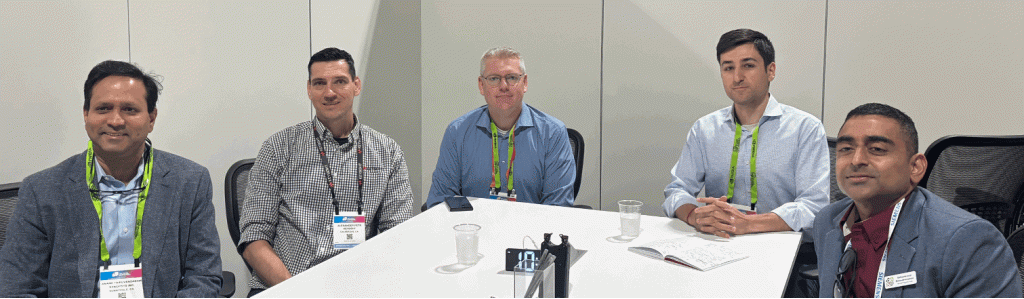
L-R: Synopsys’ Thiruvengadam; Keysight’s Petr; Cadence’s Graham; ChipAgents’ Balistreri; and Siemens’ Balasubramanian.
SE: Many agentic flows involve a mixture of experts (MoE) or a hierarchy of multi-agents with some type of leader at the top. What developments are you seeing there? Is it a top-down, military-style organization with various security and access clearances, or more of a horizontal team?
Graham: It is becoming much flatter than an army. If you’d asked me a year ago, I might have said, yes, it is a big hierarchy of agents. There will be mini agents, sub agents, and low agents. There will be generals and lieutenants and whatever else, all the way up. But AI in general, not just EDA, we are migrating much more toward a flat set of skills, or capabilities, or features, or knowledge, or whatever the word is you want to use to describe it. Everything is overloaded with terms. What we’re seeing becomes a much more dynamic, task-based organization of skills into almost dynamic agents. There is one general, if you like, or commander.
Balasubramanian: Orchestrator.
Graham: Right. And everything else below tends to be much flatter. I can pick and choose quickly to assemble my troops, but it’s much less like an army with a mechanized division and an airborne division, or something else. We have troops. Those troops have skills, and we assemble the right troops for the task dynamically, because we’re not bound, as armies are, by logistical and physical reality.
Petr: You’re better off comparing it to an orchestra. You have one conductor, and you have groups who play certain instruments. They can play individually, or they can play together. They can also play synchronously or asynchronously to achieve certain tunes and then play together.
Balasubramanian: That’s very important. Even if it’s flat, the key thing is that everyone knows their part, and they also know how they connect to everyone else. Everyone knows the end goal. Nothing is siloed. They all play by the same tune. If you look at a symphony orchestra, everyone knows everyone else. They can read the notes. They know what to do, what not to do, how to do it.
Petr: There are borders, guardrails. They all ground it.
Balasubramanian: The term I see quite a bit is headless agents. There’s no concept of having a big master agent doing everything else. We call it a headless way of working, and it’s been quite popular on the software side. It’s coming here, and what I see going forward is customers are interacting with tools. They won’t even know what the tool is. From our side, we are going to build agentic capabilities coming out of the physical engines, or deterministic engines around those engines, and that’s going to be an agent on its own. It can talk to other agents. It can understand different formats and where it sits. It can talk to understand design. Designers can interact with it, make it do work. That’s where the future is going.
Thiruvengadam: What Matt said is very interesting. We are essentially making the point that you should be thinking about digital organization—human organization, human hierarchy, digital hierarchy, roughly speaking —which is correct. But also, the fluidity of that is very important. It won’t be a rigid, hard structure. Ebb and flow will happen. It can change, depending on the complexity of the commands. The fluidity is very important. You will have a layer that orchestrates and calls upon ‘resources’ as needed to execute. This is very important. At some point in the future, it might graduate to something where it’s maybe autonomous. That is about abstraction again. We are talking about taking layer after layer of abstraction away, one by one, but we’re not there yet.
Balistreri: We have products where agents propose hypotheses and do tournament-style ranking. We have a judging agent, but there’s a lot of nuance in this idea of agents, where you could throw many agents at the problem. But if they all come up with similar hypotheses for the problem, it doesn’t matter how many agents you deploy or how good your judging agent is. It has a lot to do with how you manage context, and it comes back to local versus global context. It doesn’t matter how you deploy agents if they all have the same local context. To get the benefit of deploying agents at scale, you need to manage which hypotheses each agent generates and where that context comes from. To do that, you also can’t have point agents. You can’t do point acceleration around one tool. Agents become powerful when they can deliver the full flow. The full flow requires encoding in your agent loops how to view some of this context and how to manage that, so that you get the benefit of many parallel agents instead of them just trying to converge on the same thing.
Graham: There are two sides to that, and I agree for the most part. But I’ll draw a parallel to how synthesis changed electronic design. The vast majority of gates built now are synthesized gates. The agent writes RTL. Then, RTL gets synthesized. But there is still a certain percentage, depending on the application, that must be either hand-synthesized or laid out by hand. There will still be significant opportunity to accelerate the tools. I wouldn’t call it a point agent necessarily. But in agentifying the tool for a specific task, a smaller percentage will still need to be hand-coded, in the same way that we still hand-assemble some instructions for a PC or for any compute platform. Expecting 100% autonomy is setting too high a bar that I don’t know we can achieve. I don’t think it’s realistic or even worthwhile. Setting it at 99-point-some-odd-nines still leaves a huge amount of work to be done, and accelerating the tools themselves is still important, but I agree that it’s not the bulk of the time.
Balistreri: This might be an unpopular opinion in this room, but we can talk about accelerating existing tools, or we can talk about new tools entirely. When we talk to our customers, one of the biggest bottlenecks in taping out their chips is that they don’t have enough on-premises compute to run existing EDA tools. Can you rearchitect tools to be optimized for agent use, speed up runtime, and run more tools in parallel? Then there’s the other question of, ‘Do the models subsume it?’ In some of the complex tasks that are still hand-placed, there is an opportunity for models to take that on and solve extremely complex problems that humans just couldn’t hold in their heads. Think about all those tables you had to look at on the wall. Back in the day, you were laying sheets across a giant table to look at the resistance and capacitance and placing them for analog. All of that, I think, can be captured inside of models.
Graham: It can be. The question is, how soon will it be efficient? We’ve spent a huge amount of time solving that problem deterministically, algorithmically, and mathematically so that we get the right answer every single time. What you’re proposing is, ‘Can we use a probabilistic model to solve those problems more efficiently?’ Today, ‘no’ is the very clear answer. With the speed of technological advancement, will that be compute-efficient and dollar-efficient in the next 2 years, 8 years, 10 years?
Thiruvengadam: I agree. The key point, again, is the march of nines. The march of nines will kick in, and you’ve got a 99.99999. You need to get 100% accuracy. We’re talking about subsuming two EDA tools into models.
Balasubramanian: That’s very important. In chip design, being 99.99% accurate is a failure. All it takes is one picosecond and you have a whole violation.
Petr: We keep forgetting that we still have not fully understood all the physics. Every single model we have is a simplification of the real world. It’s an error of an error of an error of an error. No matter how well you go on the whole agentic framework, at some point, there’s a trade-off somewhere. And if you don’t capture that, your chip is dead. We spent decades optimizing the simulator engines to get deterministic results. There’s always an argument in those AI frameworks, ‘Oh, just run reinforcement learning. It can do it.’ Fair, it can. But my mathematically based optimizer is still faster and more accurate. Why would I want to do that?
Thiruvengadam: It’s important to understand that the march of nines is a problem in software. Why would it not be a problem in hardware? In chip design, it’s even more of a problem. In software, they talk about getting 100%. Failure is an important part. In hardware, costs are so high that the march of nines becomes an even bigger problem.
Balasubramanian: As we go down the flow, the band of how much error you can tolerate drops drastically.
SE: In an orchestral multi-agentic flow, who has a kill switch to prevent agents from burning through tokens and trying forever to gain 100% coverage closure, for example?
Graham: This is part of the prep before you deploy, which must be part of the infrastructure. We all have infrastructure this must sit on — the guardrails. There are still infinite problems in IC design and verification. Fundamentally, it’s an infinite or near-infinite problem, so there must be guardrails somewhere on how much time, how many tokens, and what the tool covers, etc. One thing EDA has been good at over the years is having tool providers address that with customers, having customers understand the best ROI trade-offs, and pushing us to provide them. Up until now, it was cycles on a given problem. We get the number of CPU cycles we think we need to do, whether we get them in the cloud or on-prem or whatever, for one of the thousand tasks you have to do from RTL to GDS. Now we’re adding tokens to those, but we need the same guardrails. We know this. Our customers employ entire departments of people to optimize this exact problem.
Petr: Infinite loops are not new to us. Every mathematical problem has infinite loops. If you get into those trenches, we have solutions.
SE: What about IP ownership if you’re using an agent for a design that you sell to a customer, or they use your agent for their design, who owns what IP?
Balasubramanian: IP ownership is one of the biggest concerns I’m hearing about, both from our side as the tool provider and from the customer side. Yes, [agents] can write code, but the challenge is that all it takes is one copyrighted piece of code getting into your codebase, and if you don’t verify it, you’re going to get a loss. That’s one thing. Second, the most important thing is, I always tell people that any prompt you do, that’s your IQ. You’re doing your foundation, you’re using Claude Code, and you’re letting your designers do certain things. Their prompt will be, ‘This is how I’m going to be solving this routing problem. Can you do this?’ Your prompt is pretty much your IP. You’re telling some people the algorithm for how to do certain things, and there is a lot of talk about, ‘They’re not going to look at it.’ But every prompt is necessary to the LLM providers. If it goes outside of the air gap, it’s a problem. So IP protection is going to be very key. How do you expose code outside, especially source code? That’s going to be very key, and that’s a big concern coming up.
Petr: Another problem is that U.S. copyright does not allow us to copyright code that has been generated by an AI. That means every chip designed by an AI isn’t copyrightable.
Balasubramanian: Yes, because LLMs are not [copyrightable].
Thiruvengadam: The key distinction is that we are not talking about a chip that’s 100% designed by AI with no human intervention.
Petr: There’s a clause in the copyright that says the majority of the [design] has to be done by a human and, I’m sorry to say that, but the majority is not going to be.
Balistreri: I want to recap a bit and then get to this point. There are many problems, many layers of problems, with deploying AI in a high ROI way that organizations will accept meets their security requirements. One is cost. We solve that at the harness layer. The same model, doing like-for-like tasks, uses 40% fewer tokens. Our own model is open-weight and performs similarly, but at lower cost. Then there’s the full-flow problem, which is where you need the ontology. You can’t just do point acceleration. Then there’s the autonomous problem, which is the trust. Are there going to be critical errors? Are those gated and built into your system so you can’t produce things? Then there’s the IP and security issue, and it’s a pretty simple question. Do you want to send your inference over the public internet to a model provider that is building chips that compete with your chips? If you use frontier models in your agentic layer, whatever agents you use, you run that risk. Some don’t even have zero data retention. The clear answer to us — in a highly security-focused industry, where your design and design flow itself is IP — is that you need a solution with a custom model you can deploy on-prem. That also solves the IP question. I’m not a copyright lawyer, but if the design never leaves your environment, it’s de facto still yours. It’s not copyrighted per se, but no one else can access it.
Petr: Don’t underestimate reverse engineering.
Read parts one and two of the discussion:
Agentic AI Success Relies On Excellent Human Scaffolding
Before deploying agentic AI into a chip design, engineers must define the domain ontology and agentic harness. Fundamental engines are still crucial.
Token Costs Are Becoming The New EDA Budget Battle
Cost per token is causing EDA design budgets to balloon; what comes next isn’t entirely clear yet.